Home
News
Classics
Worst Sports Cars: Smart Roadster
A sales success, but a financial disaster for Daimler.

Angel Sergeev 
By: Angel Sergeev
Jan 6, 2017 at 11:00am ET
Add Motor1.com as a preferred source in Google
- (https://twitter.com/intent/tweet?url=https%3A%2F%2Fwww.motor1.com%2Fnews%2F132861%2Fworst-sports-cars-smart-roadster%2F&text=Worst%20Sports%20Cars%3A%20Smart%20Roadster&via=motor1com)
- copy
Share
Comment
What is it?
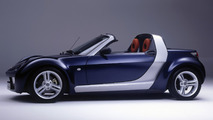
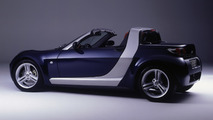
The Roadster was basically Smart’s only attempt to create a sports car. It was developed in two different versions, Roadster Coupe and Roadster, both featuring two doors, two seats, and retractable roof.
When and where was it made?
The model was introduced in 2003 and remained in production until November 2005. A total of 43,091 examples were manufactured.

Technical information
The Roadster was based on a stretched platform of the first generation ForTwo model and was powered by a 0.7-liter turbo engine with 61 horsepower (45 kilowatts) or 82 hp (60 kW). It is mated to a six-speed semi-automatic gearbox, which can be controlled through steering wheel gearpaddles.The front independent suspension featured McPherson layout with leaf springs, while the rear wheels were mounted on a torsion bar.
Was it that bad?
Not really, it was a relatively nice small sports car. Too small, in fact. It was significantly smaller than the Mazda MX-5 Miata and Toyota MR2, but costed nearly the same, which made it considerably less desirable. Trunk? The Roadster Coupe actually had two, but they were both super tiny.
By saying it was a nice small sports car, we mean it drove well. Good handling, despite the small 15-inch wheels, good brakes, and… well, that’s all. It was painfully slow – even the most powerful variant needed nearly 11 seconds to reach 62 miles per hour (100 kilometers per hour) and top speed was only 109 mph (175 kph). But you can’t expect more from a three-cylinder engine the size of handbag.
While it was generally reliable car, the Roadster had one major quality issue which literally led to the end of its life. Many Smart Roadsters leaked and this required a serious amount of warranty work, which, combined with other costs, resulted in average of $3,150 spent on each produced car. Due to these exceptional costs, the Roadster was an economic failure for the company, despite the high sales of more than 43,000 units for only three years.
We don’t all agree
Let’s get something straight from the beginning. The Smart Roadster was never meant to be a hardcore sports car. With the engine’s displacement starting with a “0,” you can’t expect it to take down Nürburgring records. The pint-sized roadster with its funky design was created as a no-frills two seater capable of putting a smile on your face on a relaxing weekend trip. After all, it was a rear-engine, rear-wheel-drive car weighing as little as 790 kilograms (1,742 pounds).
Fun fact: In 2003, Brabus merged a couple of standard 0.7-liter three-cylinder engines to create a biturbo 1.4-liter V6 unit with 170 hp (125 kW) and 162 lb-ft (220 Nm) squeezed inside eight prototypes, each tipping the scales at just 840 kg (1,852 lbs). Capable of doing 0-60 mph (0-96 kph) in 5.8 seconds before topping out at 140 mph (225 kph), it must’ve been a blast to drive.
What do you think?
View
Comments
- Adrian Padeanu, Motor1 Contributing Editor
Latest from the Worst Sports Cars series:
- Worst Sports Cars: Pontiac Fiero
- Worst Sports Cars: Mercedes CLK (first generation)
- Worst Sports Cars: Renault Fuego
- Worst Sports Cars: Plymouth Prowler
Photos: AutoWP
Gallery: Smart Roadster
34




We want your opinion!
What would you like to see on Motor1.com?
Take our 3 minute survey.
- The Motor1.com Team
Share this Story
- (https://twitter.com/intent/tweet?url=https%3A%2F%2Fwww.motor1.com%2Fnews%2F132861%2Fworst-sports-cars-smart-roadster%2F&text=Worst%20Sports%20Cars%3A%20Smart%20Roadster&via=motor1com)
- copy
GO TO COMMENTS
(
)
Got a tip for us? Email: tips@motor1.com
View all comments ( )
Popular
Audi Is Spending $4 Billion On A New US Factory For Big SUVs
Toyota's Next Mid-Engined Coupe Is Going Racing This Weekend
Alfa Romeo Has Had It With Huge Screens
Subaru Teases A New Manual WRX, But Only For Japan
latest articles
- These Defensive Driving Habits Could Save You From A Crash Oct 25 - Motor101 -
- Nissan Driver Gets An Oil Change. Then The Mechanic Sends Him Something Unexpected: 'I'm Upset That This Isn't Required By Law' Oct 25 - Trending -
- How Do Automatic High Beams Know When To Turn On And Off? Oct 25 - Motor101 -
- ‘Gave You The Midas Touch’: Man Takes Volkswagen To Midas For An Oil Change. He's In Shock When They're Done Oct 25 - Trending -
- Audi Is Spending $4 Billion On A New US Factory For Big SUVs Oct 25 - Manufacturing / Production -
- Man Buys 10-Year-Old Mercedes With Only 31,000 Miles. Then He Spots Something Fishy On The Tires Oct 24 - Trending -
- 'I Didn't Sign Up To...': Mechanic Asks Why People Leave The Job. They Don't Hold Back—But Can The Industry Be Fixed? Oct 24 - Trending -
RECOMMENDED FOR YOU
You Can Buy This Wild 1967 Alfa Romeo Giulia Built Like A Le Mans Racer
How Do Automatic High Beams Know When To Turn On And Off?
A Hidden Corvette Collection Was Found In A Texas Trailer Park
‘Gave You The Midas Touch’: Man Takes Volkswagen To Midas For An Oil Change. He's In Shock When They're Done
The Original Mercedes A-Class Is Now Old Enough To Be A Classic
Audi Is Spending $4 Billion On A New US Factory For Big SUVs
The First Maserati 5000 GT Frua Buried For 30 Years Resurfaces