I Drove The Rivian R2, The Model Y's First Real Threat
Rivian’s first compact SUV comes out of the gates strong, with style, poise, and pricing designed to dethrone Tesla. And it could work.

Nissan Ariya: dead. Volvo EX30: dead. Volkswagen ID.4: dead. Chevrolet Bolt: dead… again.
In the seven years that the Tesla Model Y has been on sale in the US, about half a dozen so-called "Tesla Killers" have come and gone. Legacy automakers continually try—and fail—to match the success that makes the Model Y not just one of the most popular EVs in America, but, at one point, the best-selling vehicle on the whole damn planet.
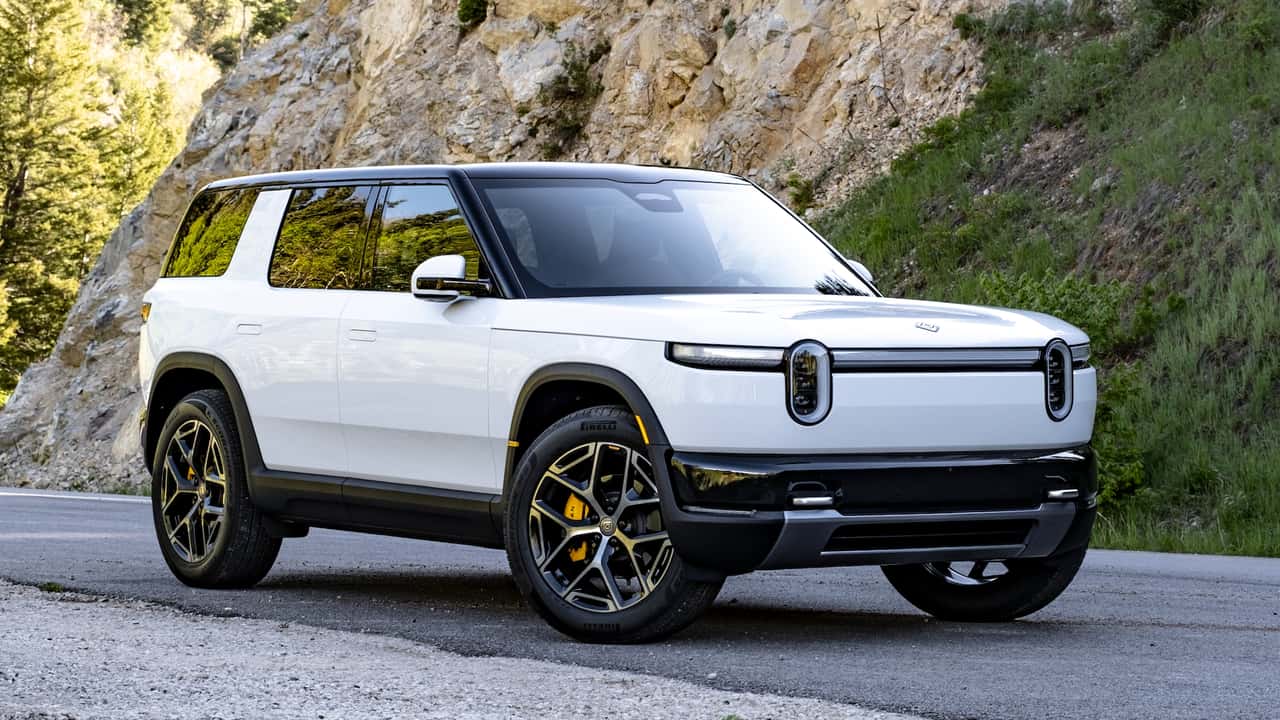
But if anyone can take the fight to Tesla, it’s a fellow pioneer. The new Rivian R2 is aimed squarely at the Model Y as the smaller, thriftier sibling to the successful R1S. It arrives with much of the same technology and off-road prowess that make that model so popular in the first place, and it even shares its rugged styling—something buyers crave these days.
Whether the Rivian R2 can even come halfway close to matching the Model Y’s success depends on several factors—rollout, marketing, etc. But after I drove Rivian’s new compact SUV in Utah, the R2 is seemingly set up for success in this ultra-competitive space, arguably better than Tesla ever could be.
Jump To: Design | Interior | Tech | On Road | Off-Road | Verdict

Rivian's Rugged Good Looks
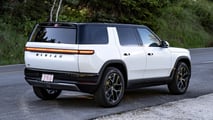
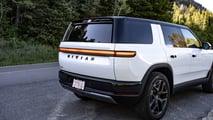
The rise of ruggedization across the industry gives Rivian a distinct advantage from a design standpoint. For better or worse, the R2 largely resembles a shrunken-down version of the R1S. But it’s the subtle details that help the R2 stand out—things you might not notice at first glance. Even I had a hard time telling the two apart at times.
From its side profile—arguably the R2’s best view—something’s missing. On the R1S, there’s an awkward piece of plastic separating the rear window from a piece of fixed glass. On the R2, there isn’t. And that was intentional.
Chief Design Officer at Rivian, Jeff Hammoud, tells me that the company’s goal was to have fully retracting glass on the R1S, but due to certain packaging constraints and the rear seat configuration, it simply wasn’t possible—thus the fixed glass.
On the R2, though, every single piece of glass—including the rear window—fully retracts into the body. Not only does it yield a cleaner look from the side view, but it also helps cut costs and gives owners that fully open-air feeling they’re truly after.
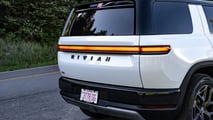
And then there are the more subtle details. Rather than logos, side markers, and badges littering the side profile, like on the R1S, the R2 simplifies things. There’s a single, cleverly branded, illuminated marker just behind the front tires.
Depending on how you spec it, the R2 comes with 20- and 21-inch wheel options, and even the base shoes don’t feel like much of a downgrade. In this case, they’re paired to chunkier rubber specifically for off-roading, which means they still fill out the wheel wells better than you’d expect. The bigger tires on thinner rubber look great, too.
New colors, like a subtle Esker Silver and a lovely Catalina Cove, join the already impressive Rivian palette. The Compass Yellow brake calipers and exterior accents add a nice additional pop of color.
A Lovely Place To Sit
The R2’s interior is largely a copy-and-paste job from the R1S—again, not a complaint. The layout is lovely, the materials are unique, and the 15.6-inch touchscreen at the heart of it sits neatly within the dashboard. But, much like on the exterior, it’s the details that separate the two.
The R2 has a stylish piece of wood trim that stretches the length of the dash. Unless you also had an R1S parked in your driveway, you’d never know that this was merely half of what you get on the three-row. It still looks great, but to keep costs down, it doesn’t get the full wraparound treatment.
Cheaper materials, like injection-molded plastic inserts, replace the R1S’s more premium details. By Rivian’s rule (and mine, too), as long as those materials live below the belt line, it's totally acceptable to help keep costs down. Most everything above the belt line—like the wood trim on the dash and the leather armrests on the door panels—still looks and feels premium.
At 185.6 inches long, the Rivian R2 falls firmly in the premium compact category. The Model Y, for comparison, is 188.6 inches long. Other newer EVs, like the BMW iX3 (188.3 inches), the Porsche Macan Electric (188.3 inches), and the upcoming Mercedes-Benz GLC (185.7 inches) are all about the same size.
But its diminutive size doesn’t hold it back. Even though it’s a whopping 15.0 inches shorter than the R1S, the R2 actually has more space in the second row—40.4 inches compared to just 36.6. Rear cargo space is on the slightly smaller side at 28.7 cubic feet, but fold the second row, and that number swells to 79.4 cubes.
2027 Rivian R2 Interior
Forward-Thinking, But Flawed
As you’ve probably already heard, Rivian has doubled, tripled, and, I guess in this case, quadrupled down on not offering Apple CarPlay or Android Auto in its vehicles. The new R2 is no exception. Instead, it runs the latest version of Rivian’s Android-based infotainment system, with a few clever AI features baked in for good measure (and, of course, to be able to splatter those two letters everywhere on your marketing materials).
The UI certainly looks pretty; the graphics are crisp, the layout is clean, and everything is exceptionally smooth. And yet, it’s all still a bit too convoluted.
Two on-screen menus afford access to a handful of features: one on the left side of the screen and one at the base of the screen. Depending on how you have it set up, there are even options you can dig into from the center portion of the screen.
The UI certainly looks pretty... And yet, it’s all still a bit too convoluted.
To Rivian’s credit, most basic functions are just a click or two away; press the axle icon on the bottom menu bar to adjust the drive mode, or press the arrow icon to quickly toggle maps. But some other options require one too many pokes.
Thankfully, Rivian listened to customers clamoring for real buttons. Sort of.
Two metallic rings occupy either side of the R2’s steering wheel—Rivian calls those "Haptic Halo" controls. Rather than a fixed volume knob or climate dials, these two cleverly engineered rings do most of the heavy lifting. And they’re great… in theory.
The Halos offer a few different functions. When setting up your personal driver profile, the Halo controls adjust the mirrors and steering wheel. And you better make sure that the steering wheel is exactly where you want it before setting off, because there is no adjusting on the fly.
Once you’re fully prepped, the left Halo control manages audio—scroll up and down to change the volume, click right and left to switch the song, or press down on it to put the audio on mute. The right halo is for temperature control, drive modes, and adaptive cruise. Rivian says customers can customize these controls as they please.
Scrolling up and down on these Halo controls is really nice; there’s even some resistance when you scroll far enough in one direction to let you know how high or low you’re getting. But oftentimes, even when trying to turn up the volume, the control is so sensitive that it’s easy to accidentally mute a song. The same goes when trying to toggle left and right between songs.
Driving The R2 On Road
Because the R2 is a smaller, cheaper model, Rivian had to cut a few things from the R1S to keep costs down. One of the biggest cuts was the air suspension—but that’s actually not a penalty in this case.
The R2 makes do with traditional McPherson struts up front and a multi-link setup in the rear, with semi-adaptive dampers designed for off-road use. It’s paired with a beautifully tuned, direct steering rack and with far less body roll than you might think.
Dare I say, through the twisting mountain roads near Park City, Utah, the R2 felt… sporty? Not exactly what I was expecting of Rivian’s shrunken SUV, but I’m happily surprised. The R2 is actually fun to fling around, not nearly as sloshy or sloppy as the bigger R1.
The R2’s traditional unibody construction certainly helps here. The construction alone helps shed 385 pounds over the R1S’s setup, while the low-mounted, 87.9 kilowatt-hour battery pack acts as a sort of brace to help quell body roll.
The R2 is just about 2,000 pounds lighter than the R1S all told. Not just because it’s smaller, but the company also introduced a whole host of consolidation techniques to further bring that weight down—and simplify the entire vehicle as a whole.
Compared to the R1S, the R2 sheds 2.3 miles of wiring. The wiring harnesses themselves are also significantly smaller, and even many of the modules—now fully developed in-house rather than pieced together from suppliers—all contribute to the lower weight.
The first versions to show up in 2026 will have two electric motors, one on each axle. The Premium model (which goes on sale later this year) comes with 350 horsepower and 355 pound-feet of torque. I drove the Performance model, which packs a whopping 656 hp and 609 lb-ft of torque by comparison.
The R2 is actually fun to fling around, not nearly as sloshy or sloppy as the bigger R1.
Those figures on the Performance trim are enough to send the SUV to 60 miles per hour in 3.6 seconds and on to a quarter mile in about 11.6 seconds. Rivian is proud to point out that both of those figures make it about as quick as a Ferrari Enzo. Neat.
That dual-motor setup boasts a 40/60 rear bias as standard, with variable splits depending on things like selectable drive modes and conditions. If you’re cruising on the highway in Conserve mode, for example, the front axle is fully disconnected, with power traveling straight to the rear wheels.
That rear bias is noticeable when flicking the R2 through tight turns, with little evidence of torque steer, and almost no indication that the front axle is doing any heavy lifting. Power delivery is to be expected from an electric crossover—it’s flat, linear, and not all that interesting. At least it’s quick hell in the Performance spec.
When you don’t feel like driving, every R2 comes standard with a host of active safety features, including a hands-free driving assist that is largely for highway use but can also be used on certain neighborhood streets.
Of course, you can’t forget about charging. The R2 juices up at a maximum of 230 kilowatts, reaching 10 to 80 percent in under 30 minutes. Both dual-motor models get up to 330 miles of EPA-estimated range.
Driving The R2 Off Road
More so than on-road prowess, the measure of a good Rivian is how well it can tackle the tough stuff. Even with unibody construction and a few key pieces of equipment missing, the R2 proves its capability on the trails of Utah.
What’s missing? For one, there’s no hydraulic suspension. That’s a pricey piece of equipment typically reserved for higher-end vehicles—like the R1S—so it’s no shock that it’s not included here. Even Rivian execs admit it wasn’t something they felt customers wanted or needed at this price point.
More controversially, though, the R2 lacks locking differentials—just like the R1S. If you’re looking purely at competitors in this class, that’s not uncommon. But if someone in their R2 wants to challenge, say, a Ford Bronco or Jeep Wrangler on slippier terrain, it probably has no shot of keeping up. Even without locking diffs, the R1S is better for that kind of duty.
Keep things moderate, though, and the R2 is thoroughly impressive. It barely shrugs at obstacles like steep hill climbs, deep ruts, and sizable rocks. The instant torque from the electric motors makes it extremely easy to modulate over tricky terrain, and the communicative steering tells you exactly where the tires are at all times.
The R2 boasts a generous 25-degree approach angle and a 26-degree departure angle, with 9.6 inches of ground clearance. The next-best Subaru Forester Wilderness gets 9.3 inches of ground clearance by comparison—so the Rivian should handily beat the Subaru on most trails.
Verdict: Tesla's First Real Rival
The Rivian R2 is an excellent SUV from top to bottom—and it’s not even that expensive. Rivian will debut the R2 with the dual-motor Performance Launch Edition trim first, which starts at $59,485. The dual-motor Premium model will show up later this year at $55,485.
By early 2027, Rivian should be rolling out the first single-motor, rear-drive models, which will cut costs significantly. The Standard RWD model is expected to start at just $46,485 with destination, while the long-range version will start at $49,985. That version will have the best range of the group, too, with up to 345 miles.
Even with a single motor, though, I doubt it will feel like much of a downgrade. Everything about the R2 just works—it’s stylish, it’s comfortable, it’s fun to drive, and like any good Rivian, it’s hugely capable for its class. A few quibbles with the infotainment and lack of CarPlay or Android Auto are annoying, but it shouldn’t stop you from considering this otherwise wildly impressive electric vehicle.
The Tesla Model Y finally has a genuine competitor on its hands.
Rivian R2 Competitors
Competitor Reviews
2027 Rivian R2 Performance
RECOMMENDED FOR YOU
I Drove Ford's 300-HP Maverick. It Feels Like A Hot Hatch
Ford Recalls 566,000 Broncos For Engine Compartment Fires
I Really Like The Ford F-150 Lobo. Just Not For The Price
The 2027 Nissan Z Is More Expensive, But It Gets One Smart Upgrade
The Volvo EX30 Is (Was?) A Swing And A Miss
Kia Has 8 Models Coming In 2026. Here's All Of Them
The Ferrari 849 Testarossa Earns Its Name