This Corvette Z06 Owner Gave It The Twin-Turbo Treatment Chevy Never Did
Late Model Racecraft’s 2027 Corvette Z06 uses Precision mirror-image turbos and custom tuning to deliver 810 rear-wheel horsepower on 93 octane.
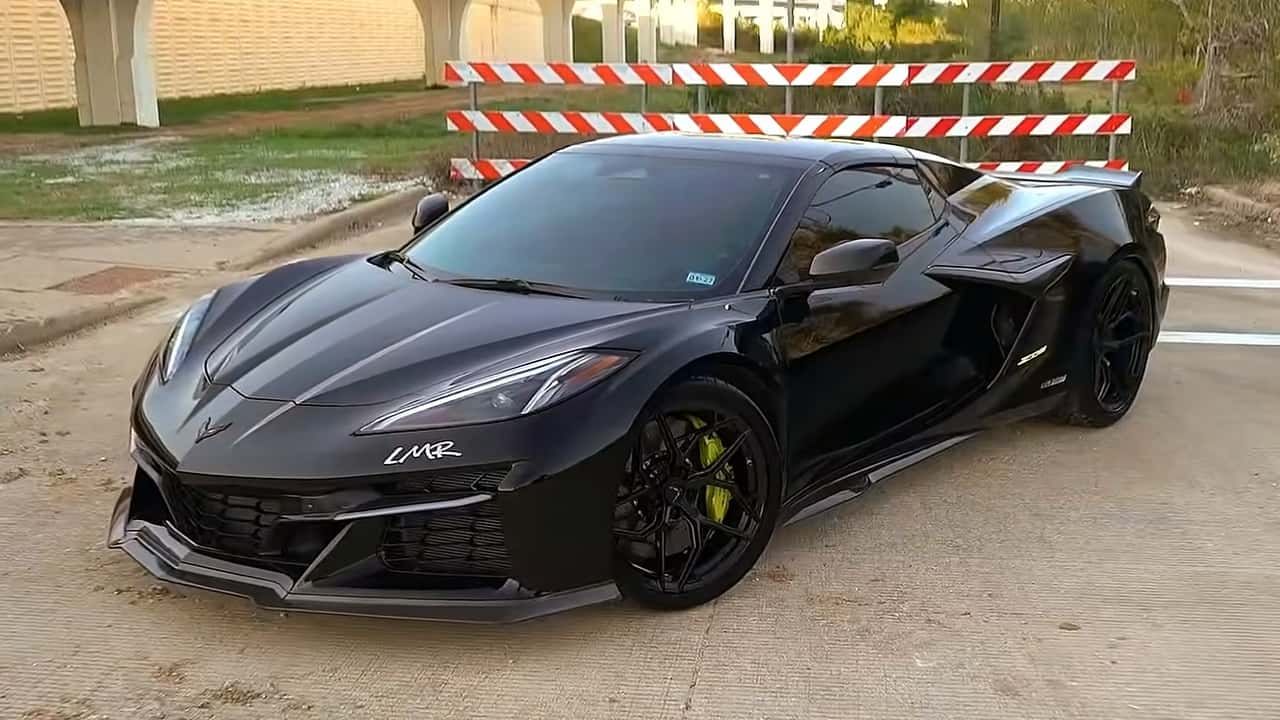

Chevrolet rates the 2027 Corvette Z06's naturally aspirated 5.5-liter V8 at 670 horsepower, with peak power at 8,400 rpm and a redline of 8,600 rpm from a flat-plane crank. Houston-based Late Model Racecraft figured that wasn't enough for one customer's C8.
The shop bolted on two turbochargers and rewrote the car's engine and transmission software from the ground up. The result is a Z06 that now runs on 93-octane pump gas instead of its earlier E85 setup, with numbers that embarrass its factory sibling.
The Corvette had already visited another shop for naturally aspirated bolt-ons before arriving at LMR running on E85. LMR owner Steven Fereday said the car baselined at roughly 597 rear-wheel horsepower before his team touched it.
What Hardware Turns A Z06 Into A Twin-Turbo Monster

2027 Corvette Z06 Twin-Turbo By Late Model Racecraft
LMR installed a pair of Precision mirror-image ball-bearing turbochargers, chosen specifically because they are air-to-water units rather than grease-lubricated turbos. Fereday says that avoids the maintenance headache of greasing turbos every 1,500 miles, which keeps the car simple to live with.
An air-to-water intercooling system, with a heat exchanger running coolant to both sides of the engine bay, manages the extra heat the turbos generate under boost. The downpipes feed a deliberately short exhaust. Fereday says that helps the flat-plane-crank V8 keep its snarl even with forced induction.
Custom ECM and TCM tuning rounds out the build. LMR adjusts clutch pressure and shift behavior to let the C8's dual-clutch transmission handle the added torque. Fereday calls that the real limiting factor on high-horsepower builds like this one. Shops chasing even bigger numbers on other GM platforms have taken a similar unlock-the-software approach.
Tuning options vary by customer too. Fereday says LMR can program anything from a loud, popping burble tune on deceleration to the subtle, factory-like behavior this particular Z06 received.
Dyno Numbers And What Owners Should Expect
2027 Corvette Z06 Twin-Turbo By Late Model Racecraft
On the dyno, the finished car produced 810 rear-wheel horsepower and 588 pound-feet of torque running on ordinary 93-octane gasoline. That's a gain of roughly 213 rear-wheel horsepower over its pre-turbo baseline, achieved after switching away from E85 entirely.
LMR estimates the crank output at around 1,000 horsepower, though that figure is a calculation rather than a direct engine-dyno measurement. The confirmed, measured number remains the 810 rear-wheel horsepower figure from LMR's own equipment.
Fereday says the car still drives like a stock Z06 in Touring mode, with turbo noise audible under underpasses during normal cruising but no drama at part throttle. He recommends stickier rear tires for owners planning first- or second-gear acceleration runs, since the factory rubber struggles to put that much torque down without spinning.
Twin-turbo packages are not LMR's only avenue to big power on GM's small-block family. The shop's work fits a trend seen in twin-turbo crate V8 builds that chase similar output without relying on specialized fuels. For Z06 owners weighing the upgrade, Fereday's pitch is a 93-octane car that can still be driven daily, parked in the garage, and driven hard again without special maintenance in between.
More On Corvette:
Source: Late Model Racecraft
RECOMMENDED FOR YOU
The Chevy Corvette SUV And Sedan Might Not Happen After All
Someone Built The Lexus Pickup That Should Probably Exist
A Used Camaro SS Is Now A Surprisingly Good Deal
Bugatti Celebrates 20 Years In America With A Spectacular Las Vegas Gathering
Man Has Pedal Commander In His Chevrolet. It’s Uninstalled. American Auto Shield Still Denies His Warranty—And Cancels His Policy
The Toyota Supra And BMW Z4 Have Officially Sold Out
AutoNation Customer Spots Chevrolet Colorado Listed Online For $34,000. Then He Tries To Buy At That Price