The Three Types Of Automatic Transmissions—And How They Actually Work
From torque converters to dual-clutch and CVTs, modern automatics take very different paths to the same job.
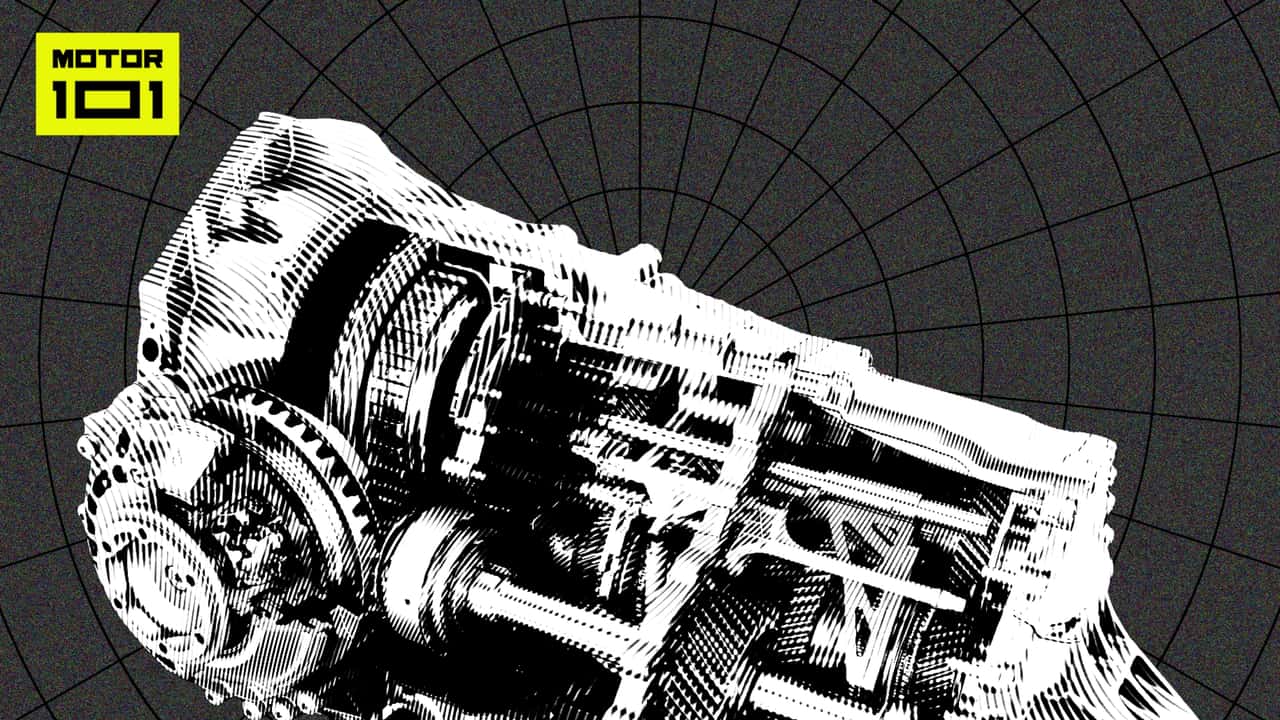

Despite its ubiquity, the automatic transmission is one of the most mechanically complex parts of the modern automobile. Transmissions allow your gas-powered car to operate efficiently over a wide range of speeds. Ever notice how you can both cruise on the highway at 80 mph and putt around town at 30 without your engine screaming its head off during the former?
A transmission with multiple gears is what makes that possible. The enthusiast-favorite manual transmission supplies you with a clutch pedal and a gear selector that lets the driver do this, well, manually, but the vast majority of cars today are equipped with automatic transmissions.
There are three main types of automatic transmissions: dual-clutch (DCT), continuously variable (CVT), and the default kind that doesn’t typically come with a specific label—most just call them automatic transmissions. What are the key differences? Motor101 is here to explain.
The Traditional Automatic (Torque Converter)

Torque-Converter Automatic Transmission
This is the classic "automatic" most people think of—sometimes jokingly called a "slushbox," though there’s a lot more happening inside than that nickname suggests.
At its core is the torque converter, a fluid coupling between the engine and transmission. Instead of a direct mechanical connection, engine power is transferred through transmission fluid that spins and multiplies torque.
Inside, a pump (impeller) flings fluid into a turbine, which then drives the transmission. From there, a planetary gearset and hydraulic clutch packs handle gear changes automatically.
Modern versions also include a lock-up clutch that removes slippage at cruising speeds for better efficiency.
The big advantage? Smoothness and creep control. You can sit at a stoplight in gear without stalling and ease forward without wearing out a clutch.
The Dual-Clutch Transmission (DCT)
Dual-Clutch Transmission
A dual-clutch transmission is basically a manual gearbox that shifts itself—and it does it fast.
Instead of one clutch, it uses two:
- One handles odd-numbered gears
- The other handles even-numbered gears
While one gear is engaged, the next is already pre-selected. That means shifts are just a swap between clutches—no waiting, no hunting.
The result is extremely quick, crisp gear changes that make DCTs popular in performance cars like Hyundai N models, Volkswagen hot hatches, and Porsche's PDK-equipped vehicles.
The tradeoff is low-speed behavior. Because clutches are actively engaging, creeping in traffic can feel less smooth than a traditional automatic, especially in earlier designs.
The CVT (Continuously Variable Transmission)
Continuously Variable Transmission
A CVT takes a completely different approach: it doesn’t really use gears at all.
Instead, it relies on a system of two variable-diameter pulleys connected by a belt or chain. As the pulley sizes change, the "gear ratio" changes continuously—creating an effectively infinite number of ratios.
That means the engine can stay in its most efficient RPM range while the car accelerates smoothly and seamlessly.
In practice, this delivers excellent fuel economy and very smooth acceleration—but also a very different driving feel. Instead of distinct shifts, the engine may hold a steady RPM while speed builds.
Because that sensation felt unusual to drivers used to traditional gear changes, many modern CVTs are programmed to simulate “fake” shift points.
They’re common in commuter cars and hybrids where efficiency matters more than engagement.
The Bottom Line
All three transmissions do the same job—getting power from the engine to the wheels—but they approach it in very different ways.
One prioritizes comfort, one prioritizes performance, and one prioritizes efficiency.
And depending on what you drive, you’re already experiencing one of them every time you hit the road.
The Latest From Motor101
RECOMMENDED FOR YOU
The 2027 Nissan Z Is More Expensive, But It Gets One Smart Upgrade
Man Negotiates For The ‘Out The Door’ Price At The Dealership. He Gets It—There’s Just One Catch
Woman Buys Nissan. Then Her CARFAX Changes After Purchase. They Missed Something Major
Man Gets Coupon For Free Mobil 1 Oil Change. Then He Realizes There’s A Catch: ‘Order Me An Uber’
Woman Gets Breakup Text On Her CarPlay. Then Her Nissan Texts Back Something Unhinged: ‘Can Someone Help Me Sue Nissan?’
Lexus Has The Happiest Dealers In America. Infiniti Doesn't
The New Nissan Leaf Nismo Is All Show Without The Extra Go