New Lotus Esprit's Engine Revealed: Twin-Turbo V8 With Nearly 700 Horsepower
Developed by Geely and Renault, the Horse W40 is paired with a lightning-fast dual-clutch automatic.
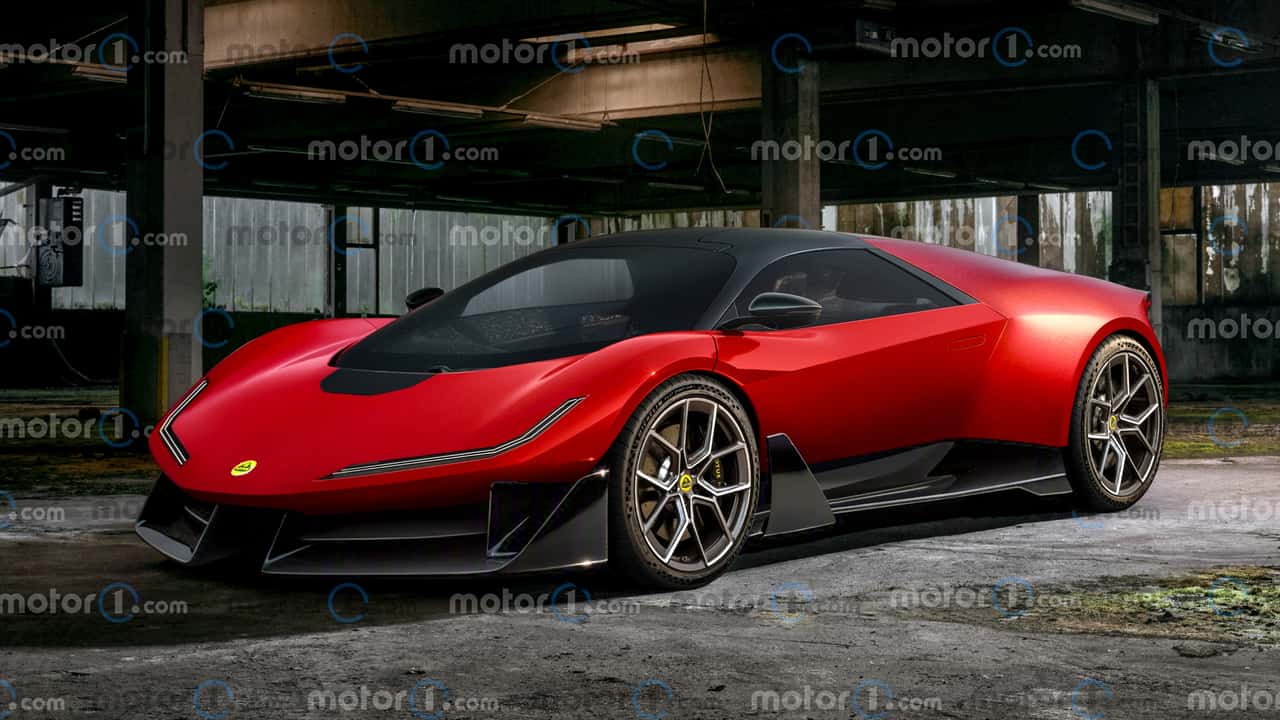

The name W40 can mean very different things depending on who you ask. Some might associate it with a nuclear warhead, the Wanderer W40 sedan from the Auto Union era, or the original Toyota Celica's W40 manual transmission. Horse Powertrain, however, wants the designation to mean something considerably more exciting: a V8 packing nearly 700 horsepower.
The Geely-Renault joint venture is introducing a newly developed 4.0-liter engine with the turbochargers mounted between the cylinder banks in a "hot vee" configuration. This arrangement shortens the intake and exhaust paths and creates a more compact package. The engine also uses direct injection and lightweight materials to keep its mass down to approximately 200 kilograms (441 pounds).
Developed primarily for high-performance hybrid cars, the engine produces 671 hp and 800 Nm (590 lb-ft) of torque on its own. Add one or more electric motors, and the combined output will be considerably higher. Horse Powertrain confirms that the engine will power the Lotus Type 135, which all signs point to becoming the revived Esprit. Name aside, we already know the supercar will deliver more than 1,000 horsepower, with the V8 alone accounting for well over half of that output.

The V8 Works With A New Dual-Clutch Automatic
The engine doesn't come alone; Geely and Renault also developed a new eight-speed wet dual-clutch automatic transmission. It supports up to 1,050 Nm (774 lb-ft) of torque and delivers lightning-fast gear changes in less than 20 milliseconds. The DCT will work alongside the V8 in the new Esprit, which is scheduled to debut in 2028.
Another impressive figure is its pre-fill time: less than 50 milliseconds. This refers to how quickly it prepares the clutch for engagement, helping reduce the delay between a shift command and the actual gear change. Combined with its wet-clutch design, the transmission is built to cope with the substantial torque generated by the V8 and its electric assistance.
We could see this engine in something other than a supercar. Horse Powertrain says its strong low-end torque delivery also makes it suitable for off-road SUVs and pickup trucks. However, the W40 will debut in the Esprit, which will also be available in an entry-level version with a smaller V6 developed by the same joint venture.
Lotus Knows That Light Is Right
Beyond the oily bits, Lotus has previously discussed using Formula 1 technology to reduce the weight of a 150-kW electric motor from the typical 75-95 kilograms (165-209 pounds) to just 20 kilograms (44 pounds). The company is also targeting a curb weight of approximately 1,500 kilograms (3,307 pounds) for the V8-powered, mid-engined Esprit.
Lotus intends to use a conventional hybrid setup rather than a plug-in hybrid. That means it won't need a large battery or charging hardware, helping keep weight under control. If the electric motors power the front wheels, the Esprit will have all-wheel drive, with the V8 sending horses (pun intended) to the rear axle. Hopefully, Lotus will offer a drive mode that disengages the electric assist for a pure, combustion-powered rear-wheel-drive experience.
There's a good chance the W40 won't remain exclusive to Lotus. Geely has a rather extensive automotive empire, with brands such as Volvo, Polestar, Zeekr, Lynk & Co, and several others under its corporate umbrella. Sharing the development costs across multiple manufacturers would make the investment in a new V8 considerably easier to justify.
We wouldn't be surprised if the engine eventually finds its way into a vehicle wearing a different badge. After all, 671 hp and 800 Nm (590 lb-ft) are too good to keep within a single brand. That said, we can't imagine Renault offering a V8. The French automaker has never put one into production, although it came close in the late 1960s with a 3.5-liter V8 developed for the ill-fated Projet H luxury car, a joint venture with Peugeot.
New Lotus Esprit rendering by Motor1
A Brand-New V8 Engine Rarely Happens Anymore
Developing an entirely new V8 in today's automotive climate is rare. Increasingly stringent emissions regulations have pushed automakers toward smaller-displacement engines, electrification, and, in some cases, abandoning combustion altogether. That's why the W40 is particularly interesting.
Horse Powertrain describes it as a "hybrid-first engine," meaning engineers designed it from the outset to work alongside electric motors rather than simply adapting an existing V8 for electrification. The hybrid hardware isn't an afterthought but an essential part of the package, allowing the engine to deliver serious performance while helping meet increasingly demanding efficiency and emissions targets. In other words, the V8 isn't fighting electrification; it's counting on it to survive.
The Esprit Is Coming Back:
RECOMMENDED FOR YOU
This Rare Supercar Was Left To Rot. One Man Decided To Save It
Last Mercedes SLR McLaren Stirling Moss Could Sell For More Than $6 Million
Lamborghini Creates Two One-Off Revuelto Supercars With A Distinctly Saudi Arabian Twist
Americans Are Already Snapping Up Fiat's Tiny $15,000 Topolino
Chinese EV Hits 312 MPH To Become The World's Fastest Production Car: Onboard Video
Europe Wants BYD Investigated Over Spying Fears. Company Responds
Bugatti Celebrates 20 Years In America With A Spectacular Las Vegas Gathering