Renault Is Getting Into Military Vehicles With An Unmanned Off-Roader
It's fully electric, but can also be fitted with a range extender.
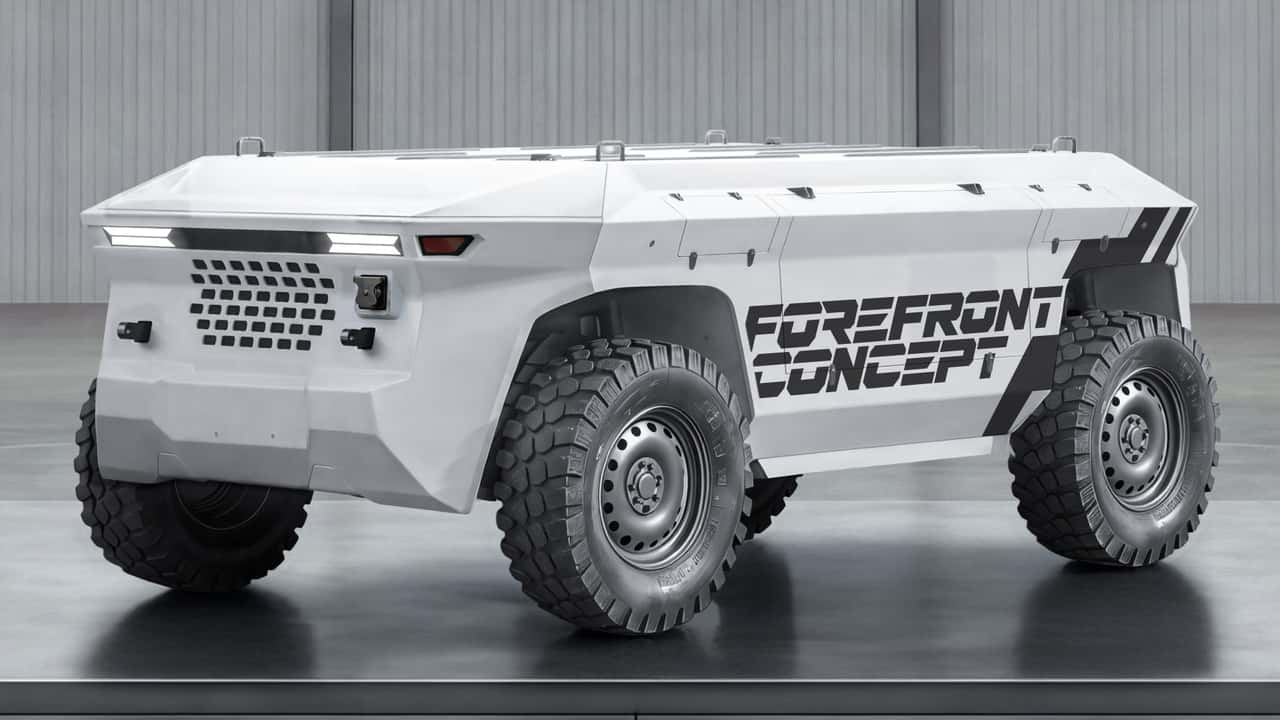

Forget the Clio and the Twingo, Renault's lineup is about to get a lot more intimidating. The company best known for building everyday hatchbacks, crossovers, and electric city cars has teamed up with a Belgian defense specialist to develop an unmanned military off-roader. The Forefront concept is designed to venture into dangerous territory without putting a human driver behind the wheel.
Rather than developing a conventional vehicle, Renault and John Cockerill have created a remotely operated platform that can perform a variety of missions in dangerous or difficult-to-reach locations. A pair of electric motors provides power for four-wheel drive, while rear-wheel steering makes the Forefront more agile in confined spaces.
The concept is expected to cover around 249 miles (400 kilometers) on a single charge, but it can go the extra mile with a range-extender combustion engine. Renault says the Forefront can carry up to 1,000 kilograms (2,205 pounds). Because it's electric, its silent propulsion should prove particularly useful during military operations where minimizing noise can make a difference.

Renault Forefront concept
It's Not Just For The Army
Although the Forefront concept has clear military applications, its potential uses extend beyond the battlefield. The companies envision the platform supporting logistics operations, intelligence, surveillance and reconnaissance, anti-drone missions, fire support, and evacuation efforts.
Civilian applications include disaster response, civil protection, logistics, and work in hazardous environments where sending human operators would be risky. Think of fires, dangerous industrial sites, or areas emergency crews cannot easily access.
The vehicle is remotely operated, but it can also perform tasks autonomously, as the platform supports autonomous driving technology. The project has also received input from the French armed forces, and the Forefront will participate in several exercises and trials in the coming weeks. This will allow the development team to gather feedback from potential military users and refine the vehicle accordingly.
However, neither company has announced production plans or a timeline for putting the platform into service. For now, it remains a concept intended to demonstrate what their combined expertise can achieve.
Ultimately, the Forefront concept is an interesting reminder that automakers can contribute to industries far removed from the usual business of selling cars. Renault isn't exactly preparing to launch an electric military SUV at your local dealership. Still, its manufacturing know-how could prove valuable in developing a new generation of unmanned ground vehicles.
2026 Renault Forefront concept
Renault Joins A Growing List Of Automakers Targeting Defense
Renault isn't the only automaker venturing into the defense sector. Mercedes continues to build military versions of the G-Class, while its Daimler Truck division has gone a step further by establishing Daimler Truck Defence as a dedicated global brand. It brings together the company's military vehicle operations and targets €1 billion in defense revenue by 2028. Its portfolio includes military versions of the Unimog, Zetros, Atego, Actros, and Arocs.
Volkswagen also has a long history of supplying military vehicles. It remains involved in the sector through its commercial vehicle operations, with models such as the Amarok and Crafter serving as platforms for specialized applications. VW is also preparing to give one of its factories a rather unexpected second life.
The automaker has agreed in principle to sell its Osnabrück plant, where production of the oddball T-Roc Cabriolet will end in 2027, to investor Aurelius Capital and the German state of Lower Saxony. The facility is expected to become a security and defense manufacturing center, with an initial project involving Israeli defense company Rafael Advanced Defense Systems to produce components for air-defense systems.
2026 Renault Forefront concept
The Military Is Becoming Big Business For Automakers
Ford is also looking to expand its defense business, pitching Ranger and F-Series pickups for military applications. It has joined forces with General Dynamics Land Systems UK and Ricardo to compete for a British Army contract, while the U.S. Army is evaluating three Super Duty-based prototypes.
Jaguar Land Rover is making an even bigger push with its newly established Defender Defence division. Its new Wolf Series II will compete for a UK Ministry of Defence contract, with the company also targeting NATO countries as potential customers.
General Motors operates GM Defense, which developed the Infantry Squad Vehicle (ISV) for the U.S. Army using the Chevrolet Colorado ZR2 as its foundation.
The harsh reality of 2026 is that defense spending is rising worldwide, so it's no surprise that automakers are discovering their engineering expertise can be just as valuable on the battlefield as it is on the road.
Other Automakers Are Also Arming Up:
RECOMMENDED FOR YOU
Police Recovered $54,000 Worth Of Hot Wheels After A Train Heist
The Simple Technology That Keeps Off-Road Trucks From Getting Stuck
Dubai Police Issue 7,735 Fines For Loud Exhausts And Illegal Mods
BMW Creates One-Off M3 Tribute To A Motorsport Legend
MapQuest Now Shows Flock Cameras In Your Neighborhood
Toyota Profits Surge As Hybrid Sales Drive Strong Recovery
Dubai Police Gets New 907-HP Lamborghini Hybrid Supercar