Toyota's Next-Gen Batteries For Hybrids Arrive In 2027
The new batteries will deliver greater efficiency and cost less to make.


THE BREAKDOWN
- Toyota will begin converting production lines in Japan for next-generation batteries in 2027.
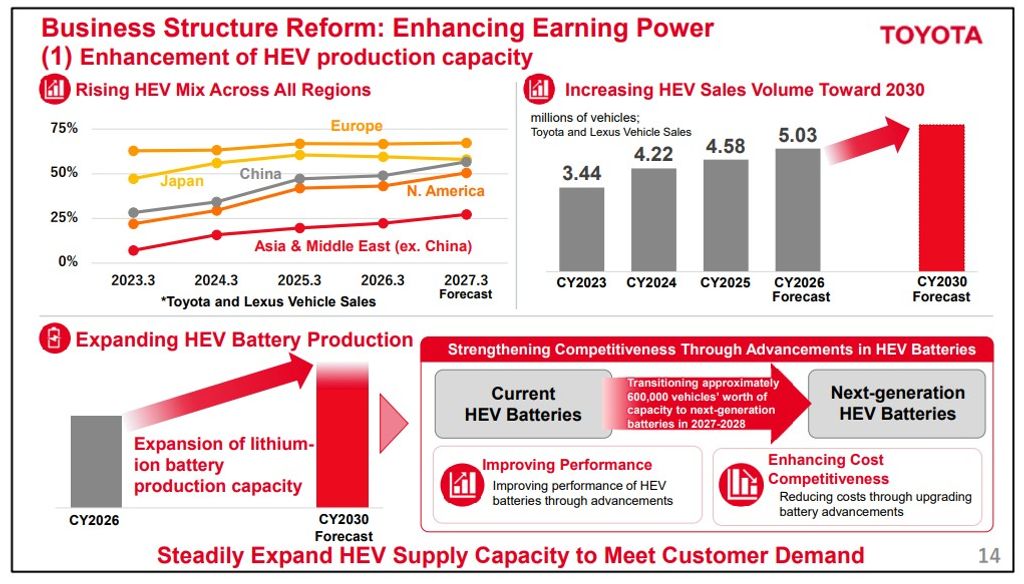
- Initial annual capacity will be enough to supply batteries for 600,000 hybrids.
- Toyota is considering additional battery production capacity.
Five million. That’s how many hybrids Toyota estimates it will sell this year, maybe even more. It would be the first time the milestone has been reached since the Japanese automotive juggernaut democratized hybrids by launching the original Prius nearly three decades ago. Through the voice of its chairman, Akio Toyoda, the company has been adamant that hybrids are a better fit globally than electric vehicles.
Toyota’s thinking is that EVs currently don’t represent a one-size-fits-all solution because of underdeveloped charging infrastructure and higher asking prices. Although range anxiety is becoming less of an issue as technology progresses, many people still swear by combustion-engine vehicles.
With that in mind, it’s full steam ahead with hybrids. Tucked away in an otherwise uninteresting press release about its Q1 results for the 2027 fiscal year (which started on April 1, 2026) is news about new batteries for hybrids. Toyota is planning to transition its battery production lines in Japan to a next-generation package during the 2027-2028 period.
Toyota Touts Greater Efficiency, Lower Production Costs
Initially, the annual production capacity will supply enough batteries to power around 600,000 hybrids. Toyota expects the hybrid take rate to increase in the following years, which is why it’s considering expanding battery production for HEVs. Of course, these won’t be used only for Toyota-badged vehicles but also for the company’s upscale spinoff, Lexus. The production ramp-up is expected to continue until at least the end of 2030.
Toyota isn’t going into details about what lies ahead for its next-generation batteries developed specifically for hybrids. All we know is that the engineers are “improving performance of HEV batteries through advancements,” so expect greater efficiency and lower fuel consumption. The vague statement comes with a benefit from a manufacturer’s perspective, as the company believes it can cut production costs. Whether these savings will be passed on to consumers, resulting in cheaper hybrids, is unclear, but we wouldn’t hold our breath.

Toyota Is Still #1
Say what you will about how Toyota dragged its feet with EVs, but no other automaker in the world comes close to its annual sales. For the sixth consecutive year, it comfortably beat the Volkswagen Group in the global sales race after selling 11.3 million vehicles, including those from Lexus, Daihatsu, and Hino. Hybrids are playing a greater role than ever in the company’s bottom line, hence why it’s doubling down on HEV battery development and production.
But changes are brewing in Toyota City, as CEO Kenta Kon recently said the company he’s running has too many models in its vast portfolio, raising the possibility of some product cuts. While everything seems okay at the moment, higher-ups have made it clear that big changes are necessary to remain competitive amid the Chinese offensive. Overly stringent supplier specifications will be relaxed to cut costs. Silver lining? “The average customer doesn’t even see these parts,” according to Shoji Nishihara, purchasing manager in the R&D department.


Motor1's Take: Akio Toyoda might have been wrong when he said EVs would never exceed a 30-percent share of global sales, but the company was right on the money by investing in hybrids. Whether full EV adoption will ever happen as most automakers claim is an open question, and in the meantime, Toyota has hybrids spanning just about every segment.
With fuel prices continuing to increase in many parts of the world, hybrids help offset the higher costs drivers are facing at the pump. At the same time, Toyota is putting more effort than ever into expanding its EV lineup for those comfortable with making the switch. The long-promised solid-state batteries might finally become a reality in the coming years, possibly debuting in the electric Lexus LFA before eventually revolutionizing mainstream EVs.
Toyota Continues To Bet On Hybrids:
Source: Toyota
RECOMMENDED FOR YOU
Man Buys Lease On New Car. The Salesman Steps In To Clarify—Toyota Leases Are Different: 'I Do This With Subaru'
Audi Claims The New A2 E-Tron Is Its Most Efficient Car Ever
Who Owns Who? Every Major Car Brand And Its Parent Company
Mechanic Works On Land Rover Discovery—He Accidentally ‘Totals’ It: 'Don't Tell The Customer'
Man Goes To CarMax, Sees 2022 Toyota 4Runner With 127K Miles. Then He Sees What They Want: ‘Let’s Not Normalize This’
Why EVs Don't Have Traditional Grilles
Man Gets His Toyota Worked On. Then His Mechanic Finds The Car's Secret Screen: 'You May Not Know'