Tesla Driver Gets New Tires Installed. Then He Takes A Closer Look At The Fine Print On Them: 'Just Drive In Reverse'
"I was today years old when I learned that this was a thing."
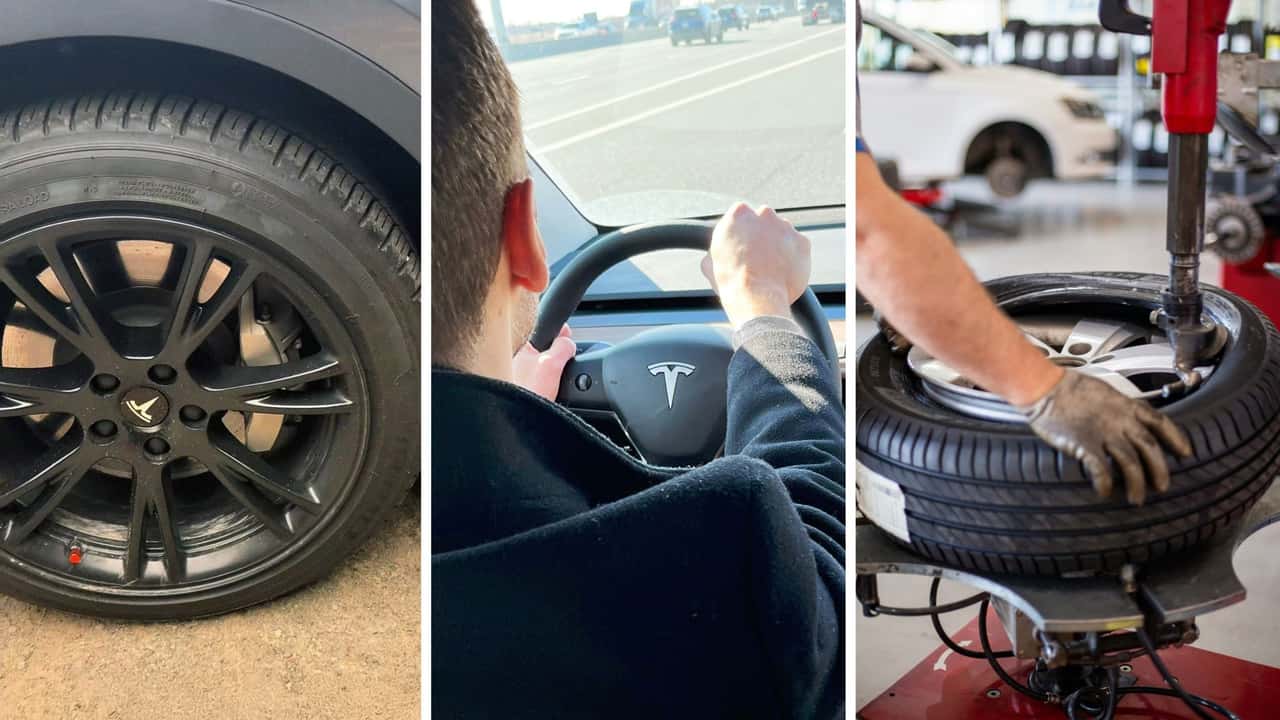

A Tesla owner who had a fresh pair of tires installed on their EV realized after the fact that the techs made a huge mistake.
Sprinter Zero (@sprinterzero) showed off the error in a TikTok. Thanks to some small text emblazoned on the tire’s inner sidewall, it was plain to see.
“My tires were installed inside out,” the Tesla owner writes in a text overlay of his brief clip. Indeed, upon zooming his lens in closer to the tire, the word “inside” is seen on the rubber’s sidewall, suggesting that workers at the tire shop placed his car’s tires on the wrong way.
Folks who commented on his video were quick to dish out variants of the same joke about the error. Namely, that the Tesla was now meant to be driven indoors. “No no. Those are inside tires. Not meant for the outside,” one quipped. “Those are inside tires. You’re supposed to only drive them inside the house. Not outside,” another remarked, echoing this witticism.
Is It Dangerous To Drive 'Inside Out' Tires?
There were also plenty of folks who urged the Tesla owner to refrain from driving his EV in inclement weather.
“Not inside out, but that side wall should be facing your car instead of the outside. You’re probably still fine to drive but just drive slowly in the rain and get that fixed ASAP. The shop should do it for free since they [expletive] up,” one said.
Another person on the app explained why driving on tires with their inner sidewall facing outward is a bad idea.
“Don’t drive in the [rain] until you can get it fixed! Now since the tread is backwards, it is encouraging water under the tire instead of excavating water outwards,” they wrote.
But is this really the case? Well, that depends on the type of tires you have installed on your vehicle.
Gallery: 2027 Tesla Model Y L






Directional VS. Symmetrical Tires
Since the tires Sprinter Zero showed off in his video clearly indicate that they have an “inside” sidewall, it’s safe to say they’re directional units. But the majority of wheels cars are outfitted with are actually symmetrical units.
Unlike their directional counterparts, asymmetrical tires “can be mounted in any direction,” according to Tire Agent. The company went on to write in a blog post that asymmetrical is “the most common tire tread pattern. [And] the inside and outside of the tire have the same tread design.”
This allows for more freedom when it comes to installations. Not to mention fewer nightmare scenarios and heart-sinking realizations after a job is done and a mistake necessitating a re-do becomes glaringly apparent.
Typically, symmetrical tires are found on “passenger cars, minivans, and light trucks,” as per Tire Agent.
The piece also covers directional tires, which “have a tread pattern designed to rotate in one direction only.”
These units will often indicate which side the tire is supposed to face with an arrow or messaging on the tire itself. Furthermore, the most common type of tread design on directional tires is V-shapes or chevrons.
Oftentimes, performance vehicles and sports cars will rock directional tires. And due to their design, and as intoned by their name, directional tires must be facing a certain direction for drivers to enjoy the benefits of their tread design.
Asymmetrical Tires
The write-up also opined on asymmetrical units, stating that they “have an inside and outside face,” which are named on the tire itself.
This means that putting them on incorrectly, as demonstrated in Sprinter Zero’s video, could result in incorrect driving dynamics and potentially put whoever’s behind the wheel in danger.
Like directional tires, asymmetrical ones are also found on sports-tuned vehicles and muscle cars, like the Ford Mustang and Dodge Challenger. Moreover, as the aforementioned commenter stated in their reply to Sprinter Zero’s footage, the design is meant to push water away from the car. Whereas an asymmetrical tire’s outer sidewall is manufactured to provide better grip and cornering capabilities.
So, depending on the type of driving you intend on doing, each type of tire comes with its strengths and weaknesses. Tesla writes in this Model 3 owner’s guide that “some … tires are asymmetric and must be mounted on the wheel with the correct sidewall facing outward.”
So, again, know whether or not your tires are asymmetric, directional, or symmetrical prior to installation. This way, you know what to look for after they’re mounted to ensure they’ve been put on properly.
Motor1 has reached out to Tesla via email and Sprinter Zero via TikTok direct message for further comment. We will update this story if they respond.
RECOMMENDED FOR YOU
RIP: These Cars Won't Make It To 2027
The Toyota Supra Final Edition Is A Lukewarm Farewell To An Icon: Driven
Woman Shops For Tesla. Then She Learns The Real Reason It's Better To Lease—Not Buy
The Simple Trick That Lets You Start Your Car When Your Key Fob Battery Dies
Man Spots Tesla Cybertruck Towing A Boat. Then He Looks Closer And Sees Who's Really Doing The Heavy Lifting
Mitsubishi Goes Under The New Pajero To Show Its Truck Roots
Man Turns On Full Self-Driving In His Tesla. Then He Pulls A Ferris Bueller To Fool It: 'So Here's The Secret...'