Home
BMW
News
'Get Blinded By It': BMW Driver Sees Holographic Tesla On Highway. Then He Notices How Light Is Reflecting Off It. Is That Legal?
'Too bright to see it.'
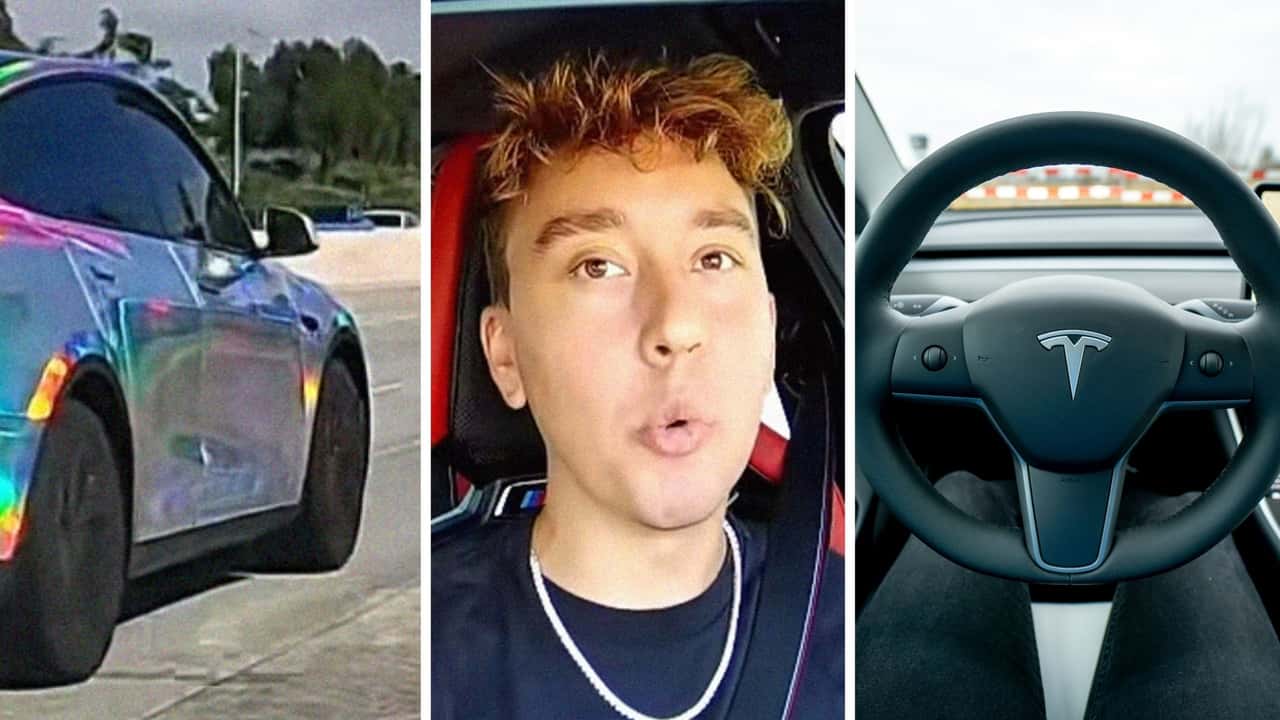
Photo by: Unsplash
Mustafa Gatollari 
By: Mustafa Gatollari
Jul 7, at 8:00am ET
Add Motor1.com as a preferred source in Google
- (https://twitter.com/intent/tweet?url=https%3A%2F%2Fwww.motor1.com%2Fnews%2F800785%2Fsan-diego-holographic-tesla%2F&text=%27Get%20Blinded%20By%20It%27%3A%20BMW%20Driver%20Sees%20Holographic%20Tesla%20On%20Highway.%20Then%20He%20Notices%20How%20Light%20Is%20Reflecting%20Off%20It.%20Is%20That%20Legal%3F&via=motor1com)
- copy
Share
Comment
A Tesla driver’s blinding holographic vinyl wrap (or paint job) is catching heads for all the wrong reasons. BMW M3 owner Nate (@nate_nexiph) took his white compact performance sedan out for a ride. While on the highway, he spotted an eye-blistering EV that was so luminous, he wondered how it was even allowed on the road.
“How is this legal?” he writes in a text overlay of his video. The split-view recording of Nate’s post shows the red interior of his M3, along with his and his passenger’s reactions. In the upper portion of the video, his exterior dash cam catches the Tesla with what appears to be a wrap with an iridescent/holographic effect.
“What is this?” another on-screen caption reads. Nate’s passenger says, "That's insane!” before the video cuts to footage of the BMW driver pulling up behind the EV. “Look at it behind. It’s literally yellow,” he says. More camera footage he provides shows the Tesla in the distance, which is reflecting a great deal of light.
Nate can be heard saying, "I'm surprised that’s legal, making blue and red [light.] That’s like super—you're not allowed to have blue and red lights.” He also points out in his video how bright of a reflection the Tesla’s exterior causes on the road, which is what prompted him to question the legality of such an aesthetic.
Are Holographic/Reflective Wraps Legal?
Vinyl Wrap Pro, a business that specializes in exterior decal covers, writes that legalities on wrap types vary from state to state. In fact, the same blog post explicitly references a Tesla driver who had a vinyl wrap installed on the car that culminated in them getting stopped by 5-0. “I learned this the hard way when a Tesla owner called me two days after his install, pulled over for ‘excessive glare,’” it states.
Additionally, the company’s blog states that “it’s essential to understand legality, safety, and even insurance implications” when putting a wrap on a car. This could even necessitate that car owners contact their insurance providers to notify them of the aesthetic modification. The website adds that “reflective wraps are conditionally legal depending on state and placement.” As Nate points out in his video, “red and blue” reflective wraps should be avoided, as per Vinyl Wrap Pro’s instructions. This is due to the potential for confusion with law enforcement.
Another type of wrap that could bring unwanted attention: “mirror chrome wraps.” As the decal business writes, these “draw the most scrutiny and potential fines.” Moreover, if a wrap "reflects[s] dangerously in sunlight,” Vinyl Wrap Pro says that it could be classified as illegal as it presents a hazard for other drivers.
Thinking Of A Mirror Or Chrome Wrap? Maybe Think Twice
As Vinyl Wrap Pro points out, there are others who’ve penned that there is no federal law banning the use of chrome or mirrored car wraps. But there are specific states that mention keeping reflectivity of car surfaces to a minimum whenever you’re on the road. When it comes to window tints, for instance, the state of Texas rules that “excessively reflective … [materials] can create dangerous glare for other drivers and hinder officer visibility during traffic stops,” as per Credible Law. The online legal resource goes on to state that this also applies to “front, rear, and side windows equally.”
Another wrapping business, Ravoony, also echoes the notion that inordinate amounts of glare caused by car wraps could result in legal woes. “Too much reflectivity might break local rules … some areas limit reflective wraps to avoid accidents. Check your local laws before picking a reflective wrap,” the business states. And Faster Capital tells drivers that there are indeed states that will put the kibosh on certain wraps. That is, if they’re ruled as being “a distraction to other drivers.” Generally speaking, rigging out a car with wraps that emulate emergency service vehicles or law enforcement is strictly prohibited.
This Toyota Supra driver was pulled over in September 2020 while rolling around in his chrome-wrapped ride. He doesn’t give too many particulars as to why police stopped him, but in the clip, even at night, the glare reflecting off his vehicle from the officer's lights is visible.
Legislation On Reflective Car Surfaces
This June 26, 1995, docket from the National Highway Traffic Safety Administration states that reflective components on vehicles must be regulated. Namely, that there are safety limits put in place to ensure that overly glossy or shiny car parts must not impede the vision of drivers on the road.
While vinyl car wraps aren’t expressly mentioned, this is where the discretion of law enforcement officials on the ground comes in. This is probably why Chrome Car Wrap tells folks looking to deck their vehicles out in this aesthetic to stay away.
What do you think?
View
Comments
“Chrome wrapping often isn’t allowed,” the website writes. Namely, because they "can cause intense glare when exposed to sunlight … [and] if a glare ends up blinding another driver … it can result in … injury … as well as the destruction of property and damage to the vehicles.”
Motor1 has reached out to Nate via TikTok direct message for further comment. We will update this story if he responds.
We want your opinion!
What would you like to see on Motor1.com?
Take our 3 minute survey.
- The Motor1.com Team
Share this Story
- (https://twitter.com/intent/tweet?url=https%3A%2F%2Fwww.motor1.com%2Fnews%2F800785%2Fsan-diego-holographic-tesla%2F&text=%27Get%20Blinded%20By%20It%27%3A%20BMW%20Driver%20Sees%20Holographic%20Tesla%20On%20Highway.%20Then%20He%20Notices%20How%20Light%20Is%20Reflecting%20Off%20It.%20Is%20That%20Legal%3F&via=motor1com)
- copy
GO TO COMMENTS
(
)
Got a tip for us? Email: tips@motor1.com
View all comments ( )
Popular

Bugatti Restores One-Off Veyron With A Mirror-Like Aluminum Body
BMW Kept This Hatchback A Secret For Decades
Skoda Wants You To 3D Print Pieces Of Your Car At Home
The Gas BMW M3 Isn't Dead: Next-Gen Prototype Roars
latest articles
- The Ford Ranger Is Getting A Bigger V6 For 2027: Report Oct 20 - Rumors -
- BMW Already Has A Deal On The New i3. But It's Not Cheap Oct 20 - Pricing -
- Remember The Ford Flex? This Weird SUV Is Now A Great Used Buy Oct 20 - Why Buy? -
- Mercedes Isn't Sold On Extended-Range EVs: 'Would You Really Switch?' Oct 20 - Interview -
- Cadillac Driver Is Fed Up With Auto Stop. Then She Buys A $9 Item On Amazon To Disable It Oct 20 - Trending -
- Bugatti Restores One-Off Veyron With A Mirror-Like Aluminum Body Oct 20 - Supercars -
- Lexus NX Goes Hybrid Only For 2027 Oct 20 - Official -
RECOMMENDED FOR YOU
BMW Already Has A Deal On The New i3. But It's Not Cheap
The Ford Ranger Is Getting A Bigger V6 For 2027: Report
The Gas BMW M3 Isn't Dead: Next-Gen Prototype Roars
Remember The Ford Flex? This Weird SUV Is Now A Great Used Buy
BMW Is Reportedly Offering Employees Up To $730,000 To Leave The Company
Mercedes Isn't Sold On Extended-Range EVs: 'Would You Really Switch?'
BMW Kept This Hatchback A Secret For Decades