The Range Rover Sport Is Going Electric: First Look
The luxury electric SUV breaks cover later this year with the same hardware as its bigger brother.

The Breakdown
- The Range Rover Sport will borrow most of the hardware from the full-size Range Rover.
- Dual motors are rated at 444 hp or 542 hp, depending on version.
- Land Rover estimates the 118.5-kWh will deliver 330 miles of range.
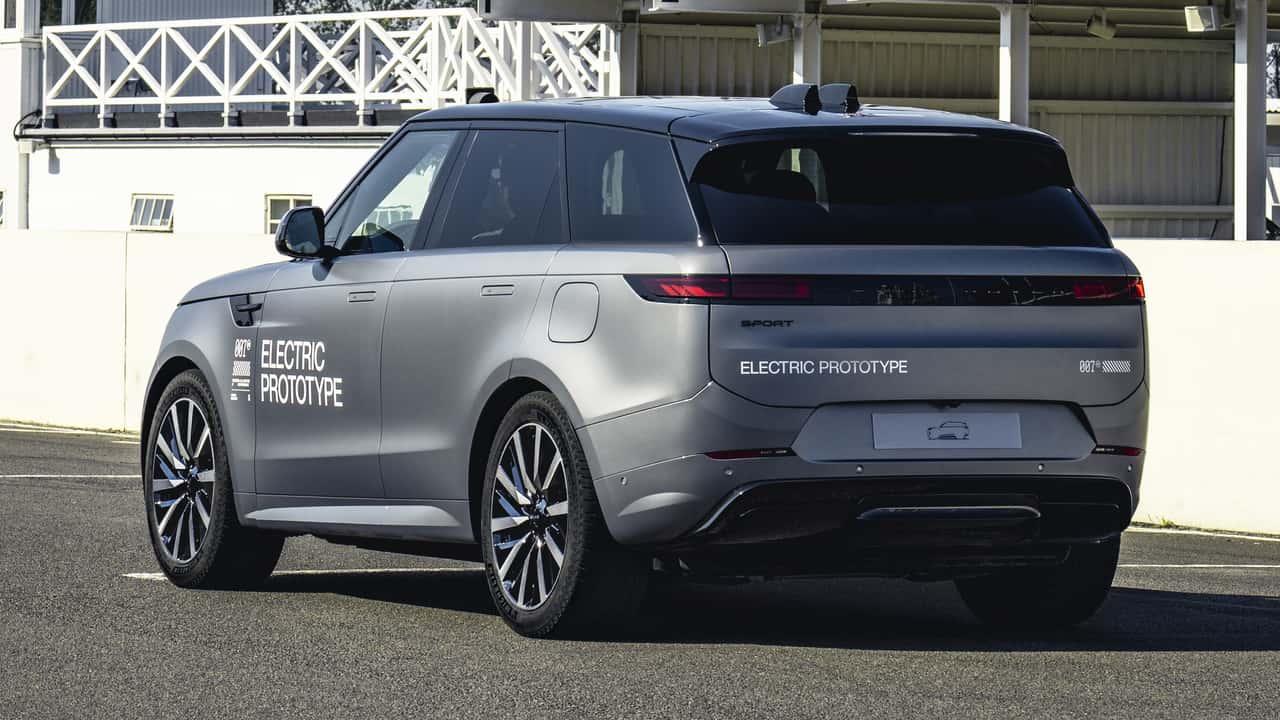
The Range Rover Sport Electric is almost here, and it looks almost identical to its combustion-engine sibling. While other automakers, such as Mercedes, have tried to lure buyers with more daring EV designs, Land Rover doesn’t want to rock the boat. The newcomer to the luxury electric SUV segment will look virtually the same as its ICE counterpart, save for the missing exhaust tips and a closed-off grille.
Ahead of its full debut later this year, the Range Rover Sport Electric is revealing some of its secrets. Predictably, it rides on the same Modular Longitudinal Architecture (MLA) as the conventionally powered model. The platform was developed to accommodate combustion engines, either on their own or as part of a plug-in hybrid setup, while also supporting fully electric models. The full-size Range Rover is built on the same architecture, as was the next-generation Jaguar XJ before the electric sedan was canceled as part of Jaguar’s bold reinvention.
The Range Rover Sport Electric will be powered by a pair of motors producing a combined 444 or 542 hp, depending on the version, along with an impressive 627 lb-ft (850 Nm) of instant torque. Since the motors are identical, expect a 50:50 power split between the front and rear axles. They draw energy from a 118.5-kWh battery, which is large but still smaller than the new BMW iX5’s massive 141-kWh pack.

Land Rover estimates an EPA range of about 330 miles (531 kilometers) on a full charge, so the WLTP figure should be higher. Since we mentioned BMW, the new iX5 is estimated to travel 435 miles (700 kilometers) on the EPA cycle and as much as 525 miles (845 kilometers) under WLTP testing.
The Range Rover Sport Electric uses AESC’s double-stacked cylindrical battery cells and supports 350-kW DC fast charging thanks to its 800-volt architecture. As expected, it comes with air suspension for a silky-smooth ride, while its off-road capability remains intact despite the switch to an electric powertrain. Land Rover’s engineers have equipped the silent luxobarge with a one-pedal driving mode that even works off-road, although few owners are likely to test that out. Rear-wheel steering is also included to reduce the turning circle and improve stability at higher speeds.
Like the exterior, the cabin is expected to carry over largely unchanged from the regular Range Rover Sport. That’s both good and bad. While high-quality materials are all but guaranteed, the all-screen interface is likely to be a turnoff for many buyers. If it mirrors the ICE-powered model, the EV will also feature an abundance of glossy black plastic on the center console.
All will be revealed later this year when the Range Rover Sport Electric makes its official debut.
Range Rover Sport Electric prototype

Motor1's Take: Even diehard EV skeptics have to admit an electric powertrain is a natural fit for a vehicle like the Range Rover Sport, or luxury SUVs in general. It should make an already refined vehicle even smoother and more comfortable. However, the so-so estimated range could be a concern, especially for owners who tow frequently, as they're unlikely to come anywhere close to the official efficiency figures.
Fortunately, the electric model won’t replace any existing Range Rover Sport variants powered by gasoline, diesel, or plug-in hybrid drivetrains. Instead, it will join the lineup as a fourth option. Pricing hasn't been announced, but Land Rover has already said its EVs will carry a premium over their combustion-engine counterparts.
Catch Up With Land Rover:
RECOMMENDED FOR YOU
Land Rover Cuts Nearly 100 Horsepower From The Defender's BMW V8
Spotted: Toyota Is Already Testing A Hotter GR GT Supercar
The Next Range Rover Velar Could Look Very Different
Mechanic Inspects Honda. Then He Realizes That The Transmission Fluid Is All Gone—It’s More Common Than You Think
Land Rover Recalls 250,000 SUVs For Bad Airbags
BMW Explains Why It Finally Gave The M2 All-Wheel Drive
Land Rover Sold These Color-Changing Classic Defenders To A Single Buyer