Home
Honda
News
Honda Driver Goes To Pump Gas. Then He Sees The Label That His Car Recommends: 'Do You Go With This, This, Or That?'
"Fuel economy improvements recorded during AAA testing."
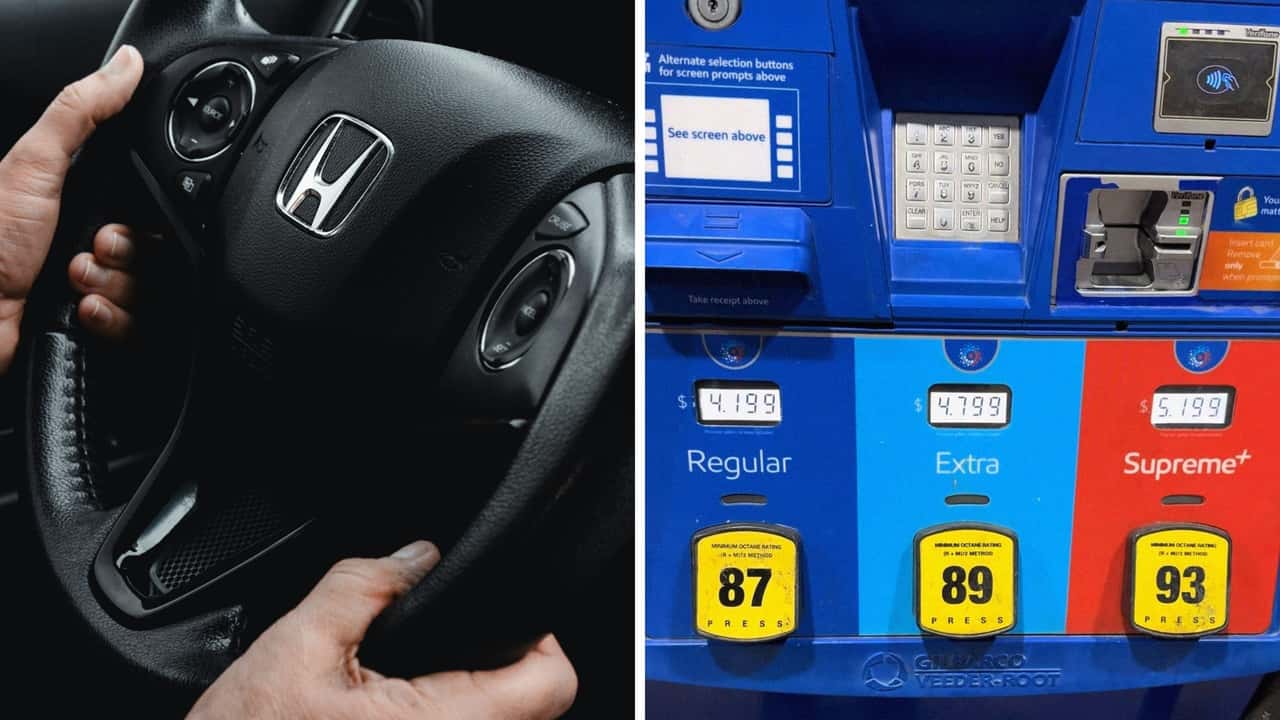
Photo by: Ivett M & ztn_drives
JT Wilson 
By: JT Wilson
Jun 29, at 4:00pm ET
Add Motor1.com as a preferred source in Google
- (https://twitter.com/intent/tweet?url=https%3A%2F%2Fwww.motor1.com%2Fnews%2F800098%2Fhonda-recommends-91-gas%2F&text=Honda%20Driver%20Goes%20To%20Pump%20Gas.%20Then%20He%20Sees%20The%20Label%20That%20His%20Car%20Recommends%3A%20%27Do%20You%20Go%20With%20This%2C%20This%2C%20Or%20That%3F%27&via=motor1com)
- copy
Share
Comment
A Honda owner recently discovered that using the recommended fuel in his vehicle might be easier said than done.
He pulled up to fill his tank, looked at the inside of his fuel door, looked back at the pump, and discovered a disconnect between what Honda recommends and what the gas station offers.
The label on TikTok creator @ztn_drives' fuel cap says 91 octane is recommended, with 87 as the minimum. The pump in front of him sells 87, 89, and 93—but no 91.
The video has racked up more than 774,000 views and inspired an engineering-heavy comment thread.
He framed the post as "question of the night."
"Says what's recommended, says what's minimum, right?" he says. "Around here, you get these three options. So you go with this, this, or that?"
What The Two Words On The Label Actually Mean
The label uses two terms that the US Department of Energy distinguishes between in its official guidance on octane selection. "Required" means the engine was designed to run on that octane and using lower-octane fuel "can cause the engine to run poorly and can damage the engine and emissions control system over time." "Recommended" is the softer version: the engine is tuned to perform best on that octane, but the manufacturer has built in enough headroom for the engine to safely operate on the listed minimum.
Ztn_drives' Honda is in the second bucket. The minimum of 87 means the manufacturer expects the engine's sensors to pull ignition timing back when 87 goes in, at the cost of some peak power and a small fuel economy hit. The car will not be damaged by running it with 87 gctane fuel; it will just be running below its tuned operating point.
It's All About Altitude
The reason ztn_drives' pump tops out at 93, and not 91, is regional.
In high-elevation US states (Colorado, Utah, Wyoming, parts of Idaho), 91 is the premium grade because the thinner air reduces detonation risk. In most of the eastern and southern US, 93 is the standard premium. The 91-recommended figure on Honda's label reflects the lowest premium octane sold anywhere in the US: in mountain states where altitude makes 91 the top tier, that label still describes premium fuel.
AAA Ran The Test So You Don't Have To
The harder question—whether the recommended octane is worth the price difference—has been extensively researched by consumer advocates.
In 2017, AAA published the results of a six-vehicle test conducted with the Automotive Club of Southern California, comparing 87-octane and 93-octane gasoline in models for which the manufacturer recommended, but did not require, premium fuel. The average improvement on premium across the test fleet was 2.7% in fuel economy and 1.4% in horsepower.
On cost, in the same study, AAA found the average national premium between regular and premium gasoline had grown from a historically steady 10% to more than 25%, or about 50 cents per gallon at the time.
"The modest fuel economy improvements recorded during AAA testing do not offset the higher cost of premium-grade gasoline," the report concluded, for cars in the recommended-not-required category.
The exception, AAA noted, is "extreme driving scenarios such as towing, hauling cargo and aggressive acceleration," where the modest gains are larger.
The Practical Answer For This Specific Pump
So what about ztn_drives's choice of three buttons?
The 87 is below recommended but at the minimum, which means the car will run with the ECU compensating. The 89 is mid-grade, which at most US stations is not a separate underground tank but a blend mixed at the dispenser from the 87 and 93 lines.
The 93 is one rung above recommended for his Honda. Per AAA, going higher than recommended will not damage the engine and offers no further benefit beyond meeting the recommendation.
The comment thread eventually reached the same conclusion.
Commenter Alxn.bk2 posted the most complete technical summary: "It can run on 87 BUT it will pull timing because of knock sensors to prevent pre-detonation, which will also reduce your power/fuel efficiency. But it is safe to drive on. 91 is recommended because the knock sensors adjust for higher octane and improves power/fuel efficiency. The rule of thumb: you can go higher than required, but never under."
What do you think?
View
Comments
Commenter Matt boiled it down even further, writing, "It's still safe to put 87 in when higher octane is not available, but if 91 or higher is available, you should be putting that in."
Motor1 reached out to ztn_drives via TikTok direct message for additional comment. We'll be sure to update this if he responds.
We want your opinion!
What would you like to see on Motor1.com?
Take our 3 minute survey.
- The Motor1.com Team
Share this Story
- (https://twitter.com/intent/tweet?url=https%3A%2F%2Fwww.motor1.com%2Fnews%2F800098%2Fhonda-recommends-91-gas%2F&text=Honda%20Driver%20Goes%20To%20Pump%20Gas.%20Then%20He%20Sees%20The%20Label%20That%20His%20Car%20Recommends%3A%20%27Do%20You%20Go%20With%20This%2C%20This%2C%20Or%20That%3F%27&via=motor1com)
- copy
GO TO COMMENTS
(
)
Got a tip for us? Email: tips@motor1.com
View all comments ( )
Popular

12 Cars With Names That Make Absolutely No Sense
BMW Kept This Hatchback A Secret For Decades
Bugatti Restores One-Off Veyron With A Mirror-Like Aluminum Body
The Gas BMW M3 Isn't Dead: Next-Gen Prototype Roars
latest articles
- The Strange Reason The Golf GTI Has A Golf Ball Shifter Oct 20 - Motor101 -
- Photos: Porsche's Mission S Concept Takes Over New York City Oct 20 - Design -
- The 2027 Honda Passport TrailSport Looks Noticeably Taller Next To Last Year's Model Oct 20 - Off-Road -
- 12 Cars With Names That Make Absolutely No Sense Oct 20 - Lists -
- The Ford Ranger Is Getting A Bigger V6 For 2027: Report Oct 20 - Rumors -
- BMW Already Has A Deal On The New i3. But It's Not Cheap Oct 20 - Pricing -
- Remember The Ford Flex? This Weird SUV Is Now A Great Used Buy Oct 20 - Why Buy? -
RECOMMENDED FOR YOU
10 SUVs That Get 30 MPG Without Hybrid Power
The Ford Ranger Is Getting A Bigger V6 For 2027: Report
Woman Drives Honda Accord. Then Her Dashboard Reads: 'Power May Be Reduced. See Your Dealer'
BMW Already Has A Deal On The New i3. But It's Not Cheap
Honda Reveals The Name And First Details Of Its Next-Generation Hybrid System
Remember The Ford Flex? This Weird SUV Is Now A Great Used Buy
2026 Paris Motor Show: What To Expect