The Ferrari 849 Testarossa Earns Its Name
Driving Ferrari's new supercar on the roads of Tenerife, the hybrid V8 roars—but it's the handling that really impresses.

"Se un'anima c'è, è molto più probabile che l'abbia un motore piuttosto che un essere umano."
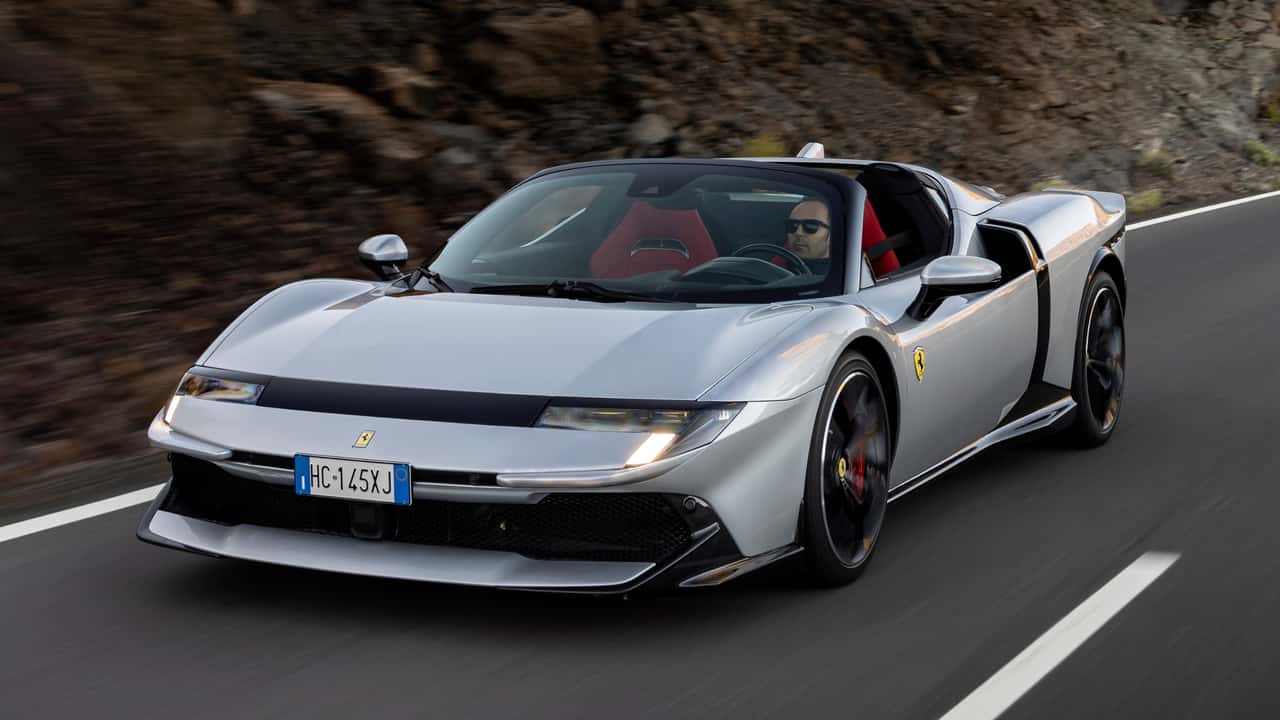
That quote, attributed to Enzo Ferrari, loosely translates to: "If anything truly has a soul, it's far more likely to be an engine than a human being." Those words echoed in my head as I walked around Maranello's newest eight-cylinder machine: the Ferrari 849 Testarossa Spider.
I'd heard plenty about this car over the past few months, from its styling to the inevitable debate surrounding the Testarossa name. "We wanted a challenge," the Ferrari team told me. "We wanted a flagship with a rear-mounted V8 wearing that name again." Ferrari's engineers are a rare breed—people whose passion runs so deep that they welcome your honest opinion.
My reaction, in the end, was surprisingly simple: I just couldn't wait to press the red start button and hear it come alive on the roads of Tenerife.
This story originally appeared on Motor1 Italy
The Numbers Don't Tell the Whole Story

On paper, the numbers are staggering: 1,050 horsepower, 0-62 miles per hour in under 2.3 seconds, and 0-124 in 6.5 seconds. It's the most powerful series-production Ferrari ever built. Then there's another very important figure to point out, though: a 1:18.10 lap time around Ferrari’s Fiorano test track, set by the Spider.
But those numbers only tell part of the story.
The real magic lies in how Ferrari combines electronics, aerodynamics, software, and engineering to make the mechanical package feel more alive—not less. Everything exists to deepen the connection between car and driver, adding that extra layer of engagement enthusiasts are always chasing.
That's what defines the Testarossa: breathtaking performance while remaining approachable enough for drivers with varying skill levels. More importantly, this car creates a genuine bond with the person behind the wheel.
Yes, it's a plug-in hybrid with a 7.5-kilowatt-hour battery, which makes electric driving useful for quietly leaving a hotel or slipping through a city center. But when a Ferrari has three electric motors—two up front and one between the engine and transmission—they're there for much more than silent running.
Heart And Soul
As you've probably guessed, the centerpiece is a twin-turbocharged 4.0-liter V8 making 830 horsepower—50 more than the same engine in the SF90. It uses the largest turbochargers ever fitted to a production Ferrari, mounted in a conventional layout rather than a hot-V configuration.
Three electric motors complete the package. Two sit on the front axle, using Ferrari's RAC-e system for torque vectoring and all-wheel drive. The third, an F1-derived MGU-K mounted between the engine and transmission, brings the combined output to 1,050 horsepower.
But the real story isn't the headline power figure—it's what the torque vectoring and all-wheel-drive systems allow the car to do.
There's no question the F154FC powertrain—part of the engine family that powered everything from the California to the 488, SF90, and beyond—is brutally fast. Yet outright acceleration is only one piece of the puzzle. Even standing still, the racing influences are impossible to miss.
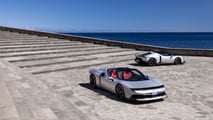
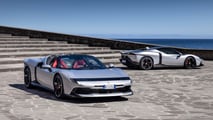
The front "mustache" echoes the Le Mans-winning 499P, while the massive splitter and asymmetric grille channel airflow with obvious aerodynamic intent. Around back, the split-tail design pays tribute to the 512 S that raced at Sebring in 1970 with Ignazio Giunti, Nino Vaccarella, and Mario Andretti.
Even standing still, the racing influences are impossible to miss.
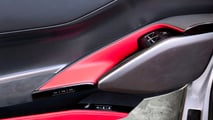
The doors deserve special attention. Each one is a patented single-piece aluminum component produced by hot forming, because conventional stamping simply wasn't possible. They're also functional aerodynamic elements that feed air directly to the enlarged intercoolers shared with the F80.
At 155 mph, the car generates 915 pounds of downforce. Thirty-five percent comes from the front underbody, while the splitter and split-tail each contribute another 10 percent. The active rear spoiler transitions from Low Drag to High Downforce in less than a second, adding up to 220 pounds of downforce on its own.
On the Spider, Ferrari made sure the folding hardtop came without an aerodynamic compromise. It opens or closes in just 14 seconds at speeds up to 28 mph. A wind deflector behind the seats reduces buffeting with the roof down, while a bridge behind the cabin directs airflow toward the active spoiler when the roof is up, matching the coupe's aerodynamic performance.
It's a small detail that says a lot about the philosophy behind this car.
Inside, the cabin feels like a single-seat race car, with a horizontal dashboard, a central spine inspired by Ferrari's classic gated shifters, and—thankfully—the return of physical steering-wheel controls, including the red engine-start button. After years of touch-sensitive buttons, it's a welcome change.
Pure Sensation
Tenerife's pavement is as smooth as a racetrack. The mountain roads, however, come with their own rules—and speed limits. Even staying well within them, the Ferrari delivers an unforgettable experience.
The acceleration is extraordinary, of course; there's always more power waiting. But what really resets your expectations is the turn-in. As someone who also tests motorcycles, I found it genuinely startling.
The torque-vectoring system works so seamlessly that it never feels artificial. Instead, your brain has to recalibrate to just how quickly the nose changes direction. The car darts into corners almost like a go-kart. On corner exit, the electric motors instantly fill the gap before the turbochargers are fully awake, firing the car toward the next straight.
Body roll has been reduced by 10 percent compared to the SF90, while springs that are 35 percent lighter—matching the Assetto Fiorano package—have been tuned specifically for road use. The result is astonishing cornering speed without sacrificing everyday drivability.
Reduced body roll also improves dynamic camber, allowing the tires to maintain a more effective contact patch right when maximum grip matters most. Ferrari developed the dampers for both road and track, and you can feel that balance every time you pick up the throttle on corner exit.
The acceleration is extraordinary, of course; there's always more power waiting. But what really resets your expectations is the turn-in.
The improvements continue on the straights. In third gear above 5,500 rpm, the 849 accelerates harder than the SF90, while both the steering and throttle feel sharper and more immediate. It's not just a more powerful Ferrari; it's a more responsive one.
Even the dual-clutch transmission has been retuned for sound, using software derived from the SF90 XX Spider to maximize combustion pressure during downshifts for a louder, more dramatic exhaust note—especially in Race mode.
Overseeing everything is Ferrari's FIVE system, a real-time digital twin that continuously monitors the car through a six-axis inertial sensor, much like the IMUs used on modern superbikes.
It's incredibly sophisticated engineering. Yet from behind the wheel, it never feels complicated. That's exactly how Ferrari test driver Raffaele De Simone describes the car's philosophy: technically complex, effortlessly intuitive.
Verdict: More Than A Name
Before anyone even drove it, the name was a talking point. "Testarossa" instantly evokes the wedge-shaped icon of the 1980s, but the history stretches back much further.
The famous red cylinder heads first appeared on the 1956 Ferrari 500 TR before carrying over to the 250 Testarossa, which won races at Buenos Aires, Sebring, the Targa Florio, and Le Mans, helping Ferrari secure its first World Sportscar Championship.
The name returned in 1984 on the legendary road car everyone remembers. Now, it returns on Ferrari's first flagship production model with a rear-mounted V8 after years of front-engine V12 flagships.
At a time when genuine mechanical emotion feels increasingly rare, the 849 Testarossa Spider puts it back at the center of the experience. Yes, the starting price hovers around $540,000. But this is the most powerful production Spider Ferrari has ever built, and more importantly, it's a car designed to be driven—not simply admired.
The name may spark debate; driving it tends to end the conversation.
Competitors
More Supercar Reviews
Gallery: Ferrari 849 Testarossa Spider First Drive Review
Ferrari 849 Testarossa Spider
RECOMMENDED FOR YOU
I Drove The Base Subaru WRX. It's Exactly What Enthusiasts Have Been Asking For
Aston Martin Built A Badass V12 SUV For The New Call Of Duty Game
I Drove The 2026 Hyundai Ioniq 9. It's The Electric SUV For Real Families
Nissan Debuts A Luxurious New Minivan You Can't Have
The Ram TRX Is Back, And It's Still Unhinged: Review
Shelby's New F-150 Super Snake Spits Venom At The Ram Rumble Bee
The Porsche 911 GT3 Is Even Better As A Convertible: Review