BYD Special Advisor for Europe: "Incentives a drug, the market does not need them"
On the occasion of the Sealion 7 launch, we interviewed Alfredo Altavilla, Special Advisor of BYD Europe.
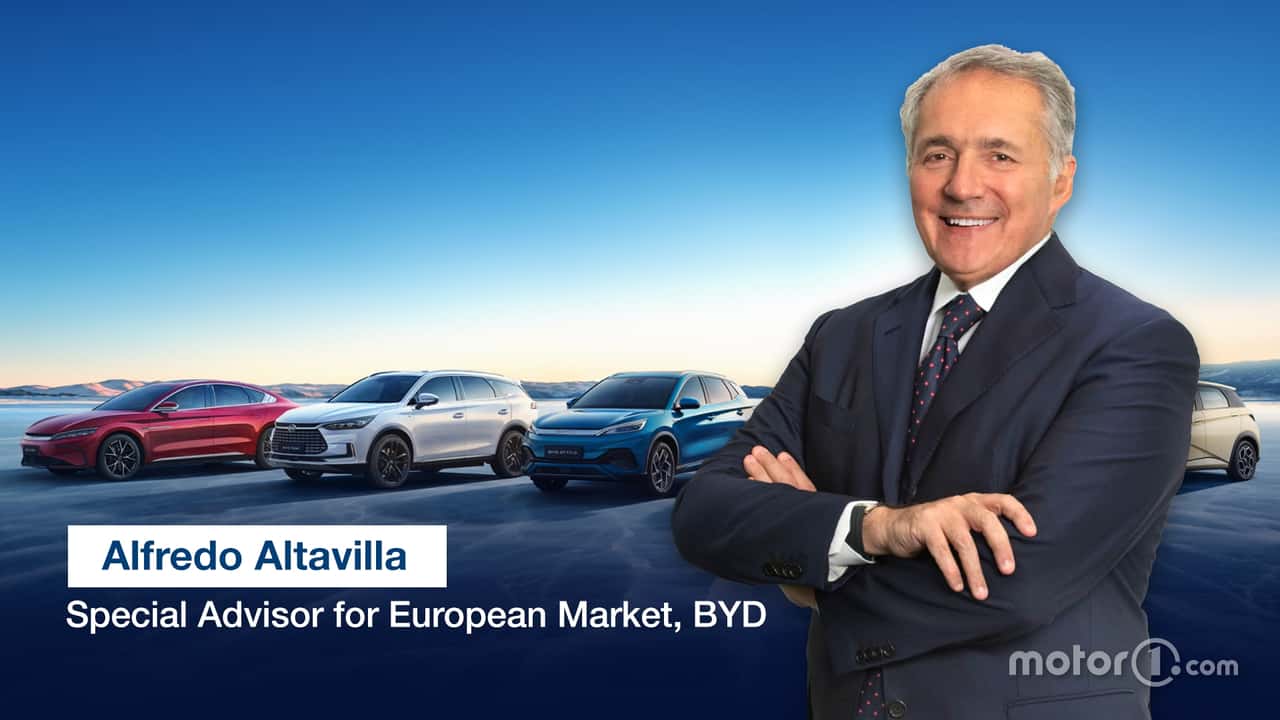

Among the most active Chinese brands in Europe, in terms of sales and strategy, BYD is certainly at the top of the list. A varied range about to expand further, electric and plug-in models, and a plan to open factories on the Old Continent, to bring production closer and avoid the duties imposed by Europe on Chinese electric cars.
A plan that has also seen BYD evolve in terms of key people, with the appointment of Alfredo Altavilla, Sergio Marchionne's former right-hand man at the time of FCA, to the position of Special Advisor for Europe. A fundamental role to guide the Chinese brand in the European market. We had the opportunity to speak with Altavilla at a round table, touching on various points: from duties to incentives, with focus on the Chinese brand's strategy for the coming years. Starting with the product itself, specifically the BYD Sealion 7.
More exclusive interviews:
For Europe
"The Sealion 7 goes to play in the so-called D-segment SUV market, which is one of the most relevant at the moment. And it is important because it is the first product that takes on board, after the Seal U DMI, the input that came from Europe regarding customisation compared to the version produced in China for the Chinese market. I believe that with the Sealion 7, BYD's ability and willingness to begin accommodating the desires of consumers that are profoundly different from those in China in the products that are coming to market is beginning to become evident."

BYD Sealion 7
Q: What will come next?
The other two products will be the ones that will bring BYD to compete in the bulk of the European market. Now the need is beginning to be felt, given the investment that is being made in the development of the European market, for products that are going to go into the bulk of the market, so let's talk about the B SUV segment, let's talk about the A segment, the full EVs. 2025 will be the year when hybrid technology will definitely become predominant in terms of BYD's sales in Europe.
I would say that - and you'll have to take my word for this on the basis of 30 years and more of experience in the industry - the speed at which they are doing this at BYD is truly unprecedented.
BYD Seal U
Chinese? No, European
While today BYD is still seen as one of many Chinese manufacturers entering Europe, the true reality is that in 18 months from now, BYD will be a full-fledged European manufacturer. The goal is to become self-sufficient in Europe thanks to the two plants in Hungary and Turkey. At that point there will no longer be any reason to think of it as a Chinese manufacturer, it will be to all intents and purposes a European manufacturer with a European engineering headquarters as well.
I simply pointed out, based on my experience, the risks of a sort of transposition of the Chinese supply chain to Europe. Basically, there was a risk in terms of timing, there was a risk in terms of quality because it is never trivial, you can be the best supplier in the world in a certain country, but if you have to go to the other side of the world it is not taken for granted that your quality and your costs will be exactly the same.

Thoughts for Italy
Europe has a component supply chain of absolute excellence. I have to say that I would really like, and this is what I am trying to do, to push the Italian supply chain in particular to be as much of a protagonist as possible in this process. I hope that there can be a focus on the competitiveness of the European supply chain, especially the competitiveness of the Italian supply chain.
There is not the classic closed attitude of "ah no, we in China do this and in Europe, you get it like this." There is an attitude of extreme attention, both from the point of view of product specifications, starting from the fact that Wolfgang Egger designs the cars, to the fact that the new head of vehicle dynamics, a German engineer who did 25 years Mercedes.
BYD Act 3
The difficulties
After that, it is clear that market conditions are difficult at the moment, because we are heading into a 2025 that is likely to be an extremely complicated year. The duty affair, which is absolute nonsense, is now clearly becoming a boomerang, first and foremost for the European industry. [...] There is a relative problem, in my opinion, and one that is greatly underestimated, to the overall uncertainty that characterises the entire automotive market.
The duties, incentives yes, incentives no, mount yes, mount no. What I would like, what I am trying to explain a little bit to everyone, especially within BYD, is that in uncertainty the consumer is simply to postpone purchases. This is true for each of us, many times it happens that we say: I have to buy a new TV, I have to buy a new dishwasher, I wait for Black Friday because I pay less for it anyway. Then I wait for Christmas discounts, then post-Christmas discounts. In the uncertainty, people don't buy and postpone the purchase. This is unfortunately what is happening in the car market, that people in uncertainty postpone the decision to buy.
That is the last thing a manufacturer of vehicles, so-called NEVs (New Energy Vehicles), wants. To be in a market that is dominated by price, because contrary to what many believe, if the 2035 [ICE ban], fines etc. are confirmed in all of this, BYD is happy because it is pushing towards EVs, towards plug-ins, and that is not. It is simply pushing a price battle.
I understand that it may seem counterintuitive, but it's a market that becomes purely price-driven, it's a market that doesn't benefit anyone and in the long run, it will kill, it will hurt companies, both OEMs and the supply chain, even more than is already happening now.
Q: Is it by chance that BYD is opening plants in less pro-European or pro-EU countries, along with the Czech Republic?
I can't give an answer, because when the location decisions in Hungary and Turkey were made, I was not yet working with BYD, so I don't know the reasons why these two countries were favoured over others. [...] Undoubtedly, these are two countries where if you produce, you can export to the rest of Europe at zero duty.
Q: Until BYD becomes a partly European manufacturer, how will pricing policy change?
This is a decision that has not yet been finalised, we are projecting different scenarios. There is a basic assumption that applies to both the talk of the possible impact of duties and the talk of incentives. When you put out a price, from that price, the customer will not deviate. So you have to be very careful about making major changes in the price positioning of your range, because then going back takes time, efforts, and a lot of money. So you have to weigh up the pros and cons of impactful measures very well.
Q: Can the latest US elections and the crisis in some European countries lead to a different discourse in terms of duties for the near future?
I think that the American discourse does not impact, in the sense that by now Biden had already decided on 100 per cent duties for Chinese vehicles. As far as Europe is concerned, I think that by now everyone is beginning to come to terms with the fact that a possible, and in my opinion quite certain, Chinese retaliation risks doing much more harm than the benefit of having put these duties in place. Not to mention that the imposition of the duties has completely stopped any further attempts by Chinese manufacturers to localise in Europe.
BYD Seagull
Q: Why would it stop the entry into Europe? In what way?
All the Chinese manufacturers were looking at possible plants in Italy. I say this with full knowledge of the facts, because before working with BYD, I was assisting others, and with full knowledge of the facts I say that the Italian government, together with the trade unions, together with the association representing the supply chain, had developed a package of extreme competitiveness. A true example of an industrial system. Then Europe comes along and says "put duties in place." So we have done ourselves wrong. [...] As soon as you become a European manufacturer, there are no more duties, but it is not a good viaticum to launch such an operation, also because nobody becomes completely localised in one country overnight.
Q: Haven't you thought about investments in energy supply on your part? You could also become an energy supplier, like Tesla with the Superchargers?
That is one of the things that is being considered at the moment, not least because BYD is the world's largest producer of solar panels, the world's second-largest producer of energy storage, so if anyone can reasonably think of such operations it is BYD.
Q: From the customer's point of view, did you have some sort of initial bias? If so, have you sought a strategy in any way?
The resistance is certainly there, it comes down in two ways: with the perceived quality of the product and with the sales and service network.
Regarding the perceived quality of the product, you have to say that, but I believe objectively that it is very good. On the sales and service network, we are favouring the appointment of dealers who are already very strong in the market and who have represented volume brands for decades, with an important after-sales network as well. The factories, warehouses and spare parts were created before we launched the cars, so today Europe has a complete network of spare parts warehouses.

Point number three, we have made an MoU (memorandum of understanding) with the Bosch service network, to multiply the network of sales and service outlets, so that we can serve the fleet market in particular extensively and not create disadvantages for those who drive cars around for work.
Q: What can car manufacturers, specifically you, do to shake up this stagnating demand for electrics?
I say what it's best not to do: smash prices. Because again we come back to what I was saying before, once you start doing that you create a problem that is difficult to solve. I sincerely believe that these constant promises that the electric car will come along that costs four quid, that it has 900 km of autonomy, etc... We should stop with these promises that only tease the customer, that generate that uncertainty that delays purchases, because the more manufacturers say the car will arrive, the more the customer says "I'll buy it when it arrives" and then it never arrives.
Help can come from fleets, because in almost all companies, carbon footprint targets make them favour cars that are either hybrid or electric as company cars. On the consumer side, I think it is not so much the manufacturers that need to do something, but the infrastructure that needs to become more attractive. Today it's unbelievable, it's still patchy. Of course, there is a part of the customer base that would in any case start to consider EVs at a much lower price, but I don't really know who would benefit from going down that road of continuing to lower prices.
Right now the real problem for the electric car is residual values. [...] When in a couple of years the large volumes that were registered at the time of the first and second rounds of incentives start to come back onto the market, we will see residual values going down. It will create what is technically called a hang-around of volumes in the dealerships, which will be difficult to dispose of. This is not good for anyone.
That is why I am so against incentives for electric vehicles, because they are a drug that the market absolutely does not need. And yet we have seen that the sales trend, at least in Italy, is directly influenced by the incentives.
Q: When there are, do people buy electric cars?
It's not the people who buy, it's the manufacturers who push the car networks to register them. Because the maths is soon done, I think some of you have even seen it. To avoid paying fines in 2025, on average, the big European players have to register between 25 and 30 per cent BEVs. So at that point it simply becomes a decision of where to sacrifice margins. Do I sacrifice them because I sell fewer petrol or diesel cars, or do I sacrifice them because I price BEVs through auto registrations? What is the lesser harm? It is not what is the greater profit. That's why I think the incentive is ultimately useless.
Q: Does the crisis of European manufacturers, especially in recent weeks, represent an opportunity for you?
A market in crisis doesn't help anyone, no one wants that. Because markets in crisis unfortunately always go in the same direction. When you have to run factories, if the machines are not selling, the only way you can do it is to lower prices. So the crisis of competitors has no impact on BYD's strategic decision. By now the decision to localise in Europe has been made, and indeed confirmed, all the more reason.
So from that point of view, it is clear that the real question is what will happen to this automobile market, not only in 2025, and not from 1 January 2035, but as I have already had occasion to say, we have to see who makes it to 2035 alive. It is clear that if this fine system is not changed, how many people can afford to write a cheque every year to pay a billion, a billion and a half fines?
Q: Don't you think that, faced with this objective reality, there cannot be a change in policy?
I personally went to vote in the European elections in the belief that my vote could serve to redirect certain choices, I was back to square one. I hope that sooner or later there will be this realisation. Certainly asking national governments for incentives to support demand is the best way to give Europe the excuse to say "industry will take care of the transition by itself."
I am convinced that not asking for incentives, and thus risking exactly the crises we are seeing in both manufacturers and components, is the only way to confront Europe with the gigantic risk that, at the end of this ten-year path, the automotive industry in Europe will really be in a derelict state.
Q: You were very critical of the decision to forcibly direct the manufacturer and the market towards electric cars. What do you think now from your new position?
I fully confirm what I said. I am absolutely convinced that the consumer must be allowed to choose what to buy. I have always made two analogies to explain this 2035 speech.
Point number one. If the European Commission had decided that the only watch allowed to be sold was the Rolex Daytona, that would not mean that all the people would flock to Rolex shops to buy the Daytona. Because there are those who don't like the Daytona, those who can't afford it, and those who say "I don't care." My current watch tells the time anyway. And that's what happens with cars.
My car keeps running and I keep going with it, so much so that since the Green Deal legislation was enacted, the fleet in Italy has aged over two years, so much for the environment.
Point number two. In what other sector - think of mobile phones with 5G technology, think of TVs with 4K technology - has it happened that what belonged to the previous technology has been banned from sale? Never happened.
Let the consumer choose what he can afford. Let's educate them to go in a certain direction, yes, but to think that just the fact of enacting a law shifts the demand, the answer is no, it does not.
When people say, "ah, but they sell a lot of electric cars in China" but there is also a very particular way they have of stimulating demand for electric cars. Try to go to Shanghai or Guangzhou and buy a combustion car. They don't give you the number plate, they give it to you after a year. You buy an electric car and they give it to you the next day. You understand that this directs the demand.
RECOMMENDED FOR YOU
Who Owns Who? Every Major Car Brand And Its Parent Company
You Can Make a Fiat Topolino Street Legal. Here’s How
Dodge's CEO Says The Best Is Yet To Come: 'We're Going To Go Faster'
Lamborghini Revuelto SV Revealed: V12 Hybrid Tuned For Track Domination
Mercedes Admits It Went 'Too Far' Removing Buttons. But Screens Aren't Going Anywhere
Porsche Turned The GT2 RS Into A Modern Slantnose. It Rules
'We're Here to Deliver:' How A Forgotten Hypercar Company Plans To Make A Big Comeback