Not just iPhone, here's why Foxtron now makes cars too
At the Foxtron Model D presentation, we spoke to Tais Chuu, Senior Project Manager, who explained what the company does today.
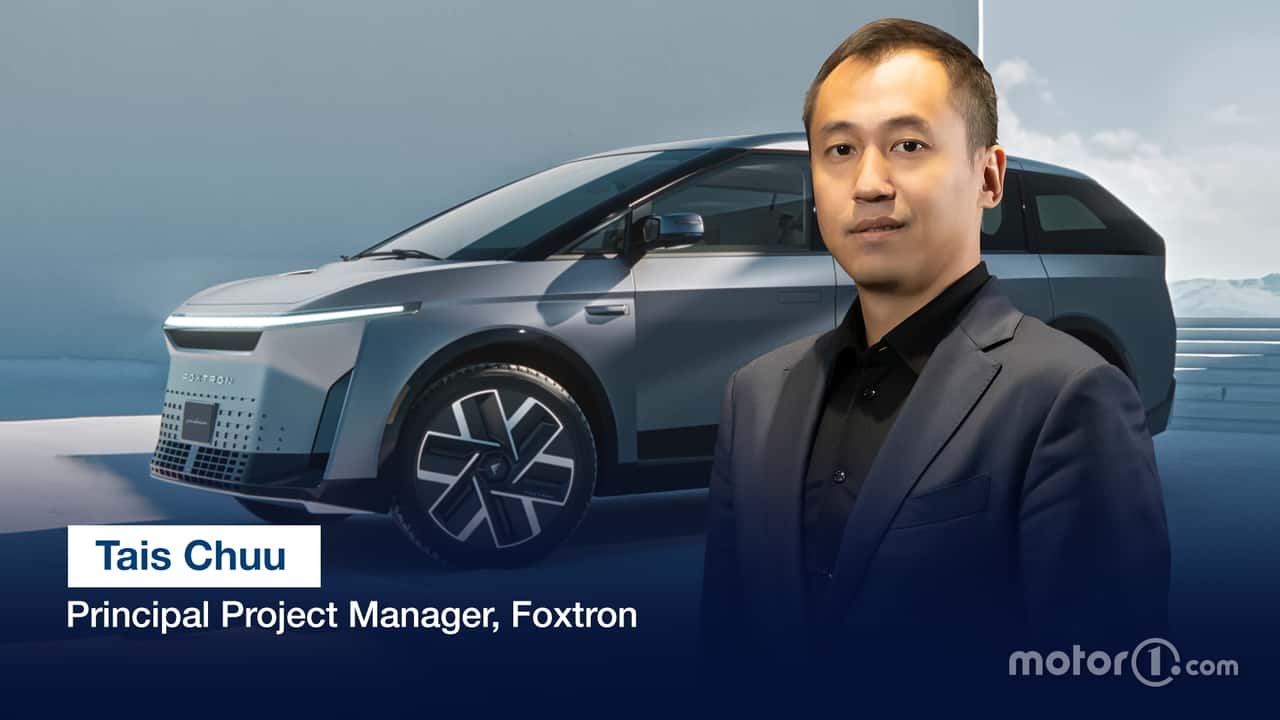

During the presentation of the Foxtron Model D, a platform that can be purchased by other manufacturers wishing to reduce the time and cost of designing new cars, we interviewed Tais Chuu, senior project manager for the brand, which is part of the Foxconn group, a company that manufactures iPhones among other things.
The director explained what has led the group to create these platforms in recent years - because, in addition to the Model D, there are also the smaller Model B and Model C - namely the idea of providing a standard model that serves as a "starting point" for building custom vehicles.
A single objective
According to what the director said at the presentation of the new Model D, the main aim of the project is to offer flexibility, allowing customers to customise the vehicle in a variety of ways that reduce costs.
To go into more detail, the company is providing its customers with comprehensive support for the creation of a new car, starting with its basic design and helping them through the customisation stages: from the design itself and engineering through to final production.
This is an innovative and very precise business idea, which makes it possible to retain certain fixed points of the main structure while modifying many other aspects, with the ultimate aim of keeping design and production costs down and, among other things, keeping the final price of the car competitive.
Will the Model D be sold under the Foxtron name or will it have another name?
Foxtron's business model is to make the platform available to other brands, whether they're a start-up or a fully-fledged car manufacturer.
There's only one slightly 'special' case where we use our name, and that's the 12-metre Model U bus, because in this sector, operators don't care about branding.

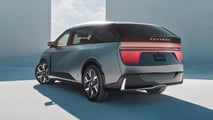
Foxtron Model D, rear
As for fleets, do you want to attract them too?
Even fleet operators like Hertz or other car rental companies don't care about the make of the vehicle. What they can get is a product that they can manage and operate and in which they can install their own operating software, thanks to our integration.
Think about it. Instead of operating a BMW, Hertz could operate a Hertz car and that would be extremely advantageous for them.
What share of your market do you think this sector will represent?
We don't know. Because fleets are complicated, they're either huge or tiny, and we don't set ourselves any limits, but when the business concept presents itself, we discuss how to overcome it.
For the moment, however, our main mission is to contribute to the progress of the electric car industry.
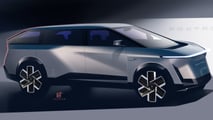
Why did you create an MPV?
Of course, I'm aware that the MPV has had a negative image over the last few decades and that's why we want to reshape it, so that it's not a boring product.
Today, luxury MPVs are very popular, particularly in Asia, where last year we saw many manufacturers launch several of these models, including Volvo with the EM90. So we think this is a very important sector, because it shows that electric vehicles can also be very useful and attractive.
Foxtron Model D, interior
How did the collaboration between Foxtron and Pininfarina come about?
How it started is a bit beyond me, because it involves a very high level of management. But one of the reasons we chose Pininfarina as our partner is because we are a platform supplier.
When I say platforms, I don't just mean vehicle platforms. We say we are a solutions provider: we manufacture, we design and we provide software solutions. So we are a supplier.
If you look at Pininfarina, they also do a very limited production of certain vehicles. They take care of the design and everything else, just as we do.
So they too are 'suppliers', but they operate in a different atmosphere. I always say that if a company manages to survive for nearly 100 years, it has its reasons.
More about Foxtron:
Where are Foxtron cars sold today?
The Model C is currently sold under a brand called Luxorin, which is part of the Luxorin group in Taiwan. However, we are also discussing the US market, where there is a lot of interest from another brand.
What is the part that your customers most want to change?
Very often, what they want to change is purely aesthetic. For example, the interior seat covers, from leather to fabric, and so on. Or the exterior, such as front and rear bumpers, side skirts, etc.
I don't think that, even on the basis of the collaborations we've had so far, they've ever gone beyond that type of modification, mainly because we've done a good job on the design.
So nobody thought that radical changes were necessary?
Partners who need a major overhaul of their design can do so. In fact, we have a number of projects along these lines. On the other hand, if two customers are interested in the same project, one of the two projects has to be radically modified.
At the same time, customers know that to keep costs down, they shouldn't change too many things. So if they can share as much as possible of the development or cost of the vehicle with others, they also benefit: that's the business model we're in today.
Foxtron Model D, Rear seats
In what year did you start supplying cars to others? About three or four years ago, wasn't it?
We started our business in November 2020. From there, it took us about a year to develop the first platform. And in 2022, we started discussing how to build vehicles for others.
So it didn't take long, about two years, and now, with the Model D, we're developing a second-generation platform.
Are you the first to offer this type of service?
In fact, we're not the first to do so. If you look more closely, there are car-sharing projects, for example. If you look at the Supra or the Z4, for example, they were also designed as a platform-sharing project, although the vehicles are very different.
But there are more and more projects of this type. I can cite the Ioniq 5 and the EV6 as examples. In fact, it's a platform that takes a vehicle and, if you can put them together, makes them more efficient. Car manufacturers are already realising this.
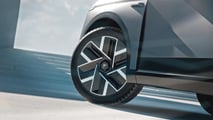
Foxtron Model D, the alloy wheel
Would you like to offer this service to a wider audience?
At the moment, they only do it between the groups to which they belong. But we can also do it between people who don't belong to a group. In this way, we can create even greater efficiency. Today, perhaps only a few component manufacturers, such as ZF for automatic transmissions, offer such a service.
That's why we wanted to do it for whole cars. We wanted to go further. Because if you share a component, you have the advantage that the component is shared. If you share the system, you get the benefit of the system. That's integration.
And if you can then integrate that into a complete package, into a complete vehicle, you get an additional benefit. As James tried to explain in his presentation, the price of electric vehicles is falling. Market share is increasing and so on.
But to do that, (economic) efficiency has to go up. For efficiency to increase, this kind of sharing is, in our view, crucial.
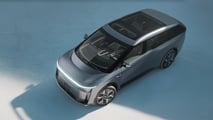
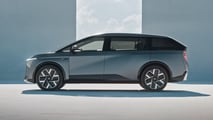
Gallery: Foxtron Model D

RECOMMENDED FOR YOU
Dodge's CEO Says The Best Is Yet To Come: 'We're Going To Go Faster'
You Can Make a Fiat Topolino Street Legal. Here’s How
Mercedes Admits It Went 'Too Far' Removing Buttons. But Screens Aren't Going Anywhere
Lamborghini Revuelto SV Revealed: V12 Hybrid Tuned For Track Domination
'We're Here to Deliver:' How A Forgotten Hypercar Company Plans To Make A Big Comeback
Porsche Turned The GT2 RS Into A Modern Slantnose. It Rules
Why Red Bull's First Hypercar Had To Have A V10: Interview