Home
Mercedes-Benz
News
First factory opens for recycling Mercedes electric car batteries
The inauguration in Kuppenheim, southern Germany, in the presence of Chancellor Scholz
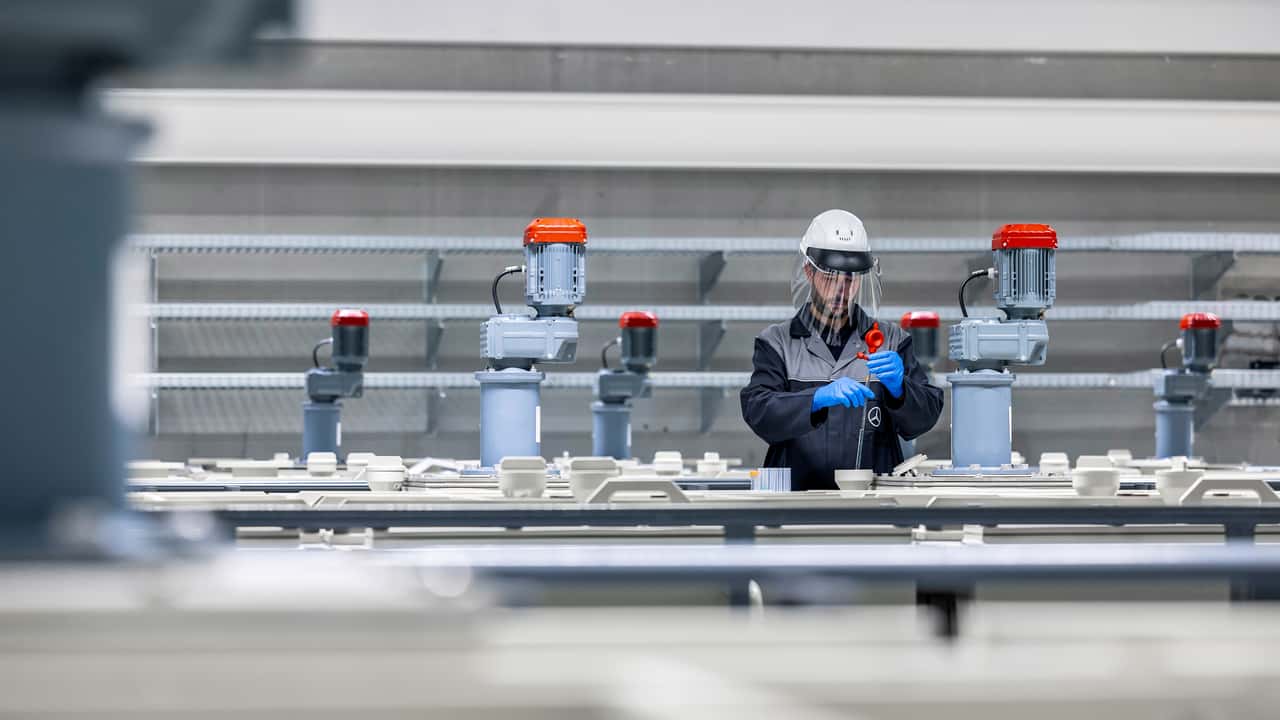
Photo by: Mercedes-Benz

By: Riccardo Ciriaco
Published by: Brian Potter
Oct 22, 2024 at 4:38am ET
Add Motor1.com as a preferred source in Google
- (https://twitter.com/intent/tweet?url=https%3A%2F%2Fwww.motor1.com%2Fnews%2F738262%2Fmercedes-opens-factory-recycling-ev-batteries%2F&text=First%20factory%20opens%20for%20recycling%20Mercedes%20electric%20car%20batteries&via=motor1com)
- copy
Share
Comment
Everyone is talking about battery recycling, because a large part of the development strategy for electric mobility in Europe depends on the reuse of so-called critical materials.
There are several announced or promised projects and even the first plants exist, but so far no car manufacturer has moved directly to set up its own 'factory' capable of recovering, dismantling and recycling battery packs.
Today, Mercedes-Benz took this first step. Yesterday, it opened in Kuppenheim, southern Germany, the first European factory for 'in-house' battery recycling.
How it works
With a 96 per cent recovery rate (where the 4 per cent that is lost is represented by the electrolyte liquid), the plant covers all phases of battery life, from the shredding of modules to the drying and treatment of active materials, thanks to a process defined as 'mechanical-hydrometallurgical', which separates plastic, copper, aluminium and iron mechanically, obtaining the so-called 'black mass'; the latter enters a chemical process functional to the separation and recovery of the most valuable materials.

The process used by Mercedes to recycle batteries
Mercedes-Benz
In detail, the process starts by placing the modules on a conveyor belt. Here, the batteries are mechanically crushed, washed and separated into very fine fractions.
Then using gravity-based air systems, magnetic separators, a grinder and various sieves, materials such as plastic, copper, aluminium and iron are separated and packed according to type.
At the same time, the black mass is separated by a sequence of chemical precipitation with increasing levels of PH, filtered and further processed to obtain copper, cobalt, manganese, nickel and lithium with purity levels of up to 99.9%.
Mercedes-Benz Kuppenheim plant dimensions 6.800 m2 target recycling of electric car batteries type of process mechanical-hydrometallurgical materials recovered cobalt, lithium, nickel recovery rate > 96% capacity 2,500 t (50,000 modules)
"A milestone
The hydrometallurgical recycling process developed by Mercedes-Benz differs from the most common today in Europe of the pyrometallurgical which requires very high temperatures (the materials are actually burnt) and thus a higher energy consumption.
This is the statement of Ola Kallenius, number one at Mercedes-Benz:
"As a pioneer in automotive engineering the first integrated mechanical-hydrometallurgical battery recycling factory in Europe marks a key milestone towards improving the sustainability of raw materials. Together with our partners from industry and science, we are sending a strong signal of innovative strength for sustainable electric mobility and value creation in Germany and Europe.
What do you think?
View
Comments
Unique and green
The new plant also uses 100 per cent green electricity: the 6,800-square-metre roof is equipped with a photovoltaic system with a peak output of more than 350 kilowatts (kW).
Solar panels on the factory roof
Mercedes-Benz
The final recycling capacity, Mercedes promises, is 2,500 tonnes of materials per year, needed to produce more than 50,000 battery modules, for a future that - the German manufacturer assures - will always be electric. A confirmation of political intentions that also speaks to Europe was sealed by the presence of German Chancellor Olaf Scholz and Baden-Württemberg Environment Minister Thekla Walker.
More on the matter of EV charging:
Tesla Cybercab's wireless charging speed leaked?
Volkswagen wallbox-photovoltaic ecosystem for home charging launched
200 new 150 kW+ EV chargers powered up England’s motorways this year
The prismatic battery that recharges in 10 minutes is a reality
Gallery: Europe's first battery recycling factory
28




Source: Mercedes-Benz
We want your opinion!
What would you like to see on Motor1.com?
Take our 3 minute survey.
- The Motor1.com Team
Share this Story
- (https://twitter.com/intent/tweet?url=https%3A%2F%2Fwww.motor1.com%2Fnews%2F738262%2Fmercedes-opens-factory-recycling-ev-batteries%2F&text=First%20factory%20opens%20for%20recycling%20Mercedes%20electric%20car%20batteries&via=motor1com)
- copy
GO TO COMMENTS
(
)
Got a tip for us? Email: tips@motor1.com
View all comments ( )
Popular
Bugatti Restores One-Off Veyron With A Mirror-Like Aluminum Body
BMW Kept This Hatchback A Secret For Decades
Skoda Wants You To 3D Print Pieces Of Your Car At Home
The Gas BMW M3 Isn't Dead: Next-Gen Prototype Roars
latest articles
- The Ford Ranger Is Getting A Bigger V6 For 2027: Report Oct 20 - Rumors -
- BMW Already Has A Deal On The New i3. But It's Not Cheap Oct 20 - Pricing -
- Remember The Ford Flex? This Weird SUV Is Now A Great Used Buy Oct 20 - Why Buy? -
- Mercedes Isn't Sold On Extended-Range EVs: 'Would You Really Switch?' Oct 20 - Interview -
- Cadillac Driver Is Fed Up With Auto Stop. Then She Buys A $9 Item On Amazon To Disable It Oct 20 - Trending -
- Bugatti Restores One-Off Veyron With A Mirror-Like Aluminum Body Oct 20 - Supercars -
- Lexus NX Goes Hybrid Only For 2027 Oct 20 - Official -
RECOMMENDED FOR YOU
Mercedes Says Coupe SUVs Are Here To Stay: 'There's A Fan Base'
Lexus NX Goes Hybrid Only For 2027
Mercedes Admits It Underestimated The V8 Crowd, Teases A V12 Surprise
Who Were The Pep Boys, Anyway?
Mercedes-AMG GT SUV Revealed: Up To 1,153 HP And Three Electric Motors
You Can Buy This Wild 1967 Alfa Romeo Giulia Built Like A Le Mans Racer
LeBron James' Custom Maybach S-Class Heads To Auction