Modern Cars Are Packed With Sensors. What Do They All Do?
Modern cars rely on dozens of sensors to monitor performance, improve safety, and power driver-assistance features. Here's why.


Modern cars are packed with technology, and much of it works behind the scenes. From the engine bay to the bumpers, windshield, wheels, and even the cabin, dozens of sensors constantly monitor what's happening inside and outside the vehicle.
It might seem like overkill, especially when cars managed to get around perfectly well decades ago without cameras watching the road or computers monitoring nearly every mechanical component. But today's vehicles must meet increasingly demanding safety and emissions requirements while offering better fuel economy, performance, and convenience.
Sensors make much of that possible.
Sensors Help Your Car Understand What's Happening
The simplest explanation for the growing number of automotive sensors is that modern cars need information to operate efficiently and safely. Their electronic control units (ECUs) rely on data collected from different components to make decisions, adjust performance, and respond to changing driving conditions. Bosch notes that powertrain sensors provide measurements such as air mass, pressure, temperature, and rotational speed to engine and transmission control systems.
Electronic stability control, for example, has been required on all new cars in the US since the 2011 model year, according to the National Highway Traffic Safety Administration (NHTSA). Technologies such as rearview cameras and tire-pressure monitoring, meanwhile, have also become widespread or mandatory.
Consider the engine. It needs the correct amount of fuel and air, appropriate ignition timing, and adequate cooling to operate properly. Sensors continuously monitor these conditions so the engine control module can make adjustments in real time. The same principle applies to the transmission, braking system, suspension, and other vehicle components.
Rather than relying on one computer to somehow understand everything, manufacturers use specialized sensors to measure different things. Their information allows the vehicle to respond to conditions that would otherwise be difficult or impossible to monitor accurately.
That's why even relatively ordinary vehicles can contain dozens of sensors. They're not necessarily there to make cars more complicated; they're there to help different systems work together.

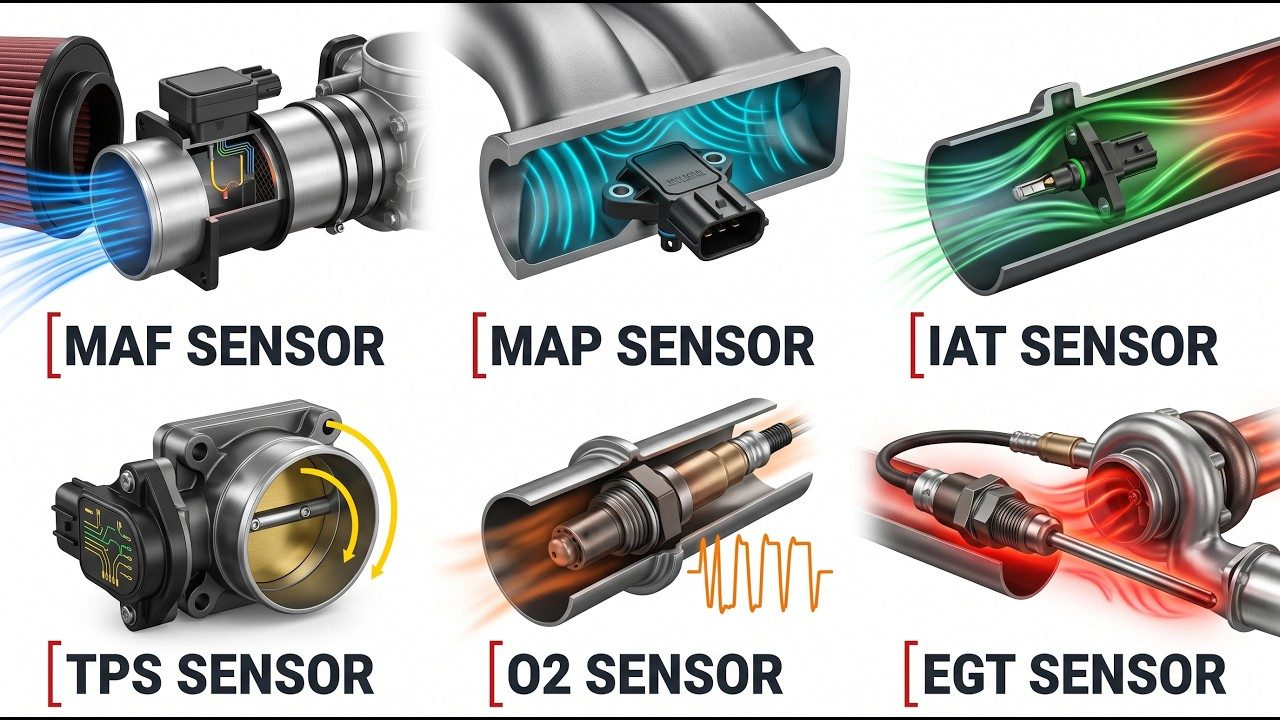
Your Engine Depends On Sensors To Run Properly
The engine is one of the most sensor-dependent parts of a modern vehicle. Its control module uses information from several components to regulate performance, fuel consumption, and emissions.
Oxygen sensors measure the amount of oxygen in exhaust gases, helping the engine control module adjust the air-fuel mixture. Mass airflow sensors measure how much air enters the engine, while coolant temperature sensors monitor operating temperatures. Crankshaft and camshaft position sensors provide information needed to coordinate ignition timing and fuel injection.
Other components, such as knock sensors, detect vibrations associated with abnormal combustion, allowing the engine computer to adjust ignition timing when necessary.
Without these sensors, modern engines would struggle to deliver the combination of performance, fuel economy, reliability, and emissions compliance that manufacturers and regulators expect. They're particularly important in vehicles with turbocharged engines, direct fuel injection, and sophisticated emissions-control equipment.
Safety Systems Need Sensors To Prevent Accidents
Some of the most important sensors in your car are designed to help prevent accidents or reduce their severity. Anti-lock braking systems, electronic stability control, and modern driver-assistance features all depend on information gathered from multiple sensors.
Wheel-speed sensors monitor how quickly individual wheels rotate, allowing the ABS and traction-control systems to identify when a wheel is losing traction or approaching a lockup. Steering-angle sensors measure how far the steering wheel is turned, while yaw-rate sensors detect how quickly the vehicle rotates around its vertical axis.
More advanced systems use cameras, radar, and ultrasonic sensors to monitor the surrounding environment. Cameras can recognize lane markings, traffic signs, pedestrians, and other vehicles. Radar measures the distance and relative speed of objects, while ultrasonic sensors are particularly useful when parking or maneuvering in tight spaces.
These technologies support features such as automatic emergency braking, blind-spot monitoring, adaptive cruise control, and lane-keeping assistance. Some vehicles also use lidar to measure distances and create detailed information about their surroundings.
Airbag systems rely on their own sensors to recognize crash conditions and determine whether airbags and seat-belt pretensioners should be activated.
Not Every Sensor Is About Performance Or Safety
Not all automotive sensors are concerned with keeping the engine running or preventing a collision. Some are designed to make everyday driving more convenient, while others help monitor components that drivers might otherwise overlook.
The tire pressure monitoring system (TPMS), for example, alerts drivers when one or more tires are significantly underinflated. Rain sensors detect water on the windshield and can automatically activate the wipers, while ambient-light sensors switch the headlights on when visibility becomes insufficient.
Other sensors monitor cabin temperature, humidity, and air quality, helping automatic climate-control systems maintain comfortable conditions. Parking sensors detect nearby obstacles, and some vehicles use additional sensors to monitor the position of seats, doors, and other interior components. A few common examples include:
- Oxygen sensors: Help regulate the engine's air-fuel mixture and emissions.
- Temperature sensors: Monitor engine coolant, transmission fluid, and cabin conditions.
- Wheel-speed sensors: Provide information for ABS, traction control, and stability control.
- Radar sensors: Measure the distance and relative speed of vehicles and other objects.
- Parking sensors: Detect nearby obstacles when maneuvering at low speeds.
- Tire pressure sensors: Monitor inflation levels and warn drivers about low tire pressure.
- Rain sensors: Detect moisture on the windshield to control automatic wipers.
Each sensor has a specific purpose, and having several specialized components is generally more effective than expecting one device to measure everything.
Do Modern Cars Have Too Many Sensors? Drivers Weigh In
Reddit discussions reveal that not everyone is convinced modern cars need so much technology. In a popular r/Cartalk thread, drivers complained about increasingly complicated features, including driver-assistance systems and electronic controls. Others argued that certain technologies, particularly blind-spot monitoring, make driving considerably safer.
Reliability is another concern. In r/MechanicAdvice, a Toyota Corolla owner questioned whether a malfunctioning front radar sensor could affect the ABS after several dashboard warning lights appeared. Meanwhile, an r/Automotive discussion highlighted how additional electronics, wiring, and software have made even routine vehicle repairs more complicated.
The debate is not necessarily about getting rid of sensors altogether. Many drivers appreciate the safety and convenience they provide, but question whether every new electronic feature is worth the added complexity and potential repair costs.
What Happens When A Car Sensor Stops Working?
Unfortunately, sensors aren't immune to failure. Heat, vibration, moisture, road debris, corrosion, and ordinary wear can eventually cause problems. Sometimes the sensor itself is perfectly fine, but damaged wiring, a poor electrical connection, or a software issue prevents it from sending accurate information.
The symptoms depend on which sensor is affected. A failing oxygen sensor can contribute to poor fuel economy, increased emissions, and an illuminated check-engine light. A faulty wheel-speed sensor can interfere with ABS or stability-control functions, while problems with an ADAS camera or radar sensor can disable features such as lane-keeping assistance and automatic emergency braking.
Repairs can also be more complicated than they were on older vehicles. Replacing a windshield, for example, can affect the position of a forward-facing ADAS camera. Similarly, bumper repairs can disturb radar sensors, potentially requiring recalibration before the associated safety systems work correctly.
Does having more sensors make cars less reliable? Not necessarily. Modern sensors allow manufacturers to build cleaner engines, more sophisticated safety systems, and vehicles that can monitor their own mechanical condition. However, every additional electronic component introduces another potential point of failure, and diagnosing problems can become more expensive.
More From Motor101
RECOMMENDED FOR YOU

Why Are Some Traffic Lights Horizontal Instead Of Vertical?
BMW's Electric Cars Are Helping Keep Its V8s Alive
How O'Reilly Auto Parts Came Up With Its Famous Jingle
Used EV Prices Were Plummeting. Now They're More Expensive Than Gas Cars
How Was Duct Tape Invented? The Answer Goes Back To 1943
Nissan Built Three Awesome Off-Road Rigs For SEMA
How A Ball Of Twine Became One Of America's Most Famous Roadside Attractions