Home
News
Trending
Man Buys A Hyundai. Then He Gets An Email Thanking Him For Signing Up For Tracking Services. There’s Just 1 Problem
"Some dealerships will automatically do this..."
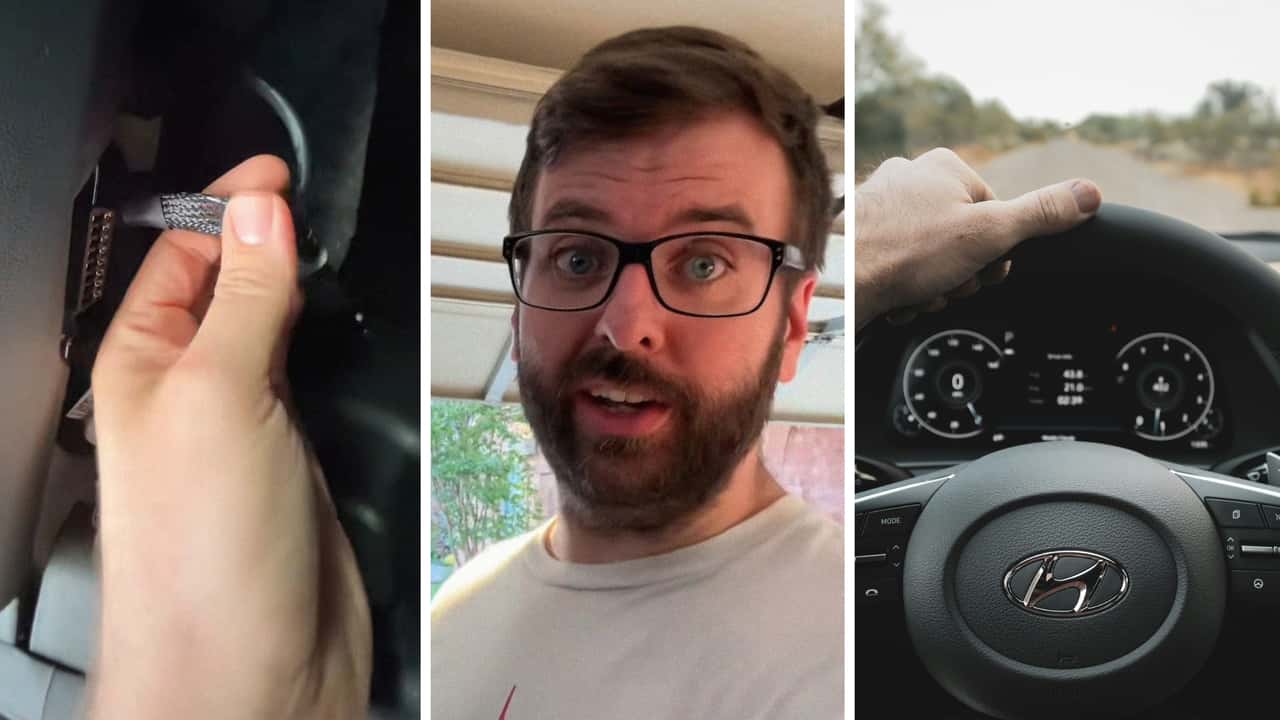
Photo by: @totouchanemu/Tiktok
Chad Swiatecki 
By: Chad Swiatecki
Jul 16, at 6:00am ET
Add Motor1.com as a preferred source in Google
- (https://twitter.com/intent/tweet?url=https%3A%2F%2Fwww.motor1.com%2Fnews%2F801789%2Fhyundai-tracker%2F&text=Man%20Buys%20A%20Hyundai.%20Then%20He%20Gets%20An%20Email%20Thanking%20Him%20For%20Signing%20Up%20For%20Tracking%20Services.%20There%E2%80%99s%20Just%201%20Problem&via=motor1com)
- copy
Share
Comment
Among the flurry of mostly harmless and mildly important emails that follow a vehicle purchase, imagine getting one thanking you for signing up for a tracking service for your new truck. That’s an alarming one, especially if you had no knowledge of a service that tracks your location and vehicle use, which naturally raises a lot of questions.
That's exactly what happened to TikTok creator ToTouchAnEmu (@totouchanemu) whose enjoyment of his recent purchase of a Hyundai Santa Cruz was dampened by learning that there was apparently a tracking module installed and working in the vehicle already. With some informed hunting around under the dashboard panel, he revealed the module, stoking his ire and frustration.
“So I started thinking, how do they know all that information about my car if they don't have some sort of GPS tracker on it? And that's when I realized they probably already did,” he said in the clip that's been viewed more than 570,000 times. “A Google search confirmed… there is probably a tracker on that car right now.”
Hidden Module Tells All
After reading that many aftermarket tracking devices connect through a vehicle's onboard diagnostics system, ToTouchAnEmu climbed into the driver's seat and reached beneath the dashboard expecting to find something plugged directly into the OBD-II port. Instead, the connector was empty.
It looked as though his search had turned up empty, but he noticed an unexpected wiring harness branching off the factory connector and disappearing farther back behind the dash. Tugging carefully on the cable brought a black plastic module into view.
"Oh my God," he says as he turns the device over in his hand. "It's got an IMEI."
An IMEI, or International Mobile Equipment Identity number, is assigned to cellular-enabled devices, indicating that the device communicates over a mobile network rather than functioning as a passive, mildly less intrusive adapter. The discovery confirmed his suspicion that the email indicated the tracking had been physically enabled without his prior knowledge.
"The craziest part is that this was not sitting out for me to see, saying, 'Hey, that's your CarRx module,'" he said. "It was tucked away and hidden. They didn't want me to find this."
The discovery also caused him to take a close look at the privacy policy included in the CarRx enrollment materials. In partial screen grabs, he pointed to sections describing the kinds of information the company may collect from connected vehicles, including identifiers such as a VIN, mileage, oil and battery status, diagnostic information, speed, braking events and other operational data.
Another section discusses sharing information with third-party marketing and advertising organizations. The creator interpreted those disclosures as evidence that activating the service could involve far more than simply locating a parked vehicle on a map.
Whether the module in his Santa Cruz was already transmitting data before enrollment isn't established by the video. But finding a cellular-equipped device hidden in the truck was all it took to convince him to investigate and learn as much as he could about the service.
Viewers See Many Violations
Viewers were somewhat split on why the module had been installed in the first place. Some believed the bigger issue wasn't the hardware itself, but whether it had been properly disclosed during the purchase.
"So my question is where in your sales contract did they charge you for it," one commenter wrote. "Cause the dealer didn't pay for it, you did."
Others suggested the device may have been installed as part of a dealership's financing strategy. One commenter familiar with the industry said some dealers outfit much of their inventory with GPS-enabled devices because lenders view vehicles equipped with tracking or “recovery” technology as lower risk.
"Some dealerships will automatically do this as a way to secure additional financing options from Bank," the commenter wrote. "They will just put them in all their cars."
Not everyone accepted that explanation, with several arguing that buyers should know about connected hardware before they sign paperwork and drive away. Others questioned whether a service that wasn't activated by the owner could truly be considered inactive, with one skeptical commenter writing, "If you're not the customer, you're the product."
The debate also expanded beyond this one Hyundai. Several commenters pointed to the growing number of connected vehicles that continuously transmit diagnostic and telemetry information using factory-installed equipment.
Factory-installed services such as Hyundai Bluelink and GM OnStar can provide conveniences like roadside assistance and stolen-vehicle recovery. But dealer-installed aftermarket devices add another layer to that conversation since they enable inventory management, theft recovery, fleet monitoring, and helping lenders locate vehicles if a borrower defaults on a loan.
What do you think?
View
Comments
Consumer advocates have long argued that buyers should receive clear disclosure about their presence, what information they collect, and whether participation is optional. We presume the video’s creator agrees, whether or not the module discovered in this Santa Cruz was actively transmitting information.
Motor1 reached out to the creator via direct message and email, and to Hyundai and CarRx via email. We’ll update this if they respond.
We want your opinion!
What would you like to see on Motor1.com?
Take our 3 minute survey.
- The Motor1.com Team
Share this Story
- (https://twitter.com/intent/tweet?url=https%3A%2F%2Fwww.motor1.com%2Fnews%2F801789%2Fhyundai-tracker%2F&text=Man%20Buys%20A%20Hyundai.%20Then%20He%20Gets%20An%20Email%20Thanking%20Him%20For%20Signing%20Up%20For%20Tracking%20Services.%20There%E2%80%99s%20Just%201%20Problem&via=motor1com)
- copy
GO TO COMMENTS
(
)
Got a tip for us? Email: tips@motor1.com
View all comments ( )
Popular

Driven: The Revuelto SV Is All Bull, No BS
Toyota's Next Mid-Engined Coupe Is Going Racing This Weekend
Alfa Romeo Has Had It With Huge Screens
Subaru Teases A New Manual WRX, But Only For Japan
latest articles
- Customer Tries To Do ‘Courtesy Lease Return’ For Mazda. There’s Just One Problem: ‘I’ve Not Seen Something Like That Before’ Oct 24 - Trending -
- Man Buys 2026 Ford Truck. Then The Salesman Gives Him A Sneaky Offer Usually Reserved For People With Bad Credit Oct 23 - Trending -
- The Legendary AMG Hammer Might Be Making a Comeback Oct 23 - Aftermarket / Tuning -
- The New Hyundai Tucson Could Be Its Most Popular Yet Oct 23 - Sales -
- How A Tire Company Created The World's Most Famous Blimp Oct 23 - Motor101 -
- Acura Just Trademarked Four New Names, Hinting At 3 New SUVs Oct 23 - Patents & Trademarks -
- Driven: The Revuelto SV Is All Bull, No BS Oct 23 - New Car Reviews -
RECOMMENDED FOR YOU
Woman Buys 4Runner. Then She Drives 2 Miles—And Realizes The Windows Don’t Work: ‘Is This Something…They Should Be Liable To Fix?’
The Legendary AMG Hammer Might Be Making a Comeback
Mechanic Asks To Do Pre-Purchase Inspection On Ford. Then The Salesman Says Something Shocking
The New Hyundai Tucson Could Be Its Most Popular Yet
Man Lets The Dealership Think He Wants To Trade In His Car. Then He Plays Their Service Department To Score A Deal
How A Tire Company Created The World's Most Famous Blimp
‘This Should Be On The Dealership’: Woman Buys VW at Hyundai Dealership. Then Her Mechanic Finds A Shocking Problem No One Caught