Man Installs New Doors For His Volkswagen Golf. Then He Realizes How Badly He Miscalculated: ‘This Is Why AutoZone Employees Ask’
"How could this have happened?"

Anyone who's ever wanted to save a few bucks and tackled a DIY repair knows the sinking feeling. You spend hours installing a replacement part, step back to admire your work, only to realize something is very, very wrong.
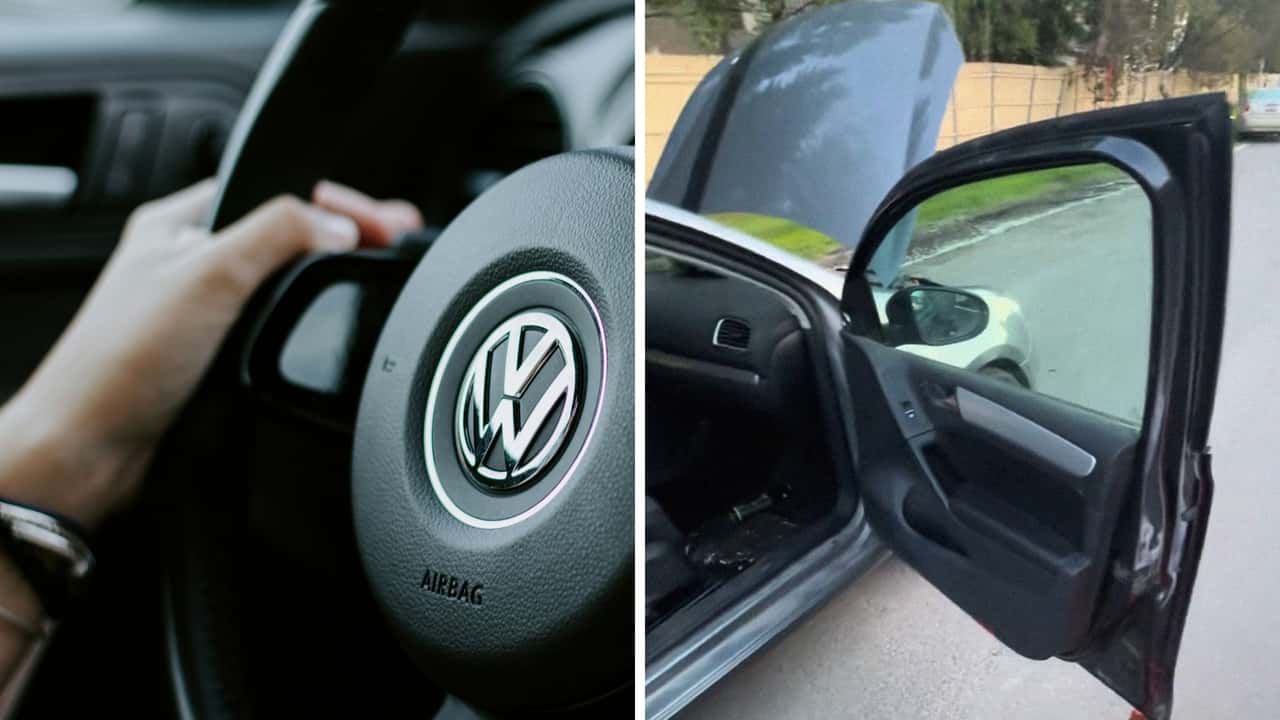
That “how could this have happened?” vibe is all over a viral TikTok clip that captures a very dejected Volkswagen Golf owner who’s got to figure out how to deal with a sizable gap in the door well of his car after trying to replace the door on his own.
Creator Carlos Becerra (@thepurpleskyman) lets out one angry expletive at the end of the video, which has been viewed more than 6 million times, after swinging the newly installed passenger door shut and revealing that it falls several inches short of the opening.
A Door Replacement Fail
The clip opens on the old passenger-side door resting against the rear passenger side of the Golf, suggesting the replacement job is already well underway. Becerra then moves the camera toward the newly installed front passenger door, which is hanging open and, at first glance, looks close enough to correct.
The problem reveals itself when he swings it shut, and it’s obvious that a minor adjustment or a little extra persuasion won’t help things to line up properly. There's no mistaking what's happened; what was supposed to be a straightforward parts swap went off the rails when Becerra failed to use a measuring tape, and whoever sold him the door didn’t think to ask a few important questions.
Now, he’s back at square one, and feeling pretty broken up about it.
At first, the mistake seems almost impossible since it would seem like there’s some uniformity to VW Golf doors. But the availability of multiple body styles, trim levels, and generations of the same model can make it difficult to find the correct replacement panels or other body components without doing proper diligence ahead of time.
To the undiscerning eye, those pieces can look nearly identical sitting on a shelf or in an online listing, with subtle dimensional differences making them completely incompatible once installation begins.
That's why professional parts suppliers and salvage yards typically ask buyers for details like the model year, body style, and sometimes even the vehicle identification number before recommending replacement components.
Door Gaffe Jokes Pile Up
Viewers quickly recognized the mistake, and many connected it to the familiar experience of buying replacement parts. One of the most-liked comments summed it up simply: "This is why AutoZone employees ask," a nod to the seemingly endless list of questions customers field before purchasing everything from body panels to brake pads.
Once the practical observations were out of the way, the comment section took a predictable turn of roasting Becerra with varying degrees of severity. The runaway favorite compared the undersized replacement door to "a grower," with dozens of others jumping in with variations of that joke. Others wondered how the mismatch wasn't discovered before the installation was complete.
While the comments leaned heavily into the comedy, they also underscored the lesson behind Becerra's frustrating afternoon. Replacement body panels often look close enough to work until they're mounted on the vehicle, making careful measurements and confirming compatibility before buying essential steps for anyone hoping to save money with a DIY repair.
Becerra's mishap and resulting door gap highlight why buying used body panels has become easy in theory but sometimes pretty complicated in practice. Online marketplaces and salvage networks offer customers access to inventories from thousands of auto recyclers, with original factory doors, fenders and hoods available at deep discounts.
As a practice, those marketplaces emphasize that buyers should verify compatibility before making a purchase, since seemingly similar parts can vary by model year, body style and other vehicle specifications. The many subtle and easy-to-miss differences in body styles are why professional parts suppliers rely on VIN lookups rather than only a vehicle's make and model.
Auto recyclers also rely on interchange databases to determine which components actually interchange between vehicles, rather than assuming that parts sharing the same name can automatically be swapped out.
In the end, Becerra's viral mishap serves as a reminder that two doors that look almost identical can still be different enough to turn a weekend repair into an internet-famous lesson in checking part compatibility first. In a twist on the old carpenter adage on wood cutting, automotive DIYers should make sure to “measure twice, and buy once.”
Motor1 reached out to Becerra via direct message and comment on the clip. We’ll update this if he responds.
RECOMMENDED FOR YOU

The VW Group Is Gutting Its Lineup. Up To Half Its Models Could Die
Man Makes Offer On $25K Car. Then The Dealership Reveals The Out-The-Door Price: 'This Is Why Delivrd Has A Business'
This Volkswagen Supercar Isn't Real, But It Should Be
Car Salesman Says Customer Catfished Him—And Walked Away With The ‘Best Price Out The Door’
Volkswagen Explains Why The New Atlas Looks Different Than China's Teramont
Woman Tries To Rent A Car From Enterprise. Then She Checks Out Her Options At Costco: ‘I Was Literally Shocked’
The Stick Shift Isn't Dead Yet: Every Manual Car You Can Still Buy In 2026