Sandrider and the Dakar challenge: Impervious laboratory for the Dacia of the future
A romantic project, but also a technology laboratory to test extreme robustness, technology, rationality and sustainability
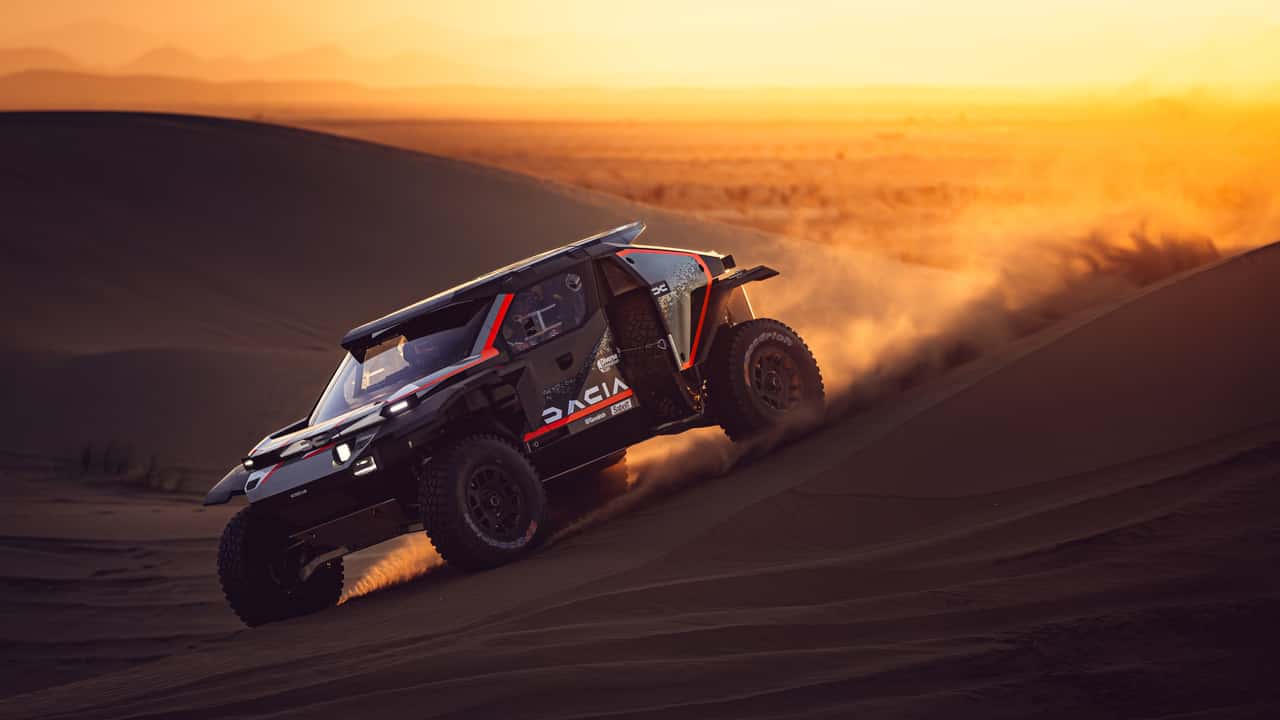

The Sandrider is a knight of the sand, of the desert. This is what it is all about. Navigating practically alone among the dunes, rocks and unexpected events of a sun-drenched desert. The Dakar is the ultimate challenge, the one that puts man and machine in the most difficult situations. It is a challenge that Dacia has decided to take on.
Dacia's new frontier
Finnish rally legend Ari Vatanen once said: "I love the Dakar because it makes you feel how small you are in the world. See those grains of sand? We are like that".
Sebastien Loeb and Nasser Al Attyah, together with Cristina Gutièrrez, are the grains of sand chosen by the Romanian manufacturer to drive the Sandrider and challenge this desert. If you do not realise that the Dakar is driven by a hidden desire for adventure, you will not be able to grasp the essence of such a high-level human and technological challenge. It is frontier, pioneering. It pushes the limits. And that is probably why Dacia decided to embark on such an idea.

Dacia Sandrider (2024): first tests ahead of the Dakar
The Sandrider Manifesto
It is a dream that has probably been on the minds of the men and women in the company for a long time. Because when you look at the Sandrider, you see the lines and ideas of the Manifesto that we were able to see and touch at a product event two years ago. It was a concept, of course, but I still remember the engineers and PR people saying, "It's an idea, yes, but also the symbol of a change of pace". And who could have imagined...
So, the Sandrider is the "manifesto" of this change in mentality. In fact, this buggy, which complies with the FIA Ultimate T1+ regulations of the World Rally Raid Championship, is a product that by its very nature must adhere to concepts such as robustness and lightness, reliability, essentiality, but also concreteness. All this in order to develop solutions as a travelling laboratory. Because, yes, racing is also a showcase and a romantic attraction.
Dacia Sandrider: testing in the desert ahead of the Dakar
The Dacia Manifesto seen live at the Paris event
The Sandrider seen live

A laboratory for future Duster (and more)
The Sandrider is a prototype measuring 4.10 metres long, 2.29 metres wide and 1.81 metres high. It is powered by a Nissan-derived 3.0-litre V6 engine, supercharged with twin turbos and tuned by the Alpine engineers of the Renault group. It produces 360 PS, but more importantly 539 Nm of torque. Naturally, it has four-wheel drive, a 6-speed sequential gearbox... and a whole range of developments that will be put into production in the future.
La Dacia Duster in versione "Soul of Dakar 2024"
The Bigsters, Dusters and all the models of the future will benefit from the use of synthetic fuel specially developed by Aramco, the product of a low-carbon sustainability concept that will keep prices affordable in the long term, as well as from developments in the areas of suspension, arm attachments, weight distribution, chassis rigidity - in this case a tubular one - and, why not, even innovations such as the anti-reflective paintwork requested by the drivers during the first tests.
Dacia Sandrider, testing in the desert
They seem to be marginal details, but when you are in the bivouac, watching the cars on their stands, with the mechanics working on the vehicles, a world opens up, made up of admiration, of course, but also of an awareness of how the design of a single detail can decide 'life or death' in a race.
Trivially, the positioning of the suspension mounts can make the difference between victory and defeat. And this is not just a figure of speech. These are elements with a travel of 35 cm that have to absorb extremely hard shocks and withstand all the pitfalls of the desert. All it takes is a protruding, sharp rock or a too-long jump on a dune to wipe out days and nights.
Dacia Sandrider: first tests ahead of the Dakar
The challenge of the desert
And this is where the concepts of robustness and reliability come to life. The drivers Dacia has chosen, for better or worse, know this very well. Al Attyah, of course, with his five Dakar victories, but also Loeb, who has come close to winning the Dakar several times, often losing out due to minor setbacks.
For Dacia, completing the Dakar would mean taking a further step towards the idea of reducing carbon emissions and, at the same time, towards the rational, focused, concrete and well-anchored development that the manufacturer has set itself.
These are obvious issues, especially when such a marathon is being run. Because, of course, it is one thing to test, even on complicated, rocky, sandy and desert terrain, and quite another to take part in the actual race. The drivers and navigators know this very well.
So, despite the difficulties and setbacks, the goal is always to see the finish line in Shubytah.
To win the Dakar? Well, this is the dream of every constructor, every driver, every man who is enchanted by the desert. And how often does this spark ignite the motoring world?
RECOMMENDED FOR YOU
Hyundai Want Its Electric N Cars To Feel ‘More Realistic’
Woman Gets Her Windshield Changed At Safelite. Then She Tries To Use Her Rearview Mirror
This Startling Statistic Is Why Seatbelt Reminders Have Gotten So Annoying
This Adorable Buggy Is Street-Legal But Costs More Than A Corolla
Mazda Says Big Screens Aren't More Distracting Than Buttons
The New BMW X5 Has A Face Nobody Saw Coming
The IIHS Tells Us Which Driver Aids Actually Work—And Which Don't