Fiat 600 (1955-1969): The Italian Volkswagen turns 70
To this day, the first Seicento remains in the shadow of the legendary 500


Whether in Italy, Spain or Yugoslavia, the little car with the four-cylinder engine in the back made the South mobile. No, we're not talking about the VW Beetle. We're talking about the first Fiat 600, which made its debut 70 years ago. We take a look back at the iconic small car.
In the meantime, Fiat has revived the 600 name, which is now emblazoned on a compact SUV that is visually reminiscent of the electric 500. Seven decades ago it was the other way round: the 3.30 metre long 600 with four rear cylinders was introduced first, followed two years later by the smaller Nuova 500 with two fewer cylinders. Both became popular cars in the south in the 1960s and 1970s.
Gallery: Fiat 600 (1955-1969)

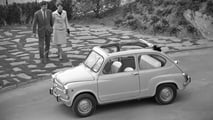

Premiere in Geneva
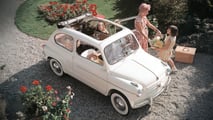
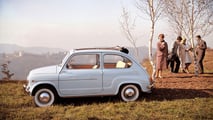
Geneva Motor Show 1955: Fiat heralds the future. The 600 was not only the successor to the Topolino, which had been in production since 1936. With a water-cooled four-cylinder engine at the rear and a self-supporting body, the Fiat 600 was also a completely new technical concept for the Turin-based company. Engineer Dante Giacosa designed a saloon which, thanks to relatively low material consumption and economical production at Fiat's main plant in Turin, allowed a list price of 590,000 lire - making the new four-seater affordable even for the average wage earner.
Fiat 600 (1955)
Modern and robust technology contributed to the success of the Fiat 600. At the front, independent suspension on triangular wishbones was combined with a transverse leaf spring, while at the rear Giacosa used independent suspension with spring struts and trailing arms. A payload of 310 kg is permitted. The rear-hinged doors also allow easy access to the two rear seats.
The rear engine has a displacement of 633 cubic centimetres and produces 23 PS. Thanks to its low weight - less than 600 kilograms unladen - the Fiat 600 could reach almost 62 mph in fourth gear. Unlike some of its competitors (such as the VW Beetle), the four-cylinder engine is water-cooled. This meant that the heater worked even in winter.
First series until 1960
In 1956, Fiat introduced a second body version with a roll-top covering the entire roof. Nearly 900,000 of the first series were built. In 1960, the Fiat 600D was launched with a larger 767 cc engine. Now 29 PS drove the rear axle, increasing the top speed to 68 mph. The exterior featured larger rear lights and the turn signals were placed under the headlights.
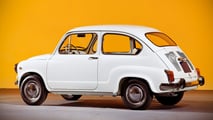
With the model update in 1965 - and after more than two million units of the second series had been produced in Turin - the rear-hinged doors gave way to the front-hinged version. The fuel tank was increased to 31 litres to improve range. Other changes included larger headlights, the removal of the side chrome strips and a new front badge.
Fiat 600 from 1965
The 600 worldwide
Fiat responded to the worldwide demand for a low-cost family car with a large number of registrations. In many countries, derivatives of the 600 played a key role in bringing motoring to the masses. In the former Yugoslavia, the Seicento rolled off the assembly line as the Zastava 750. Nearly 800,000 units left the Barcelona factory between 1957 and 1973, including a unique four-door version with an extended wheelbase.
Steyr built the model in Austria. Between 1970 and 1982, Fiat Argentina produced around 160,000 units of the small car nicknamed Fitito in two variants, with small numbers also produced under licence in Uruguay, Chile and Colombia. NSU-Fiat even built four body versions in Germany under the model names Jagst 600 and Jagst 770. A total of 170,000 units were produced, including the extremely rare "Riviera" Spider designed by Giovanni Michelotti for Vignale.
The Turin-based Carozzeria Vignale offered a whole range of derivatives of the Fiat 600 and Fiat 600 Multipla, from coupés and various beach cars to vans with sliding side doors and flatbed trucks. The "Jolly", based on the Fiat 500 and 600, with no doors but a colourful fabric roof, are a common sight on golf courses and in Italian seaside resorts. Miotti and Moretti also build bespoke bodies based on the Fiat 600, and there is even an off-road vehicle.
Fiat 600 Savio Giungla
By far the most powerful variants were created by tuner Carlo Abarth. Right from the start, the Austrian-born designer concentrated on increasing the engine capacity in order to go beyond the usual limits of touring car racing. From an initial 750 cc, it already produced over 40 PS. Abarth did not limit himself to the factory-built saloon. Together with Boano, he designed the Spider 210A. Carozzeria Zagato produced the aluminium body with the characteristic "double bubble" in the roof of a coupé originally designed for record-breaking drives.
In the Abarth 750 Zagato GT Bialbero, the four-cylinder engine even had two camshafts, producing almost 60 PS. The Abarth 1000 Zagato and Abarth Monomille coupés still used parts of the Fiat 600 chassis. Abarth also used a brightly coloured Fiat 600 Multipla to advertise its sports exhaust systems.
Fiat 1000 TC Abarth - Ignazio Giunti
The Abarth 750 sports saloon and racing touring car (from 1956) became the Abarth 850 Turismo Competizione (from 1960), which for the first time featured the characteristic oil cooler under the front bumper. Abarth even enlarged the engine to almost 1,000 cubic centimetres. Enough to produce over 100 PS in the Abarth 1000 TC (from 1966). The sportiest of all 600 derivatives, it was almost unbeatable in its class in touring car races.
The first MPV in history
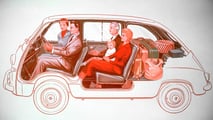
Just one year after the launch of the Fiat 600 saloon, Fiat scored another coup. The Fiat 600 Multipla, also designed by Dante Giacosa, was launched in 1956. The slightly longer floorpan, the front axle with independent suspension and spring struts from the Fiat 1100 and the relocation of the driver and passenger seats over the front axle made it possible to fit a third bench seat at the rear. This means that up to six people can be seated in a car that is only 3.50 metres long. The two rear seats can also be folded down to create an almost flat loading surface.
Fiat 600 Multipla
Fiat 600 Multipla as a taxi
This concept made the four-door Fiat 600 Multipla the world's first MPV and the ancestor of today's minivans. The Fiat 600 Multipla made a name for itself as a shuttle car, with many being used by hotel receptionists or taxi companies. As the Fiat 600T van, it became the faithful assistant of countless tradesmen. Around 77,000 were built between 1956 and 1960.
Seen from the subjective distance of half a century, the Fiat 600 is somewhat overshadowed by the Fiat 500, which was introduced two years later, but the two models were on equal footing at the time. By 1969, almost 2.7 million Fiat 600s had been built at the main plant in Turin alone, at times an astonishing 1,000 per day for the production methods of the time. The total number of Fiat 600s produced worldwide, including all body and engine versions, was almost five million.
End only in the 1990s
After the introduction of the Fiat 850 in 1964, the 600 became increasingly marginalised. Positioned between the Fiat 500 and 850, its sales dwindled. Production in Italy ceased in 1969. But there was a German following that continued to place orders right into the 1970s, most recently for the Seat offered in Germany as the Fiat 770 S, which according to the car's papers was built at Seat in Barcelona.
In Germany, the Fiat 770 was only finally withdrawn from the range after production in Spain was discontinued in 1973. The Zastava 750 continued to be produced in Yugoslavia until 1985, the last model with an enlarged 850cc engine. After production ceased in Yugoslavia, the car was built by Tofaş in Turkey until 1995, when it was finally discontinued.
More classics from Fiat:
RECOMMENDED FOR YOU
A Fiat Topolino Abarth Sounds Ridiculous, But It Could Happen
This New Italian Supercar Turns A Porsche 911 Into An 800-HP Custom Machine
The Fiat Topolino Is America's Cheapest New 'Car' At Just $15,000
Man Hits Traffic Lane Divider In His $50,000 Honda. Then He Sees Smoke: ‘That Actually Totaled It’
Winners And Losers From June Auto Sales
The Volkswagen Atlas Just Got More Expensive
Morgan's Best Performance Car Is Coming To America Without An Important Feature