I visited the most exclusive factory in the world - the Home of Rolls-Royce
They do not produce simple cars but real luxury goods, and in fact the factory is unique. I tell you about it

If I ask you the first inaccessible places that come to mind, Fort Knox, the historic armoured storage facility where the United States keeps much of its gold reserves, or Area 51, the super-secret military base in the Nevada desert where, according to some, recovered UFOs are kept, probably spring to mind.
If, however, we narrow the field to the world of cars, then one of the most difficult places in the world to get into is definitely the Rolls-Royce factory in Goodwood, England. Why? Well, you’re either one of the 2,500 highly specialised people working there or you are a millionaire customer about to order or pick up a Rolls. Either way, it's not exactly easy.
But there can be a third way, and that is being one of the few lucky journalists invited to visit the plant. That's exactly what happened to me, and in this article I tell you everything I was able to see - but not film - and what secrets make the Rolls-Royce factory unique.
Technological pearl surrounded by greenery
The English countryside of West Sussex, not far from the South Downs nature park, is just as you imagine it: narrow roads, typical brickwork to make up the roadside walls, a few cottages overlooking the road. And, after a couple of bends surrounded by green tree fronts, a gate. The double R on one side leaves no doubt.

Aerial view of the Home of Rolls-Royce
The Home of Rolls-Royce was founded here after BMW took over the British marque and has been in operation since 2003, when production of the now more than iconic Phantom VII began. And perhaps there was no better place to build it as the proximity to the Goodwood race track and the neighbouring airfield underline the link with the world of cars and aviation, while the ports of Southampton and Portsmouth facilitate logistical operations and Heathrow and Gatwick airports guarantee the fastest connections.
The main entrance to the Home of Rolls-Royce
Outdoor spaces are designed to inspire designers
The development of the architectural design followed very precise lines. On the one hand, there was the need to blend in with its surroundings, so much so that the Home of Rolls-Royce has even become a refuge for a wide variety of wildlife. Its 17 hectares include 400,000 trees, shrubs and plants and a wildlife garden where native insects, birds and animals are welcome. And then there are the more than 250,000 bees that live in the five hives that make up the Goodwood apiary and in which Rolls-Royce honey is produced.
Natural light filters into the interior of the structure
The main square is used for photo shoots
On the other hand, the structure had to reflect the values and status of the British brand, and so the large front courtyard offers designers the chance to be inspired while photographers can capture the cars, each one a unique example, before they are delivered to customers. As I step out of the Ghost that accompanies me towards the main entrance of the facility, I immediately notice one thing: the silence, total silence, that reigns supreme in this place.
How a Rolls-Royce is made
The first thing I see, having crossed the threshold, is the elegant reception desk in the centre of a large hall. To my right, the latest incarnation of the Phantom is on display. To the left is the so-called Whisper Room, an elegant lounge where guests and customers can linger, perhaps enjoy a cup of tea or delve into the history of the brand or models.
This is where my tour begins. In 2003, 200 people worked here and only one car was produced per day, the aforementioned Phantom VII. Today there are more than 2,500 workers (plus another 7,500 for the allied industries) and four cars produced: the Phantom VIII, the Ghost Series II, the Cullinan Series II and the Spectre, with a total reaching 6,000 by 2023.
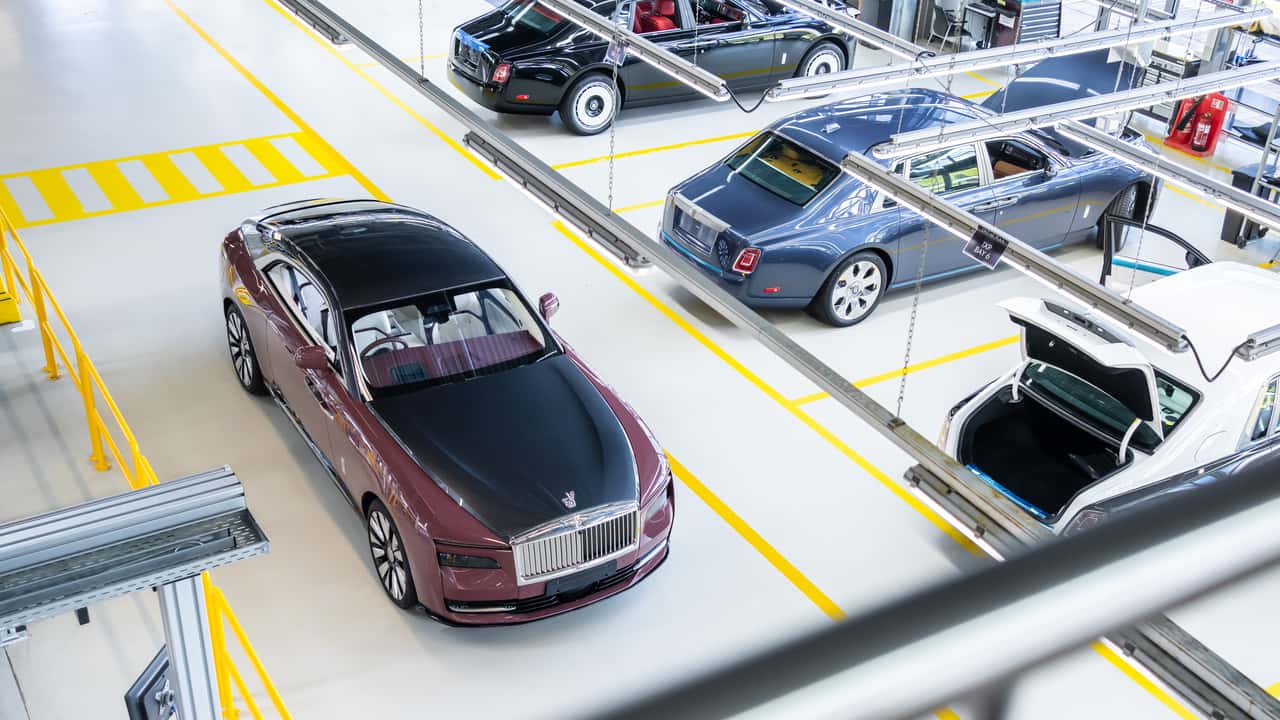
The 4 Rolls-Royce models are produced on the same line
All Rolls-Royce models are produced at Goodwood and share the same production line. Including the Spectre, which means that it is produced right next to its combustion-engined sisters. Something complex, from an industrial point of view.
There are 42 workstations, each with a monitor detailing the characteristics of the car being assembled, from the colours to the accessories and the final destination market. After all, no two Rolls cars are the same and the operators must know precisely how to make them according to the specific configuration. Each worker also knows how to do the work of the assembly line stations before and after his or her own, so that emergencies can be dealt with.
The production line consists of 42 work stations
Some of these operators are not 'simple' workers but true craftsmen. Dare I say artists. Rolls-Royce has devised a growth path for its apprentices that lasts about three or four years and in different areas, so that they know how to work in all phases of production. There are very few robots here. The work is almost entirely done by hand and it is also for this reason that, although it is a car factory in its own right, the silence, even inside, is surprising.
The Spirit of Ecstasy can be chosen in different materials
Rolls-Royce offers the possibility of customised paintwork
Among the things that impressed me the most was a sealed room - and in fact I was not able to go inside to see it directly but only through a glass window - to ensure that not even a speck of dust can get trapped in the Phantom's gallery, which is the decorative band that embellishes the dashboard.
The exclusive realisation of the Rolls-Royce coachline
Again, I saw a warehouse where thousands of wood panels from all over the world are stored at controlled temperature and humidity, waiting to be processed. And where do we put the expert coachline painter, that is the one who by hand paints the line that crosses and decorates the sides?
Veneers are preserved under ideal conditions
The designs on the wooden sheets are laser-carved and then handmade
Let's not forget the leather department, with experts who touch the leather flaps to identify irregularities and then mark them with a felt-tip pen, so that the machinery knows which parts to use and understand automatically for which purposes they are intended.
The skins are analysed one by one
All upholstery is handcrafted
I mean, I have been lucky enough to visit other factories in the course of my career. Here, the term 'factory' is not quite correct as it is better to speak of a real atelier.
Space for the future
How long does it take to finalise a Rolls? Hard to say, considering the complexity of each model's uniqueness. It can take 450 hours of work, with customers waiting from six months to four or even five years depending on the request and the project. And everything is done here at the Goodwood plant, including the Black Badge, Extended and Bespoke variants.
The growing demand for vehicles in the latter programme, the more advanced customisation programme, is one of the reasons why the company decided to expand, as work will begin in 2025 to enlarge the site with the new areas to be operational from 2027. The other reason for expansion? The increasing complexity of models and the desire to focus on electric vehicles. Space must be made for the transition, literally.
Each worker can work on all models in the range
Not cars but luxury goods
This is often reiterated at Rolls-Royce. Vehicles are one thing, Rolls is another. That's why there is also the Coachbuilt programme, intended for the few among the few, that most radical incarnation of the customisation concept that even goes so far as to intervene on the bodywork, leading to the birth of models in their own right.
And because the typical Rolls-Royce customer, who is now younger than ever with an average age of 42, may not have time to follow the conception stages of their car, a team of designers works tirelessly to find inspirations to guide their tastes. Especially, since choosing from over 40,000 body colours to begin with is no easy task.
Rolls-Royce logo detail on a headrest
From 2030 all Rolls-Royces will be electric. And before you turn your nose up at that, you have to bear in mind that a typical customer, apart from being young and therefore tending to be more open to the transition, does less than 3,000 miles a year with their car. Not to mention that, by its very nature, a Rolls-Royce lends itself perfectly to electric drive. Don't believe us? Then you'll have to catch up with my test of the Spectre.
More from Rolls-Royce:
RECOMMENDED FOR YOU
Rolls-Royce Debuts Project Nightingale, An Opulent Drop-Top Limited To 100 Units
Man Buys Ford Mustang. You Won't Believe The Trouble It Costs Him With His HOA: 'Threatened To Call The Police On Me'
Rolls-Royce Scraps EV-Only Plan, Promises To Keep The V12 Alive
Why Every New Car Seems To Have A Giant Screen Now
This Gorgeous Rolls-Royce Restomod Hides A Quiet Secret
Your Car Has a Hidden Mechanical Key. Here's Why It's There
You Don't Need a V-12: Why Rolls-Royce's New Performance Car Is Better As an EV