UK consortium working on 'modern Tuk-Tuk'
The electric vehicle makes use of novel lightweight materials.


A advanced engineering firm in the UK has designed what it says is a modern equivalent for the famous 'Tuk-Tuk', the three-wheeled vehicle widely-used in part of Asia and Africa as a taxi and commercial vehicle.
D2H is leading a consortium funded by Innovate UK's IDP15 scheme which aims to accelerate the transition to zero emission vehicles in the UK and globally.
More on electric vehicles

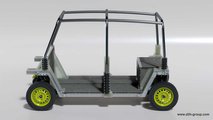
The design meets the L7E Heavy Quadricycle EU classification, and uses suspension, brakes and steering components from a current production chassis, with front-wheel drive from a front-mounted motor and battery packs stored at the back – this machine is a four-wheel vehicle unlike the more traditional Tuk-Tuk.
"Many electric vehicle projects target high-performance, high-value chassis concepts" said D2H engineering director Matthew Hicks. "While these are great engineering projects, we identified a need for a very low cost, zero emissions utility vehicle which can be adapted to different configurations and offers the potential for much greater uptake.
"Having secured Coventive Composites and Warwick Manufacturing Group (WMG) as partners, alongside Innovate UK's funding assistance, we have carried out a detailed design study to create a novel chassis which can be built locally to the market it is intended for, incorporating materials and manufacturing processes which are simple to use, abundant in the market and considerate to environmental issues, whilst providing consumers with the option of an accessible electric-powered utility vehicle."
The concept weighs just 480 kgs, without the batteries, and makes use of a new jute-based natural fibre thermoplastic polymer that has been developed by Coventive Composites.
"This material has many advantages – the jute is readily available in the target markets and is both lightweight and relatively strong," said Hicks. "When compared to metal alternatives, fibre reinforced thermoplastics have reduced manufacturing cycle times and energy requirements and allow high levels of detail to be moulded in, so they typically require less post processing. It was a material we wanted to incorporate into our design."
"This a modern, clean running version of the legendary Tuk-Tuk, which has been so successful in mobilising millions of people in India, South-East Asia and South America.
"If we can create a lighter, safer, zero emissions alternative that competes on cost and utility, then we will have done the job."
Gallery: D2H electric Tuk-Tuk concept
RECOMMENDED FOR YOU
BMW’s Car2Car Project Proves 51% Of Scrap Can Feed New Cars
Man’s Mercedes Notifies Him It’s Time For An Oil Change. You Won’t Believe What Mercedes Charges Him: ‘Bro…’
Ford's Affordable Electric Pickup Has a Name—And A Price
What Really Happens When You Put Your Car In Sport Mode
Mercedes-AMG's Electric GT 53 4-Door Coupe Has ‘Authentic’ Inline-Six Sound
Woman Takes Her Car To The Dealership. Then A Tech Asks Her To Replace Every Lug Nut: ‘That Expensive?’
Toyota's Next-Gen Batteries For Hybrids Arrive In 2027