Five Things You Probably Never Knew About Alfa Romeo
From an iconic logo to aircraft engines, Alfa Romeo's history is a fascinating one.
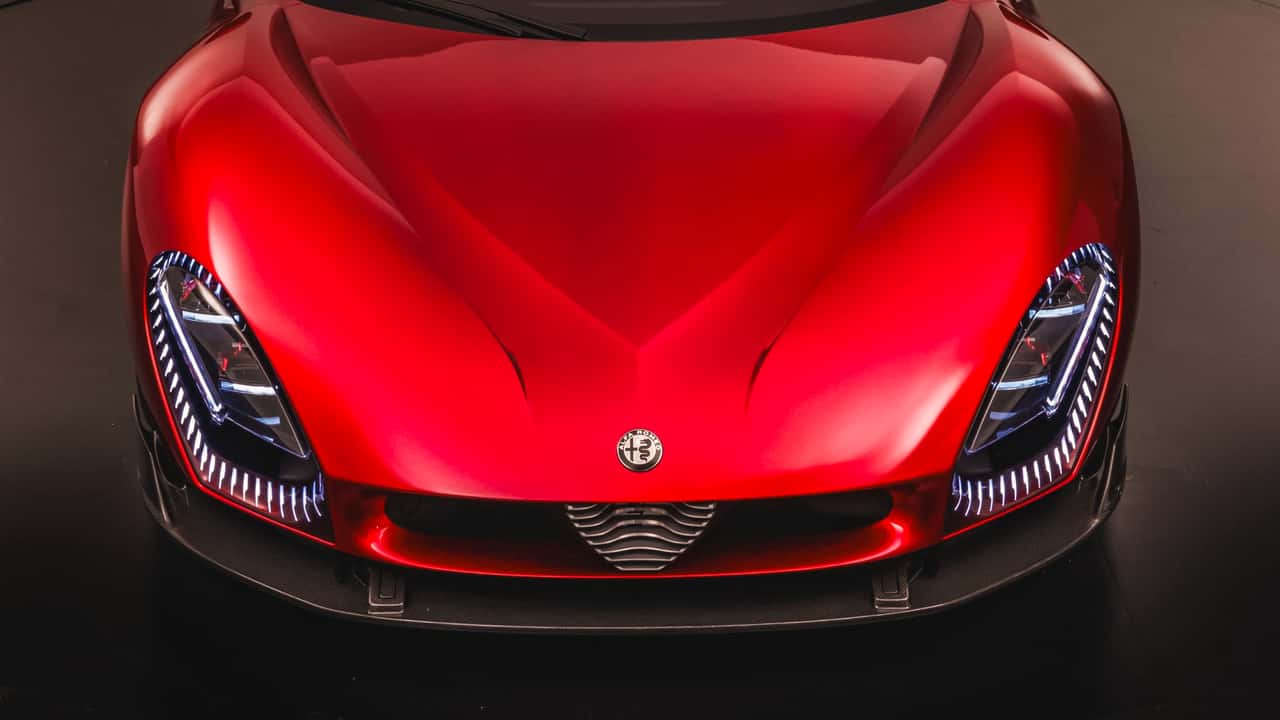

Alfa Romeo is a brand that, beyond its iconic models and rich racing heritage, also has a history filled with little-known details that reveal far more than what appears in price lists or museums.
From the origins of its emblem to its most advanced technical achievements, the Milan-based brand has often pioneered solutions and decisions that left a lasting mark on the auto industry. Some of these stories are known only to the most dedicated enthusiasts, while others have nearly been forgotten over time. Here are five fascinating facts that shed light on a lesser-known side of Alfa Romeo.
This story originally appeared on Motor1 Italy
The Serpent Logo Didn't Always Look Like That

The Alfa Romeo Logo (1919)
The first fact concerns the famous Biscione, Alfa Romeo’s emblem. In its original 1910 version, the logo was much more minimalist than it is today: the serpent and the accompanying graphic elements were depicted more simply, with a major stylistic evolution taking place throughout the 20th century until it became the globally recognizable image we know today.
The colors, graphic details, and outer border also changed several times over the years. Despite those updates, the badge has always retained its core historical elements, inspired by the city of Milan and the Visconti family, preserving an identity that remained instantly recognizable while adapting to different eras.
Alfa Romeo Also Built Aircraft Engines
Alfa Romeo 135
Another little-known chapter involves the production of aircraft engines. Alfa Romeo did not focus solely on automobiles, but also built powerplants for airplanes, especially between the two World Wars. During that period, the brand contributed to the development of aviation engines, including those for military aircraft, demonstrating industrial capabilities that extended well beyond car production.
This activity represented an important part of the company’s business and helped develop advanced engineering expertise that was later carried over into its automotive work.
The Original 33 Stradale Was Nearly Hand-Built
Alfa Romeo 33 Stradale
On the sports-car front, one emblematic example is the Alfa Romeo 33 Stradale, one of the rarest and most captivating cars in the brand’s history. Built in extremely limited numbers, it was assembled with an almost hand-crafted approach, with each example featuring small differences from the next, effectively making it an early tailor-made supercar.
Introduced in 1967, it was derived directly from the brand’s race cars and brought highly advanced technical solutions for the era to the street. Even today, it is regarded as one of the most beautiful Alfa Romeos ever made and one of the most sought-after Italian cars among collectors worldwide.
A Global Brand Ahead Of Its Time
Alfa Romeo 6C 1750
Looking at its international history, Alfa Romeo already played a leading role in the early decades of the 20th century. In the 1920s and 1930s, the brand exported cars to distant markets such as the United States and South America, competing abroad and achieving success overseas at a time when many European automakers were still focused almost exclusively on their domestic markets.
That reputation was built above all by models such as the Alfa Romeo 6C 1750, a Mille Miglia winner, followed by the Alfa Romeo 8C 2300 and Alfa Romeo 8C 2900, considered among the most advanced and fastest cars of their time. Victories in major international competitions helped transform Alfa Romeo into one of the most prestigious names in the global automotive world, long before the arrival of modern multinational auto groups.
A Pioneer In Wind Tunnel Testing
The 1962 Alfa Romeo Giulia TI
Finally, one often-overlooked technical aspect concerns aerodynamics. Alfa Romeo was among the first Italian automakers to use the wind tunnel systematically as early as the 1960s and 1970s. One of the most significant examples is the 1962 Alfa Romeo Giulia TI, a sedan that, despite its apparently boxy shape, was developed with extensive aerodynamic work.
Thanks to those studies, it achieved a drag coefficient of about 0.34, a remarkable figure for a four-door car of that era and one comparable to many cars that reached the market decades later.
Sports models derived from it also benefited from this design philosophy, with solutions developed to improve stability, efficiency, and speed. That focus on aerodynamics made it possible to create cars that were safer at high speeds and better able to make full use of the power available.
It is an approach that may seem normal today, but at the time it was a pioneering choice that helped make several Alfa Romeos true benchmarks for road manners and performance. It is no coincidence that in the 1960s, the House of the Biscione liked to describe the Giulia as a car "designed by the wind," underscoring the central role aerodynamics played in its development.
More From Alfa Romeo
RECOMMENDED FOR YOU
Alfa Romeo Teases New Crossover. No, Still Not The Stelvio
Listen To This New 1,070-hp V12 Come To Life
A New Alfa Romeo SUV Is Coming Soon. Here's Everything We Know
'Honestly Feel Really, Really Bad For Her': Woman's A/C Goes Out. Then Her Mechanic Discovers The Real Reason It's Out
Alfa Romeo Is Making A New Hatchback With Gas Engines
The Grand Tour Returns In September With Three New Hosts
The New Alfa Romeo Giulia And Stelvio Are Coming—Just Not Anytime Soon