Honda Driver Pays $10,000 For Bodywork. Then His Mechanic Finds Something Problematic: ‘Surprised How They Stay In Business’
"Y'all gotta be careful with the scammers out there."
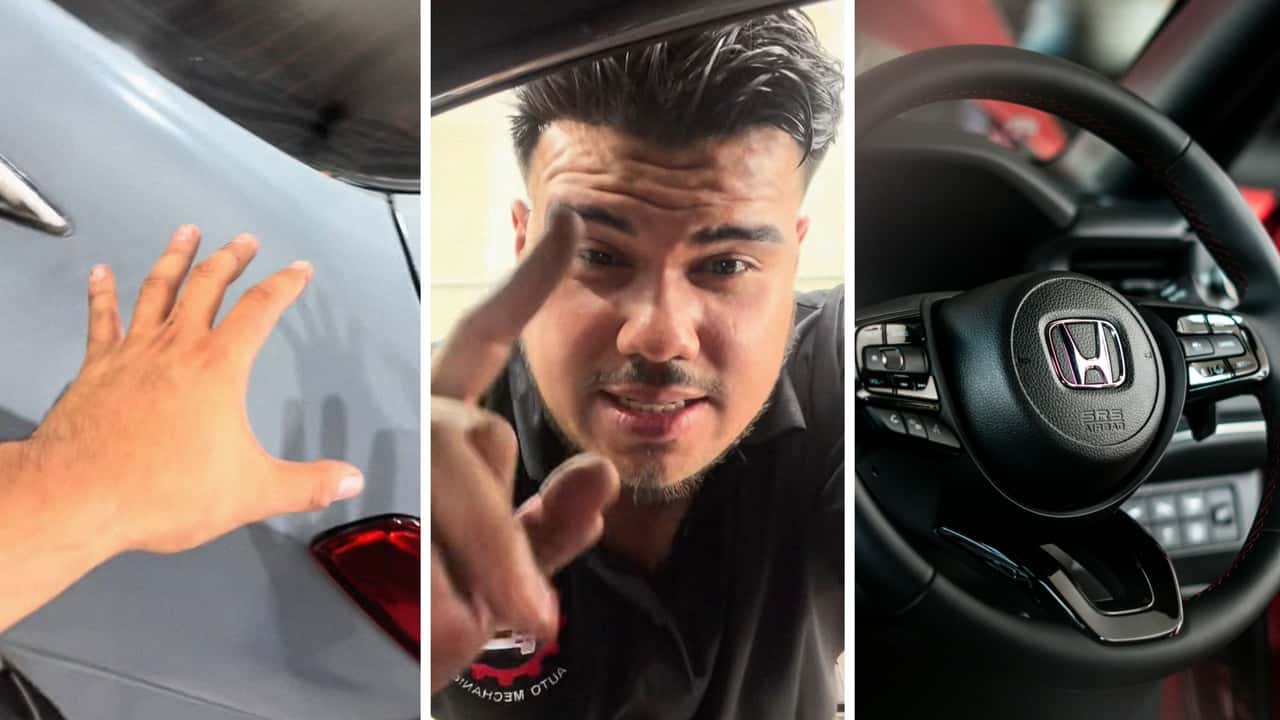

A Houston mechanic inspecting a customer's Honda found overspray across the wheel, a bumper that wasn't attached properly, and a body line that still showed where the car had been hit. All of this was on a job the owner said had cost $10,000.
Jimmy Avila (@boss_shittg), who runs a general repair shop on Hugh Road in Houston, walked through the Honda's issues in a two-minute, 14-second video posted on August 4. It has drawn more than 1,864 views since. "Some people, I'm really surprised how they stay in business," he says at the start.
"Customer paid $10,000 to get this bodywork done, and I can see there's overspray all over the wheel," he says, moving the camera along the panel. "You're definitely able to tell where the car was hit." The bumper got the same treatment: "Bumper's not even attached the right way."
Problems Under The Honda's Hood
The car had not come in for a paint critique. It came in because it would not pull. "It doesn't want to go over 40, 50 miles per hour," Avila says. "Struggles. It's sluggish." He found multiple misfires, and the owner had concluded the transmission was on its way out.
Under the hood, Avila found broken wiring and a cooling fan repair he had no time for, and then the thing that mattered. "The way they fixed the fan, this hose is loose, and this hose pretty much goes to the intake," he says. "So that could explain a lot of our problems."
Why A Loose Intake Hose Takes A Car's Power Away
Air that enters an engine without passing the sensor that measures it is air the computer does not account for, which pushes the fuel mixture lean and can set misfire codes across several cylinders.
A technical guide in Tomorrow's Technician sets out the mechanism: "A vacuum leak into the intake port of the cylinder in question can cause a lack of fuel," and those leaks "commonly occur around intake port gaskets or vacuum hose connections."
Where the leak sits shapes what the scan tool reports, since "depending on where the vacuum leak is on the manifold, it can generate random or specific cylinder misfire codes."
The symptoms line up with what the Honda owner had been driving around with. A steady misfire "is hard to miss," the same guide notes, because "the engine usually feels rough, lacks power and uses more gas than usual."
Reconnecting the hose settled the transmission theory. "As you guys can see, we recovered power on the Honda now," Avila says. "Car goes over 50 miles an hour, 60. I went to 80 already. Car got power now." His summary of the diagnosis was shorter: "He really thought it was the transmission, but y'all saw it was a loose hose."
Gallery: 2025 Honda Civic


The Dashboard Lights That Are Still On
Clearing the hose problem took out the check engine light and left the others burning. "We don't have a check engine light anymore, but we do have the other lights, because remember the car was hit in the front," Avila says. He puts the outstanding work on the driver-assistance hardware: "They have to fix the radar sensors with the dash camera in order for the rest of the lights to go out."
That is the part of this job with a published standard attached to it. American Honda's position statement on post-collision work says that "all vehicles involved in a collision must have the following minimum diagnostic scans, inspections, and/or calibrations done to avoid improper repair," and defines a collision as "damage that exceeds minor outer panel cosmetic distortion."
Two of those minimums bear on a car that left a body shop misfiring. Honda requires a scan during the estimating phase and "a post-repair diagnostic scan to confirm that no DTCs remain," adding that "damage that requires the replacement of body parts always will require a post-repair diagnostic scan."
The document also rules out the test most owners apply, which is looking at the dashboard. "The presence or absence of dashboard indicators/warning lights is not an acceptable method to determine if post collision diagnostic scans are necessary," it says.
Radar and camera-based systems, including collision mitigation braking, lane keeping assist, and adaptive cruise control, need aiming or calibration once parts near them are disturbed, and Honda warns that those systems "often will not display DTCs during a vehicle scan unless there is damage to the applicable system."
The wording got firmer last year. Repairer Driven News reported on July 18, 2025, that Honda had changed the heading over that section from "Diagnostic Recommendations" to "Diagnostic Requirements."
'Good Eye'
The comments section is small, and one viewer gave the original shop's work a three-word review: "Sure they did," wrote PepBlaze. Gricelda Rosales961 credited the diagnosis: "Good eye Jimmy."
Half the thread was people asking Avila to take on their own repairs, which is what he was angling for. "The people out there who don't know, we do actually do body work," he says. "We work with the insurances."
His advice to everyone else was blunter. "[Expletive] just sucks," he says. "Y'all got to be careful with the scammers out there." For anyone collecting a car after collision work, the cheapest check available is asking the shop for the post-repair scan report, which by Honda's own rules should exist before the keys change hands.
Motor1 reached out to Jimmy Avila via TikTok direct message for comment. We'll be sure to update this if he responds.
RECOMMENDED FOR YOU
Your Car Has a Hidden Mechanical Key. Here's Why It's There
Shelby Daytona Cobra Just Broke US Auction Record At $42.9 Million
Monterey Car Week 2026: Every New Supercar, Hypercar, And Concept
JLR Hands US Defender Production To Stellantis, Game Changer?
Honda Will Sell You Its Actual Race Cars, Then Restore Them For You
This McLaren F1 GTR Just Sold For A Record-Breaking $34.6 Million
Why Some Cars Have 'Hidden' Door Handles