Rivian's Volume Knob Replacement Is Clever. Maybe Too Clever
Rather than adding a fixed volume knob to the R2, Rivian opted for something different. It's a good idea in theory.
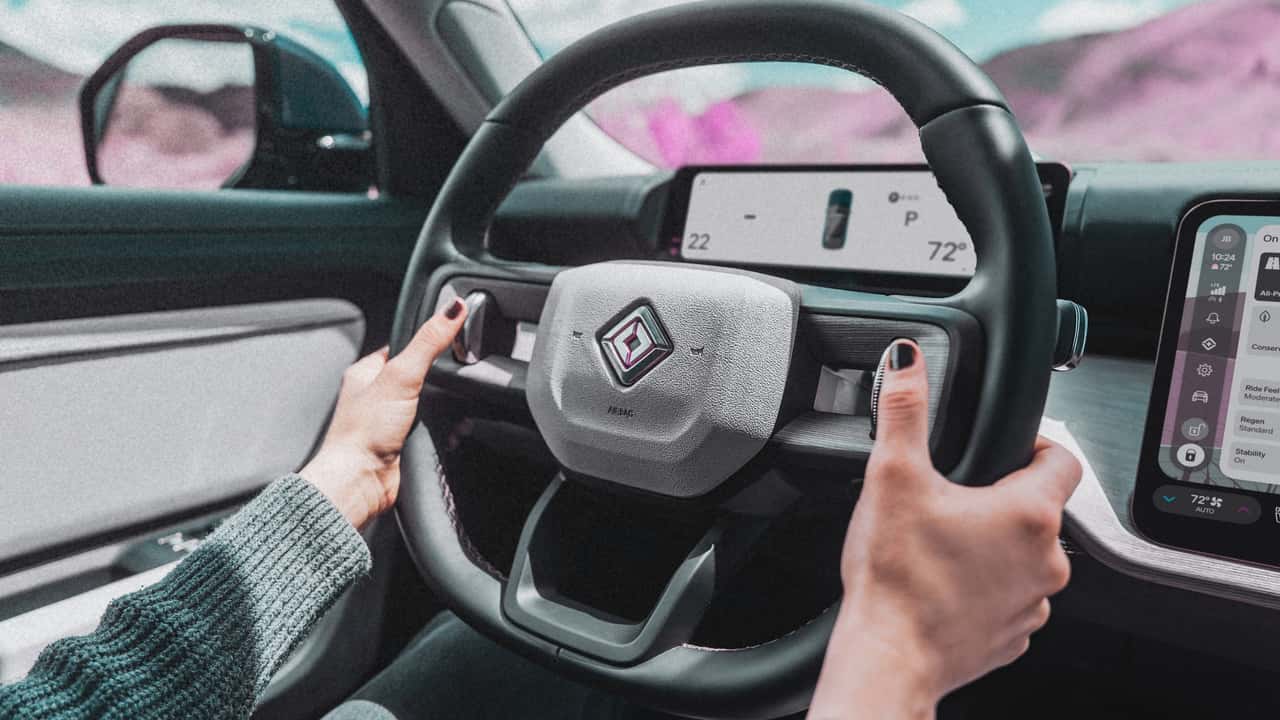

One of the biggest complaints Rivian heard from R1S and R1T owners was the lack of a volume knob (and other fixed controls). That’s not exclusively a Rivian issue, either; customers everywhere have been asking automakers to revert to physical controls after going touchscreen crazy the last few years.
But rather than taking the feedback in stride and simply giving customers exactly what they want in the new R2, Rivian tried to be a bit too cute with it.

The company’s new compact SUV introduces what Rivian calls "Haptic Halo" controls. These are two circular dials on either side of the steering wheel designed to operate up and down, side-to-side, and otherwise, controlling multiple vehicle functions at once.
It’s a good idea in theory. As a company defined by software and focused on streamlining its manufacturing, Rivian says adding one-function hard controls to its vehicles doesn’t make a whole lot of sense. That’s especially true for a vehicle like the R2, which goes hard on consolidation in an effort to keep costs down.
So instead of buttons, we get Halos.
How the Halos work is actually quite clever. The left Halo mostly controls the audio; roll the dial up and down for volume, push it left and right to change the song, or press down to mute. Scroll up high or low enough in the determined range, and there’s real, actual resistance from the halo telling you how far you’ve gone. Nifty.
The right halo manages a few different things, but in my test, it’s mostly just for climate control functions. Scroll up and down to make the temperature hotter or cooler—simple. But you can also scroll left and right to operate different functions of the vehicle, or pull back (toward you) on the Halo to adjust drive modes.
You can see exactly how they work here:
Turning up the volume or turning down the temperature is pretty seamless, and the resistance at the top or bottom of each control is a nice touch, especially when your eyes are focused on the road. But things get a bit clunky from there.
Pressing down on the Halo to mute audio requires more pressure than you think, which means you’re bound to accidentally scroll up or down instead of simply muting the audio as intended. Pulling back on each Halo also takes some force, and other than the drive modes on the right Halo, tugging on the left Halo seemingly did… nothing. Maybe it wasn’t programmed yet.
When pressing right and left to manage audio or cycle between functions, again, you’re bound to accidentally scroll up and down, or even mute, in pursuit of that next great song. And when you’re on a technical path—like the off-road trail we tackled—it’s almost inevitable that your hands will accidentally push or scroll either one of the Halo controls as you shuffle the steering wheel.
Much of the problem likely comes down to the fact that there is no physical "feedback" happening here at all. The Halos instead use a capacitive-touch function with haptic feedback, which, as in other vehicles I’ve tested, is imperfect at best.
Am I being hypercritical here? Absolutely. The Rivian R2 is an otherwise phenomenal piece of engineering that excels both on the road and off it, and the Haptic Halos still work better than other haptic controls in most vehicles. But could Rivian have simply added a volume knob and saved me more than 600 words' worth of digital ink? Absolutely.
Sometimes, simpler is just better—and that should have been the case here.
The Latest From Rivian
RECOMMENDED FOR YOU
Toyota Has Too Many Models. These Ones Need To Go
The New BMW X5 Costs Over $95,000 With Every Option
I Drove The Rivian R2, The Model Y's First Real Threat
I Drove Ford's 300-HP Maverick. It Feels Like A Hot Hatch
Rivian Is Already Planning More Versions Of The R2
Ford Recalls 566,000 Broncos For Engine Compartment Fires
Rivian R2 Launches With Its Priciest Trim: $57,990