She's Sick Of Her GMC Yukon. So She Lets The Bank Repo It: 'Hope I Don't Regret This'
"I just stopped giving a..."
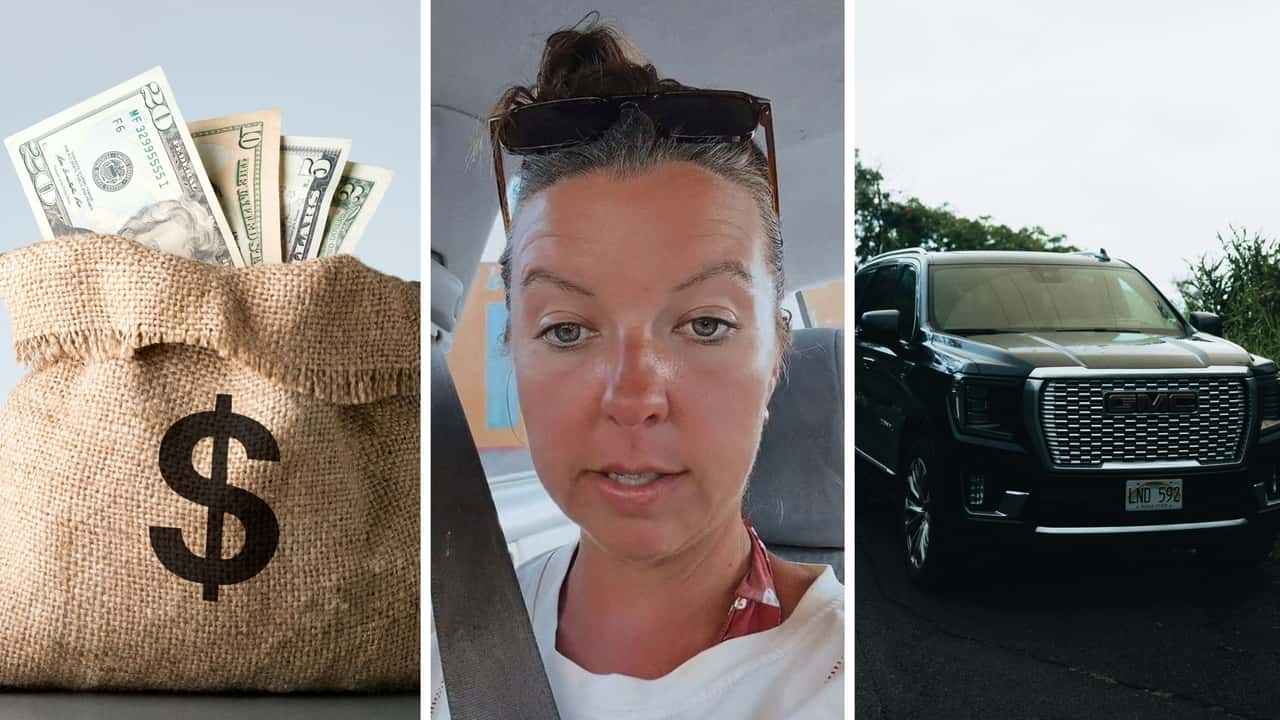

As the average car payments climb ever higher, more consumers are finding themselves dreading that monthly bill. One woman got so fed up with the $1,000 her ride cost her each month that she simply let it get repossessed.
Content creator Lilli Hitt Bryant (@lillihittbryant) was paying about $1,000 a month for the payment and insurance on a GMC Yukon. Her husband was paying roughly the same on a brand new Chevrolet Silverado. They decided the arithmetic had stopped making sense and let both vehicles go back to the lender. She replaced hers with a 2008 Toyota Corolla she bought outright for $2,000.
Bryant, whose channel is mostly given over to her weight-loss journey and the business built around it, explained her decision in a recent TikTok.
"I don't know if I'm going through something mentally, but this past year I just stopped giving a [expletive]," she says.
Her post has been watched more than 27,600 times.
The Math That Changed Her Mind
The Silverado went first. "His truck went back a few months ago, and I knew they were coming for my car," Bryant says. She would rather it had gone differently. "I wish I would have done a voluntary repossession, but I'm just, I'm not paying $12,000 anymore to ride around."
The replacement arose from a job she took on. "I did me a post-construction clean, and I took 2,000 of those dollars, and I went and got me an 08 Toyota Corolla," she says. "I think she's cute. $2,000 is paid for. It looks ridiculous, but I don't care."
She keeps returning to how much the couple was paying annually for their vehicles.
"That's $24,000 a year," she says. "The things we can do with $24,000 a year now."
Her stated goal is less about transportation than about the type of vehicle you drive signals.
"I've had the phase of the flashy cars and trucks and all that, and I'm just, I'm over it," she says. "I want to be rich. I don't want to look rich. I want to have money in the bank. I don't want to be working for a car note anymore."
Gallery: 2026 GMC Yukon Denali Ultimate Review






Four-Figure Payments Are Not Unusual
The size of the payments she walked away from is uncomfortably close to the mean. Figures from Edmunds, reported by trade outlet Auto Remarketing, show 20% of all financed new vehicle purchases in the fourth quarter came with monthly payments of $1,000 or more, up from 19% the previous quarter. Among used-vehicle buyers, a record 6% signed up for four-figure payments.
Edmunds' director of insights, Ivan Drury, framed it as a response to conditions rather than a spending spree. "Faced with persistently high vehicle prices and borrowing costs, many consumers were forced to adapt by financing larger amounts, stretching loan terms and, increasingly, taking on four-figure monthly payments," he reportedly said.
What the video does not account for is the part that comes next, and the comment section caught it immediately. "The loan company will auction those vehicles, and what they don't get, they'll garnish your wages for the difference," wrote Kayleigh.
That is indeed how the repossession process works. The Federal Trade Commission notes that even if you hand the car back voluntarily, "you're still responsible for paying the difference between what you owe on your contract and what your lender gets for selling the car," a sum lenders call the deficiency.
The FTC provides an example: owe $15,000, and if the lender sells the car for $8,000, the deficiency is $7,000 plus repossession and other contract fees. "In most states, your lender can sue you for a deficiency judgment to collect the balance owed," the FTC reports.
Bryant is part of a large cohort. Roughly 1.73 million vehicles were repossessed in 2024, the highest total in more than a decade, on the back of 2.3 million auto loan defaults. The rise has since leveled off, with the New York Fed reporting auto loans entering serious delinquency at 2.97% in the first quarter of 2026, a slight uptick from 2.94% a year earlier.
When a commenter asked whether the lender had pursued them after auctioning their vehicles, she replied that it was "the only thing making me think I may file bankruptcy." To another she was more confident, writing, "The difference is still less than 24k. Either way we're still gonna come out ahead."
Would a Voluntary Surrender Have Made a Difference?
A voluntary surrender may not have helped. The FTC notes that with a voluntary repossession "you might pay less in fees," but that the deficiency still stands and "your creditor still may put the late payments or repossession on your credit report."
Two commenters with relevant experience said the same. "Don't fret over voluntary vs involuntary," wrote one who said they have 25 years’ experience in banking and collections. "There's zero difference between the two." A commenter posting as Drell had been through both: "They showed up the same on my credit report."
The Consumer Financial Protection Bureau says credit reporting companies "can generally report negative information about your credit account payment history for up to seven years."
Most of the thread was on Bryant’s side. Many said they too have opted for cheaper cars with no car payment. Angel Duke reported driving a 2014 Camry at 110,000 miles, paid off since 2020. Jennifer Smith Harper listed four paid-for vehicles across her household.
"I drive a 2005 GMC Yukon," wrote Cathy Hall. "That girl is paid for. I don't care what other people think of me, I'm happy and I can buy groceries."
Motor1 reached out to Bryant by email for comment. We'll be sure to update this if she responds.
RECOMMENDED FOR YOU
Mechanic Breaks Handle On Chevrolet Silverado. Then The Shop Tells Him He Has To Replace Entire Door Panel: 'What Do You Mean?'
What Is The Most Reliable Car Brand? Here's What The Data Says
The Next Chevy Camaro Could Be A Four-Door Performance Sedan: Report
Man Goes To Car Wash. Then He Uses A Little-Known Trick To Deep Clean The Inside
Man Gets His Chevrolet Serviced. Then He Catches A Mechanic Spray-Painting This Part Black
Man's Uber Gets Pulled Over. Then The Driver Asks Him To Lie To The Cops: 'Mind You It Was $75'
Man Never Removes Apple CarPlay Screen's Plastic Film Cover. Then It Costs Him Thousands Of Dollars