Home
Toyota
Tundra
News
Mechanic Says Your Toyota May Be Getting The Wrong Oil. Then He Changes Mobil 1 Formula: ‘As A Warranty Inspector This Would Void’
“I’m sure you know more than the engineers at Toyota."
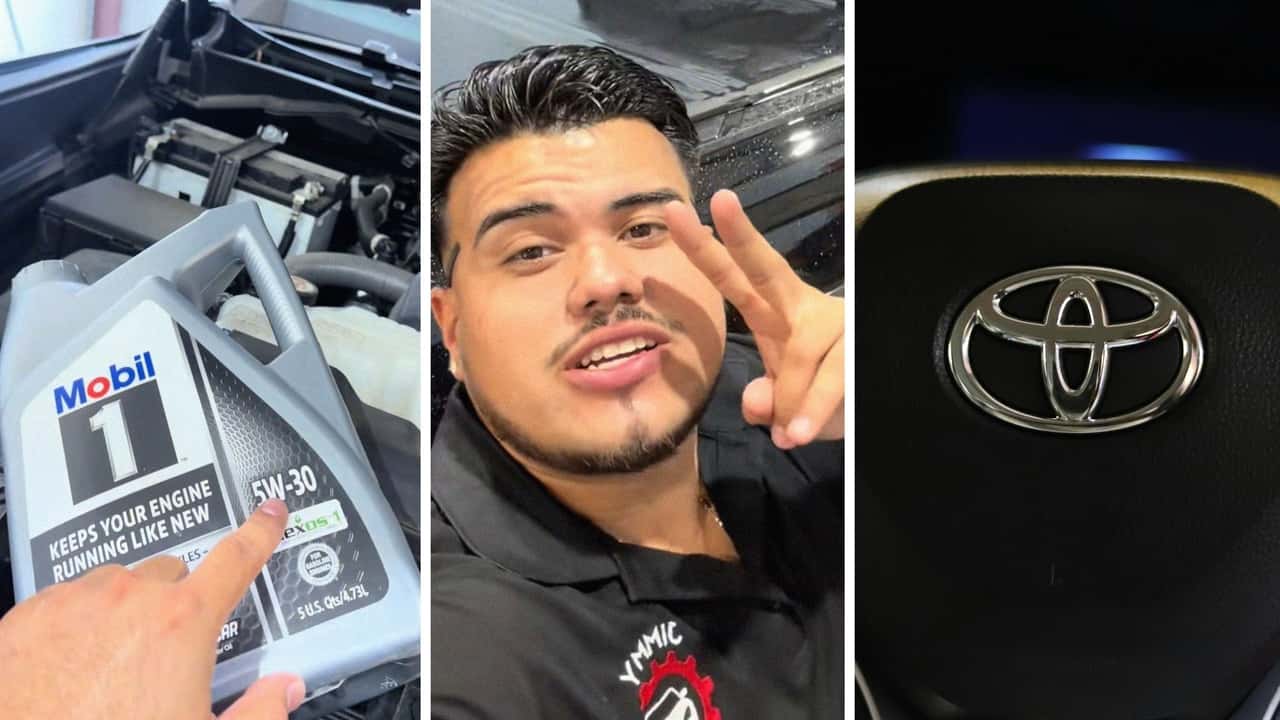
Photo by: @boss_shittg/Tiktok
Chad Swiatecki 
By: Chad Swiatecki
Jul 22, at 4:00pm ET
Add Motor1.com as a preferred source in Google
- (https://twitter.com/intent/tweet?url=https%3A%2F%2Fwww.motor1.com%2Fnews%2F802421%2Ftoyota-oil%2F&text=Mechanic%20Says%20Your%20Toyota%20May%20Be%20Getting%20The%20Wrong%20Oil.%20Then%20He%20Changes%20Mobil%201%20Formula%3A%20%E2%80%98As%20A%20Warranty%20Inspector%20This%20Would%20Void%E2%80%99&via=motor1com)
- copy
Share
Comment
A Houston mechanic is convinced he knows better than the manufacturer which oil is ideal for Toyota Tundras. He believes you should use a thicker oil than Toyota calls for.
Observers, however, say he’s wrong and could be costing his customers more money in the long run.
The TikTok clip from creator Jimmy Avila (@boss_shittg) finds him preparing for oil changes on two fairly new, low-mileage trucks, both of which have oil caps that prescribe 0W-20 grade oil. Calling that mix far too thin to provide meaningful protection for engine components, Avila said in both cases he switched to 5W-30 grade.
“Instead of putting 0W-20, we end up putting 5W-30, thicker oil. 0W-20 is just water in the engine pretty much,” he said in the clip that’s been viewed more than 20,000 times. “Gonna be running fine, way better, because it's thicker oil, lubricates the engine way better, it doesn't lock up.”
How Is Oil Involved?
The response from viewers was quick and pointed. “I’m sure you know more than the engineers at Toyota,” one commenter wrote, prompting Avila to answer with apparent sarcasm, “Yeah because engineers been doing a great job right.”
When the commenter invoked Toyota’s decades-long reputation for building durable vehicles, Avila brought up the Tundra’s recent troubles. He noted that the latest generation has been subject to a major engine recall, arguing that this gives owners reason to question the company’s judgment.
Other people were less persuaded, saying a manufacturing flaw does not necessarily make the factory oil recommendation suspect.
The engine problem Avila references is real, though Toyota’s explanation does not match his diagnosis. The automaker recalled more than 100,000 newer Tundras after determining that debris left behind during engine production could contaminate internal components. In affected trucks, that material could damage crankshaft bearings and lead to knocking, rough operation, stalling or a complete loss of power.
Toyota has not identified 0W-20 oil as the cause of those failures. Instead, its recall documents point to contamination introduced during manufacturing and the resulting bearing damage. That distinction leaves Avila on firmer ground when questioning the engine’s reliability record than when declaring that its specified lubricant is responsible for “killing” it.
One commenter made that case, essentially arguing that Toyota engines have logged hundreds of thousands of miles using 0W-20 and that the more likely culprit is faulty design or inadequate quality control. Another claimed American owners are being directed to use thinner formulas than drivers in other markets, though oil recommendations can vary by engine, climate, emissions rules and regional owner’s manuals.
This all means the disagreement extends beyond whether one bottle is thicker than another and lands on whether the Tundra recall provides enough evidence for a mechanic to disregard the company's guidelines. Avila treats the engine failures as proof that the factory guidance cannot be trusted, while naysayers see him connecting two unrelated issues of oil viscosity and manufacturing debris.
Could Using Different Oil Void The Warranty?
Avila’s decision to go off script from the manufacturer could carry some heavy and expensive stakes if a truck develops an engine problem while still under warranty. One commenter who identified themselves as a warranty inspector warned that using the thicker oil “would void” the coverage.
That’s an attention-getting claim, but the actual decision-making process for those situations is more nuanced and detailed. Toyota’s 2025 Tundra warranty guide says damage caused by improper maintenance is excluded, and specifically includes the use of fluids other than those listed in the owner’s manual.
That does not mean a single oil change automatically erases every warranty protection. Federal Trade Commission guidance says an automaker generally cannot deny coverage merely because an owner used an independent shop or a non-factory product. It can, however, refuse to pay for damage if it can show that the product or service caused the failure.
For Avila’s customers, that creates a potentially expensive gray area. If a window motor, infotainment screen or unrelated component failed, the oil choice would have little bearing on a warranty claim.
An internal engine failure, however, would invite closer scrutiny. This is where the oil selection would become a real problem. That’s particularly true if service records showed that the truck had repeatedly received a viscosity different from Toyota’s specifications.
What do you think?
View
Comments
Avila may believe the added thickness offers protection Toyota’s engineers overlooked. But his assurance that the switch won't cause any problems leaves out the possibility that an owner could later be forced to argue that the substitute oil played no role in a costly repair.
Motor1 reached out to Avila via direct message and comment on the clip, and to Toyota via email. We’ll update this if they respond.
We want your opinion!
What would you like to see on Motor1.com?
Take our 3 minute survey.
- The Motor1.com Team
Share this Story
- (https://twitter.com/intent/tweet?url=https%3A%2F%2Fwww.motor1.com%2Fnews%2F802421%2Ftoyota-oil%2F&text=Mechanic%20Says%20Your%20Toyota%20May%20Be%20Getting%20The%20Wrong%20Oil.%20Then%20He%20Changes%20Mobil%201%20Formula%3A%20%E2%80%98As%20A%20Warranty%20Inspector%20This%20Would%20Void%E2%80%99&via=motor1com)
- copy
GO TO COMMENTS
(
)
Got a tip for us? Email: tips@motor1.com
View all comments ( )
Popular

Honda Wants To Take On The Tahoe With An Even Bigger SUV. Here's What We Know
BMW's First Electric 3 Series Wagon Spied Looking Nearly Ready For Production
The 2027 Honda Passport TrailSport Proves An Extra Inch Goes A Long Way: Driven
Forget The Sedan: This Alfa Romeo Giulia Quadrifoglio Is A Two-Seat Convertible
latest articles
- The Rotary Engine Should Be Everywhere. Why Isn't It? Oct 21 - Motor101 -
- Acura Wants More Models Than Ever Before Oct 21 - Rumors -
- GM Is Turning OnStar Into An AI Assistant For Your Car Oct 21 - Technology -
- This Custom Gunther Werks Porsche Is An 860-HP Tribute To A Racing Legend Oct 21 - Aftermarket / Tuning -
- Ford Recalls 102,000 F-Series Trucks Over A Strange Gauge Issue Oct 21 - Recalls -
- Honda Wants To Take On The Tahoe With An Even Bigger SUV. Here's What We Know Oct 21 - Everything We Know -
- The Michelin Man Has A Strange History. And His Original Design Was Terrifying Oct 21 - Motor101 -
RECOMMENDED FOR YOU
Toyota Tech Works On Car With Extended Warranty. Then The Warranty Company Says It’ll Only Cover A Quarter Of The Cost
GM Is Turning OnStar Into An AI Assistant For Your Car
Mechanic Works On Toyota. Then He Realizes The Owner Almost Got Ripped Off: 'Bad TXV Valve'
This Custom Gunther Werks Porsche Is An 860-HP Tribute To A Racing Legend
Toyota Mechanic Inspects Customer's Car. Then He Checks The Warranty—And Decides To Quit His Job Instead
Ford Recalls 102,000 F-Series Trucks Over A Strange Gauge Issue
Toyota Wants To Convince The EU That Some Hybrids Are Zero Emissions