Home
BMW
7 Series
News
BMW 7 Series (E38, 1994-2001): The most beautiful of all 7 Series?
You still can't tell that the luxury saloon is 30 years old.
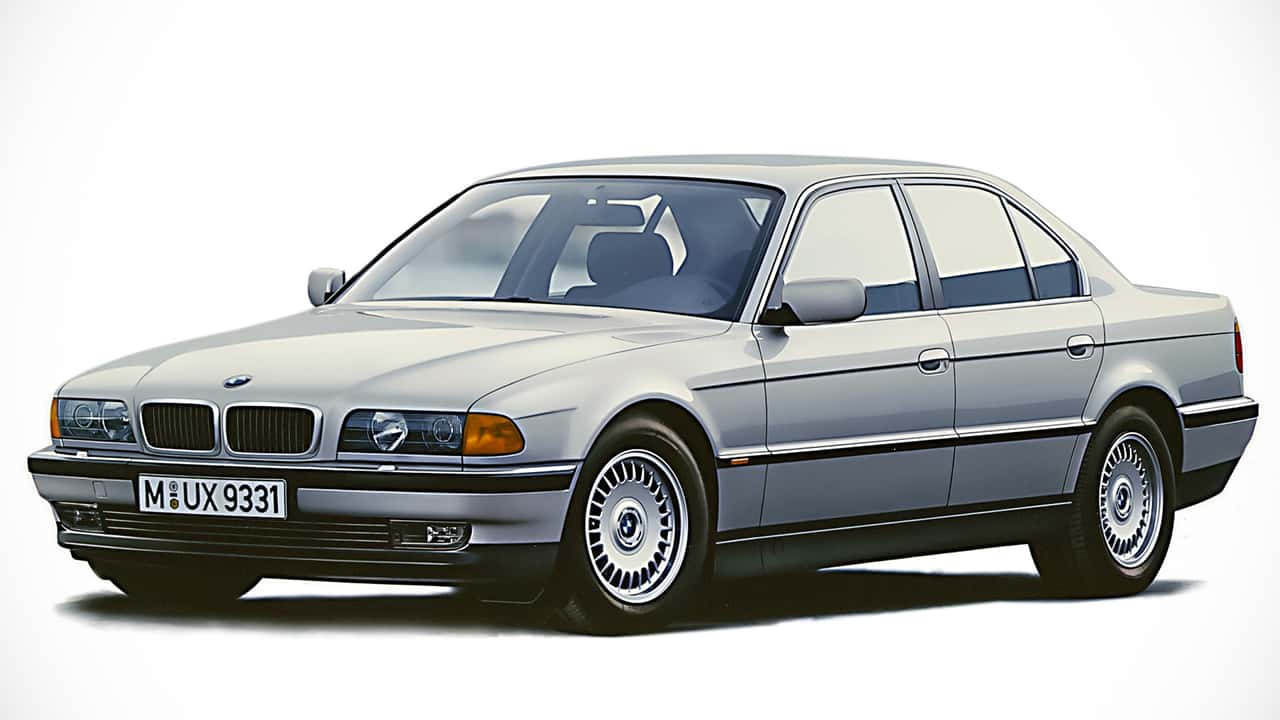
Photo by: BMW

By: Roland Hildebrandt
Published by: Angel Sergeev
Nov 27, 2024 at 4:44am ET
Add Motor1.com as a preferred source in Google
- (https://twitter.com/intent/tweet?url=https%3A%2F%2Fwww.motor1.com%2Fnews%2F742403%2Fbmw-7-series-e38-history%2F&text=BMW%207%20Series%20%28E38%2C%201994-2001%29%3A%20The%20most%20beautiful%20of%20all%207%20Series%3F&via=motor1com)
- copy
Share
Comment
With the second generation of the 7 Series, internally known as the E32, BMW succeeded for the first time in standing up to the previously all-powerful Mercedes-Benz S-Class. But what was the successor supposed to look like? "Once again a superior format" announced the brand 30 years ago. They were referring to the new E38 model series, which some fans still consider the most beautiful 7 Series to this day.
Indirectly, BMW had landed a lucky strike. The Lexus LS 400 had set new standards from 1989 onwards, particularly in the USA, while Mercedes faced a powerful headwind when it presented the new S-Class W140 in 1991, as many found it too bulky. The third generation of the BMW 7 Series did not represent a complete innovation in terms of design. The characteristic lines were adapted to modern tastes and the car was made to appear even more graceful and dynamic despite its larger exterior dimensions.
Gallery: BMW 7er (E38, 1994-2001)

5


Source: BMW
The design process had begun long before the W140. Development of the E38 started at the beginning of 1988. From 1988 to 1990, the styling was initially developed under the direction of Head of Design Claus Luthe (until April 1990), after which the concept design was selected by Boyke Boyer and further developed to production readiness. In February 1991, the final production design for the new 7 Series was approved by the Board of Management, 36 months before the start of production of the series models planned for 17 February 1994.
Weird 7 Series:
BMW 750iL V16 (1990): Second 16-cylinder comes to light
Tour rare BMW 7 Series models, including one with a V16 engine
Market launch 30 years ago
Production began on 23 July 1993 with the pre-series models and on 13 January 1994 with the US variants. On 18 February 1994, BMW informed the press for the first time about the new 7 Series, which was presented at the Geneva Motor Show. The market launch in Germany began in June 1994 with the 730i and the 740i, in the USA in November 1994. Production of the 750i began in November 1994, even before its market launch in January 1995. By this time, another competitor had entered the luxury class with the first Audi A8.
The range included the 728i and 728iL with six-cylinder engines, 730i, 730iL, 735i, 735iL, 740i, 740iL with V8 and, of course, the top models 750i and 750iL with V12. The 740i was the most popular, with a good 130,000 vehicles built. It initially cost 120,000 DM as the 740 iL, the short 750i was priced at 148,000 DM and the entry-level 728i at 83,000 DM. The press noted "driving pleasure", although the 750i was already scratching the two-tonne mark.
BMW 7 Series (E38, 1994-2001)
Photo: BMW
The E38 was the first vehicle to be equipped with curtain airbags. It was also the first European vehicle with satellite navigation and the first BMW to offer a built-in television. The E38 was the first 7 Series to be available with a diesel engine and the last to be offered with a manual gearbox. The GPS sat nav was not cheap, however, with BMW charging a whopping 6,600 DM for it 30 years ago.
The 730i and 740i models were initially offered for the market launch in Europe. They had the V8 M60 with a displacement of 3.0 and 4.0 litres respectively under the bonnet. While the 730i was delivered with a five-speed manual gearbox as standard, the 740i was fitted with a newly developed six-speed manual gearbox. The BMW 750i followed in the autumn 1994, with the V12 M73 with a displacement of 5.4 litres and an output of 326 bhp. It was coupled to a five-speed automatic gearbox. In autumn 1995, the 728i with the six-cylinder M52 inline engine with 193 bhp was introduced as the new basic engine.
New engines from 1996, facelift from 1998
In March 1996, the M60 engines were replaced by the new M62 engine series. The displacement of the 3.0 and 4.0 litre engines was increased to 3.5 litres (735i) and 4.4 litres (still referred to as 740i) respectively. Maximum torque increased from 290 Nm to 320 Nm and from 400 Nm to 420 Nm respectively. The 735i now produced 235 bhp instead of 218 bhp. The rated output of the 740i remained unchanged at 286 bhp. From April 1996, the 725tds was available with a six-cylinder diesel engine with swirl chamber injection and 143 bhp.
A 750i became particularly well known when it was used in the James Bond film "Tomorrow Never Dies". In the film, the vehicle could be controlled by remote control; the vehicle used in the film was extensively modified for this purpose. TV inspector Derrick also had himself chauffeured in an E38 in the final episodes of the series (although this was inappropriate for his rank).
The E38 facelift models (also known as Life-Cycle-Impulse, LCI for short) were introduced in the 1999 model year (produced from September 1998). The most important changes were a revised headlight and tail light design and the introduction of the 740d model with the 3.9-litre M67 V8 twin-turbo diesel engine.
The 735i and 740i were upgraded to the "Technical Update" (TU) version of the M62 with variable valve timing on the intake camshaft (Single-VANOS). The 728i was given the M52 TU with variable valve control on both camshafts (double VANOS). Another new feature was the sports package (option code ZSP), which included the M sports suspension, the Style 37 "M Parallel" alloy wheels, the Contour seats and the Shadowline exterior trim. The DSCIII electronic stability control system was now fitted as standard in all 7 Series models, as were head airbags.
A total of 340,242 vehicles were produced, 327,598 according to other sources. The last E38 rolled off the BMW production line on 27 July 2001, making way for the new, visually very controversial 7 Series E65.
BMW L7 (E38)
Photo: BMW
Long version and armouring
Of course, the E38 also had specialities: from 1997 to 2001, BMW launched a saloon with a greatly extended wheelbase, which bore the name L7. The wheelbase was extended by 250 mm compared to the iL models, resulting in an overall length of 5.37 metres. Features included electrically adjustable rear seats, rear footrests, fold-down rear shelves, a refrigerator, a rear TV screen, a video device and a fax machine. The sales price was 246,000 DM.
The L7 was based on the 750iL, but Karl Lagerfeld designed a very special version of his own. The L7 was only available in the Middle East, South East Asia and Europe, and 899 were built. The 2000-2001 models had an optional "privacy window" to separate the driver from the rear passengers.
What do you think?
View
Comments
The armoured "Protection Line" vehicles were built from 2000 to 2001 and were based on the 740iL and 750iL models. The security features included armouring, bullet-proof glass and tyres with run-flat properties. An intercom system made it possible to communicate with people outside the vehicle while the windows and doors were closed.
A high-security version with protection up to B6/7 was also available in Europe, known internally as the 750iL S. The additional security measures added an extra 950 kg in weight compared to the normal 750iL. Features included a detonating cord around the windscreen, allowing the windscreen to be removed to facilitate escape, and hydraulically operated windows. A breathing air system was also available, supplying air from a cylinder in the boot, as well as up to three cases designed to hold a Heckler & Koch MP5K.
We want your opinion!
What would you like to see on Motor1.com?
Take our 3 minute survey.
- The Motor1.com Team
Share this Story
- (https://twitter.com/intent/tweet?url=https%3A%2F%2Fwww.motor1.com%2Fnews%2F742403%2Fbmw-7-series-e38-history%2F&text=BMW%207%20Series%20%28E38%2C%201994-2001%29%3A%20The%20most%20beautiful%20of%20all%207%20Series%3F&via=motor1com)
- copy
GO TO COMMENTS
(
)
Got a tip for us? Email: tips@motor1.com
View all comments ( )
Popular
The Rotary Engine Should Be Everywhere. Why Isn't It?
The Mercedes-AMG GLE53 Makes The 63 S Feel Unnecessary: Driven
Honda's Mitsubishi-Based Truck Is Official, Coming In 2028
For Around $40,000, You Can Buy BMW's Sports Car Of The Future
Volkswagen Wanted An Electric Bugatti Tourbillon, But Mate Rimac Pushed For A V16 Engine
latest articles
- Ford Explains Why Naming Cars Is So Hard: 'Everyone Has An Opinion' Oct 22 - Official -
- Cadillac Built A $239,000 Escalade-V To Celebrate 125 Years Oct 22 - Design -
- For Around $40,000, You Can Buy BMW's Sports Car Of The Future Oct 22 - Why Buy? -
- The Mercedes-AMG GLE53 Makes The 63 S Feel Unnecessary: Driven Oct 22 - First Drives -
- Ford's Electric Mustang Gets Cheaper And More Rugged For 2027 Oct 22 - Pricing -
- Honda Is Finally Bringing Race-Inspired Parts To Its Road Cars Oct 22 - Aftermarket / Tuning -
- Woman Takes Toyota To Shop Because It’s Making Weird Noises. Then The Tech Sends Her A Video: ‘I’ve Never Been So Embarrassed' Oct 22 - Trending -
RECOMMENDED FOR YOU
BMW Brings Back The V8 7 Series: Meet The New M760
The Mercedes-AMG GLE53 Makes The 63 S Feel Unnecessary: Driven
BMW Unveils Armored 7 Series With Discreet Bulletproof Protection
Ford's Electric Mustang Gets Cheaper And More Rugged For 2027
BMW's First Electric 3 Series Wagon Spied Looking Nearly Ready For Production
Honda Is Finally Bringing Race-Inspired Parts To Its Road Cars
BMW Already Has A Deal On The New i3. But It's Not Cheap