Home
News
Concept Cars
Yanfeng shows Electric Vehicle Interior (EVI) for autonomous driving
If you want to drive yourself, simply pull the steering wheel towards you

Photo by: Yanfeng

By: Stefan Leichsenring
Published by: Brian Potter
Aug 25, 2024 at 4:49am ET
Add Motor1.com as a preferred source in Google
- (https://twitter.com/intent/tweet?url=https%3A%2F%2Fwww.motor1.com%2Fnews%2F731240%2Fyangfeng-electric-vehicle-interior-autonomous-driving-concept%2F&text=Yanfeng%20shows%20Electric%20Vehicle%20Interior%20%28EVI%29%20for%20autonomous%20driving&via=motor1com)
- copy
Share
Comment
What will the cockpit of a self-driving electric car look like? The Chinese supplier Yanfeng is now showing one possibility with its Electric Vehicle Interior (EVI).
The system was presented at the CES at the beginning of the year. Now it is making its European debut, as the company writes. The basic idea: if the steering wheel is to be folded in autonomous mode, a steer-by-wire system is required. And then you can also hang the steering wheel on a side arm. Among other things, this should provide more freedom of movement.
The main component of the design study is the "Smart Cabin Seat" module, which consists of the two front seats and a console between them with the arm for the steer-by-wire steering. During autonomous driving, the display integrated into the steering wheel serves as a control console for what is happening on the large monitor at the front, where you can watch films or surf the internet:

The cockpit with retracted steering wheel
If you want to drive yourself, simply pull the steering wheel towards you, as shown in the video above. There are various buttons on the steering wheel so that touch interaction with the large main screen is no longer necessary. This means it can be moved far forwards.
The most important controls appear on the steering wheel display, in the armrest or in the centre console
There is no longer a traditional dashboard with touchscreen in the EVI concept. Nevertheless, the large screen at the front is important because the driving data appears there and not on the steering wheel display.
The speed and remaining range are apparently displayed on the large screen
Initial results from consumer studies with an EVI prototype show that the concept is well received, writes Yanfeng. In particular, the generous feeling of space and the innovative layout were praised - although the size and shape of a traditional SUV have not been changed.
In the following video from the CES, Jeff Stout, Executive Director of Global Innovation at Yanfeng, explains the operation:
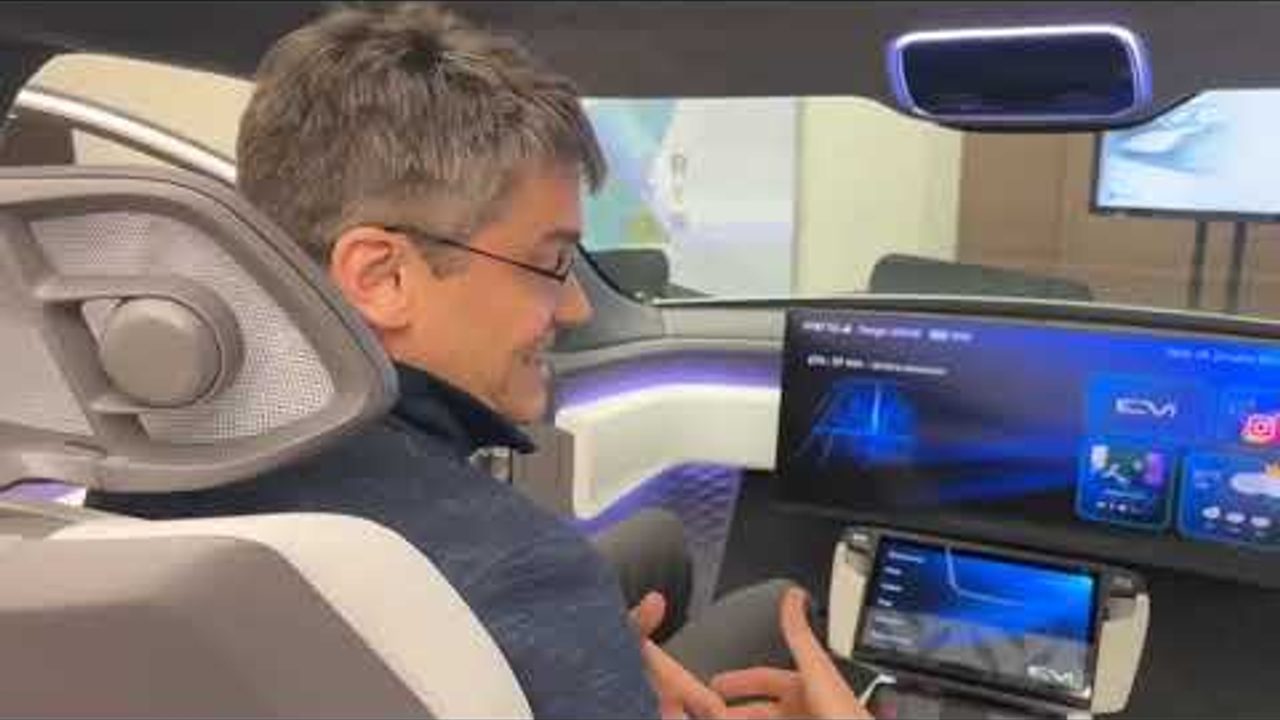
For the car manufacturer, the assembly of the seats should be simplified. The modular approach also simplifies disassembly at the end of the vehicle life cycle, thus supporting the circular economy. In addition, the elimination of the instrument panel should reduce the vehicle weight by around 11 kilos, resulting in lower power consumption and therefore greater range.
Added to this is the use of sustainable materials: Compression Hybrid Moulding (CHyM) enables the use of natural fibres. In this hybrid compression moulding process, natural fibres are embedded in a plastic framework.
As the full company name Yanfeng Automotive Interiors (Wikipedia) makes clear, Yanfeng specialises in car interiors. This includes the development and production of electronics, safety systems, seats and interior fittings. The Shanghai-based company has over 50,000 employees and was one of the 20 largest suppliers in the world in 2021.
More interesting design studies:
Cadillac Opulent Velocity Concept revealed: Luxury electric coupe
BYD revealed £22,000 electric car (for Europe)
The bottom line
What do you think?
View
Comments
I recently drove the new BMW i5 and experienced just how much autonomous driving is possible today. You can speed along endlessly on the motorway, even changing lanes by looking in the side mirrors is possible - you no longer have to use the steering wheel. But if you take your eyes off the road, autonomous driving is immediately over.
So it will still be a while before we can watch films while driving - it probably won't happen this decade. But perhaps things will move faster in technology-loving China, and then Yanfeng will be ready with EVI.
Sources: Yanfeng (per E-Mail), Yanfeng (CES)
We want your opinion!
What would you like to see on Motor1.com?
Take our 3 minute survey.
- The Motor1.com Team
Share this Story
- (https://twitter.com/intent/tweet?url=https%3A%2F%2Fwww.motor1.com%2Fnews%2F731240%2Fyangfeng-electric-vehicle-interior-autonomous-driving-concept%2F&text=Yanfeng%20shows%20Electric%20Vehicle%20Interior%20%28EVI%29%20for%20autonomous%20driving&via=motor1com)
- copy
GO TO COMMENTS
(
)
Got a tip for us? Email: tips@motor1.com
View all comments ( )
Popular
Driven: The Revuelto SV Is All Bull, No BS
Toyota's Next Mid-Engined Coupe Is Going Racing This Weekend
Alfa Romeo Has Had It With Huge Screens
Subaru Teases A New Manual WRX, But Only For Japan
latest articles
- Woman Takes Her Kia For Routine Maintenance. That’ll Be $1,000: ‘On A Kia?!?’ Oct 24 - Trending -
- Ferrari's CEO Praises The Tesla Roadster: 'We Have To Keep Dreaming' Oct 24 - Design -
- Woman Takes Her Car For An Oil Change At Meineke. Then She’s Told It'll Be $800: ‘How Much?!’ Oct 24 - Trending -
- NASCAR's Coolest Stock Cars Were Too Good At Their Jobs Oct 24 - Motor101 -
- Woman Buys RAV4. Then She Realizes This Highly Sought-After Item Is Already Built-In: ‘They Did Not Tell Me This’ Oct 24 - Trending -
- Customer Tries To Do ‘Courtesy Lease Return’ For Mazda. There’s Just One Problem: ‘I’ve Not Seen Something Like That Before’ Oct 24 - Trending -
- Man Buys 2026 Ford Truck. Then The Salesman Gives Him A Sneaky Offer Usually Reserved For People With Bad Credit Oct 23 - Trending -
RECOMMENDED FOR YOU
Listen To The Porsche Mission S Rev Its Mysterious Engine: Video
Woman Takes Her Kia For Routine Maintenance. That’ll Be $1,000: ‘On A Kia?!?’
This Is Porsche's Supercar Of The Future: The Mission S
Ferrari's CEO Praises The Tesla Roadster: 'We Have To Keep Dreaming'
Avatr T09 Debuts With Six Seats And 1,000-HP Hybrid System
Woman Takes Her Car For An Oil Change At Meineke. Then She’s Told It'll Be $800: ‘How Much?!’
Citroën Brings Back The Iconic 2CV Van With A Modern Twist