Time travel: Testing the Opel Corsa B (1993-2000)
This little car may be 30 years old, but it remains surprisingly young.
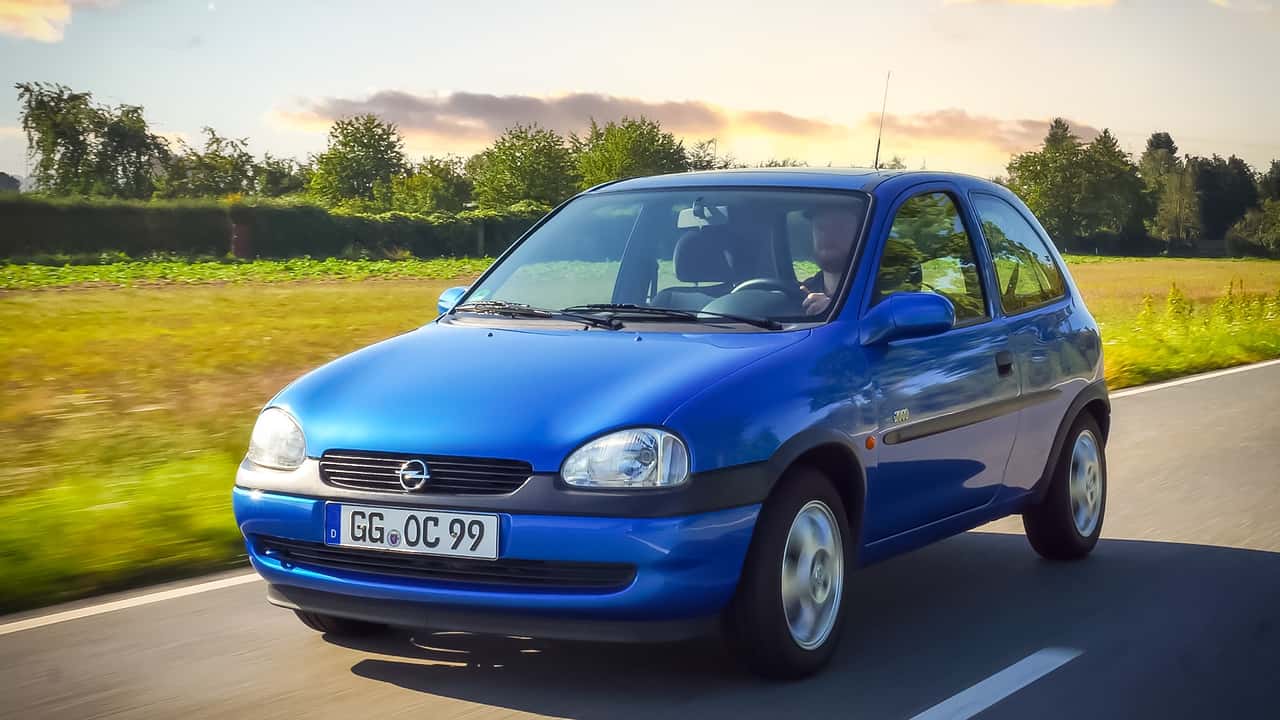

After Opel entered the small car category with the Corsa A in 1982, 11 years and two model updates later it was time for a new generation. So in the spring of 1993, the manufacturer introduced the Corsa B. Yes, the model that seems to have been released 'two days ago' is 30 years old. Crazy, and of course, this is already a classic car. So... come on in, let's take a trip back in time.
Many engines, even more equipment lines
Even its eternal rival, the Volkswagen Polo, took its time for a successor. It wasn't until 1994, after an incredible 13 years, that the time came. By then, the Opel Corsa B was already on the market and scoring points.
Gallery: Opel Corsa B (1993-2000)


Apart from the fact that the GM Gamma platform was used under the S93 body (the internal designation of the Corsa B), the biggest difference to its predecessor was clearly the strongly rounded body design. It had a much more modern look and catapulted the series from the pragmatic, angular 80s straight into the fun and colourful 90s.
You might think so, but in reality much of the design dates back to a time when the Corsa A was becoming a car that wouldn't last long on the market. Key word: Opel Junior. A 1983 show car, which in retrospect smelled a lot like the second generation Corsa. Significantly involved in both cars: Japan's Hideo Kodama.
Although the aesthetics of the new car were trend-setting, the big revolution under the bonnet did not take place for the time being.
Initially, the Corsa B (from March 1993 as a three-door model and from August 1993 as a five-door vehicle with a modified tailgate and narrower tail lights) was only available with 1.2 and 1.4-litre four-cylinder petrol engines with 45 or 60 hp and the 1.5-litre diesel (with or without turbo) with 50 or 67 hp. All powertrains thus remained the same as those of the predecessor.
Between autumn 1993 and mid-1994, a GSi version with a 109 hp 1.6-litre Ecotec engine was also offered again. From the summer of 1994 until the end of production, the output of the 16-volt unit dropped slightly to 106 hp. The Corsa Sport was positioned below the GSi and was offered with an 82 hp 1.4-litre 8V 1.4-litre engine until August 1994. At from September 1994, it was replaced by the 1.4-litre 16V with 90 hp.
Subsequently, from September 1995, a 1.7-litre 60 hp naturally aspirated diesel engine replaced the old 1.5-litre turbo block. In the summer of 1997, the engine range was extended with a newly designed 1.0-litre three-cylinder petrol engine with 55 hp and four-valve technology. Electric power steering (EPS) was also introduced on models with this engine to reduce fuel consumption.
By this time, the Corsa had received its only (but complete) facelift. It included modified front and rear aprons, wider side protection strips and side indicators as standard. The design of the hubcaps and alloy wheels was also modernised. Inside, new fabrics and a three-spoke steering wheel with airbag were introduced, and the previously square gear knob was replaced by a round one.
With the revision, Opel also changed the model designations and equipment variants. As if 15 versions weren't enough, the Eco, City, Swing, Sport, GSI, Joy, Atlanta, World Cup, Grand Slam, Viva, Familiy, CCD, Vogue, Advantage, Coiffeur, Twen, Cappuccino, Vogue, Advantage, Edition 100, Edition 100 Cool, Edition 2000, World Cup, World Cup Cool, World Cup Sport, Webc@r, Viva, Snow, Young, Special, City, Trio and Twist arrived. Yes... 33 names in seven years. A feast for Opel historians.
The last engine update
Two years before the end of production, the last operation on the Corsa B finally took place. Again with an open heart, because Opel equipped the small car with a new engine for the last time in 1998. It was a 1.2-litre four-cylinder petrol engine with 16 valves, 65 hp and 110 Nm of torque.
The engine was based on the three-cylinder engine introduced a year earlier. It was mated to a five-speed manual gearbox and accelerated the car, which weighed only 950 kg, from 0-100 km/h in 14 seconds. Top speed? 163 km/h.
And it is precisely this engine that our test car is powered by. A blue 1998 facelift model in the three-door version and Edition 2000 equipment line, with a length of 3.74 metres, a width of 1.61 metres and a height of 1.42 metres.
More space, less pragmatism
We immediately remembered how cramped it was last year when we drove the Corsa A to celebrate its 40th anniversary. And even in the B model, roominess isn't necessarily spelled with a capital letter. However, despite the manual sunroof, the headroom offered by the height-adjustable driver's seat is quite acceptable.
The shoulders of the driver and front passenger don't touch at every turn, and even in the rear, with its adjustable backrest, we can find a reasonably comfortable seating position. What a difference an extra 100 millimetres of wheelbase can make! Crazy.
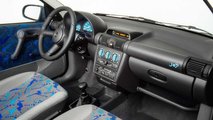
But it's not just the claustrophobic feeling that has largely disappeared from the Corsa B. The practicality of the 1980s has also given way to a rounded interior design. Of course, everything necessary for driving is clearly in view. Simply for lack of technology. Thus, behind the steering wheel with airbag, we only see a speedometer, a fuel gauge, a temperature gauge and a handful of warning lights.
No air conditioning, but a phone
On the centre console of our test car, however, a veritable fireworks display of technology unfolds. Control of the ventilation (no air conditioning) is handled by three knobs and a slider, below which sits the radio. In our case, a Phillips CCRT 700, which was unusual for small cars of the time (and which, of course, had to be paid for), with telephone function and a corresponding digital display on the dashboard. It included crystal-clear radio reception. That's comfort in a small car.
Now quickly move the seat and mirrors into the correct position with muscular strength, insert the key into the ignition switch, turn it over and the fuel-injected engine wakes up to idle without a murmur and pleasantly quiet. First gear is surprisingly smooth and reasonably accurate.
Gallery: Opel Corsa B (1996) im Test
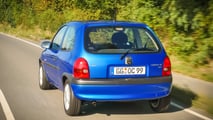

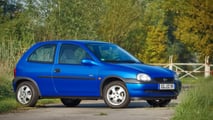
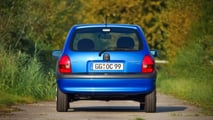


On the move, the McPherson struts with coil springs at the front and torsional rear axle, together with the aforementioned EPS steering system, ensure a fairly modern driving experience. From lively to comfortable. The sub-tonne car brakes solidly with disc brakes at the front and drum brakes at the rear. In any case, we felt quite comfortable, even above 100 km/h.
And today?
Unlike the rusty Corsa A, the Corsa B can still be found quite often on the relevant used car markets. There are somewhat worn models with an MOT for less than €1,000. Good condition examples with low mileage (our test car, from the Opel collection has an incredible 3,136 km on the clock) are now quite rare and can be advertised for more than €4,000. However, with ABS and airbags, they are still a very affordable way to get from A to B in safety and comfort.
In contrast, the Corsa F, which has just received a facelift, breaks all the boundaries set by the second generation. It is packed with technology that wasn't even available in the luxury class 30 years ago. It is bigger, heavier and, of course, significantly more expensive. At least in a generational comparison. Whether the minimum price of €17,400 for the petrol version or €32,590 for the all-electric model is still worth it is a personal question.
Want to know more about Opel?
RECOMMENDED FOR YOU
'A Tribute To The Very Beginnings:' McLaren Rebuilt Its First Road Car To Absolute Perfection
Man Gets 4 New Tires For His Lexus. Then The Shop Calls Him About A Missing Part: 'I Threw That Away'
Opel Brings Back The Hot Hatch, Minus Its Gas Engine
Woman Buys Chevrolet Tahoe. Then Her Wheel Flies Off. Then The Dealership Ghosts Her—After Agreeing To Take Accountability
2024 Opel Corsa Facelift Debuts With Updated ICE And EV Models
The 10 Fastest Cars At Goodwood This Year
2020 Opel Corsa Debuts With Up To 130 Horsepower