Forget Wings. These Supercars Use Giant Fans To Create Downforce
Some supercars use powerful fans to create incredible grip at any speed. Here's how they literally suck themselves onto the road.


Most supercars use massive rear wings, splitters, and carefully sculpted bodywork to generate downforce. But some of the most extreme performance cars in the world take a completely different approach: They use giant fans to literally suck themselves onto the road.
It sounds ridiculous, but the technology is very real. One modern hypercar can reportedly generate more than 4,400 pounds of downforce while sitting completely still. The idea dates back decades, with one of Formula 1's most controversial race cars helping pioneer the technology.
It's called fan-assisted downforce, and it could be one of the strangest ways engineers have ever found to make a car go faster.
How Does A Fan Actually Suck A Car Onto The Road?
The principle is relatively simple. A fan mounted in or near the rear of a car pulls air out from underneath its floor. This reduces the air pressure beneath the vehicle, while the higher pressure above it pushes the car downward. The resulting force is called downforce, and it increases the amount of grip the tires can generate.
Think of it as the opposite of an aircraft wing. An airplane wing is designed to generate lift, while a ground-effect car uses its underbody to create a low-pressure zone that pulls it toward the road. The closer engineers can control the airflow beneath the car, the more effectively they can generate this suction effect.
The fan also addresses one of the biggest limitations of conventional aerodynamics. A rear wing or diffuser needs airflow to work, so its effectiveness is closely tied to vehicle speed. A powered fan, on the other hand, can move air even when the car is barely moving. That makes it possible to generate substantial downforce from a standstill, something that would be impossible with ordinary wings alone.
The McMurtry Spéirling Takes The Idea To An Extreme

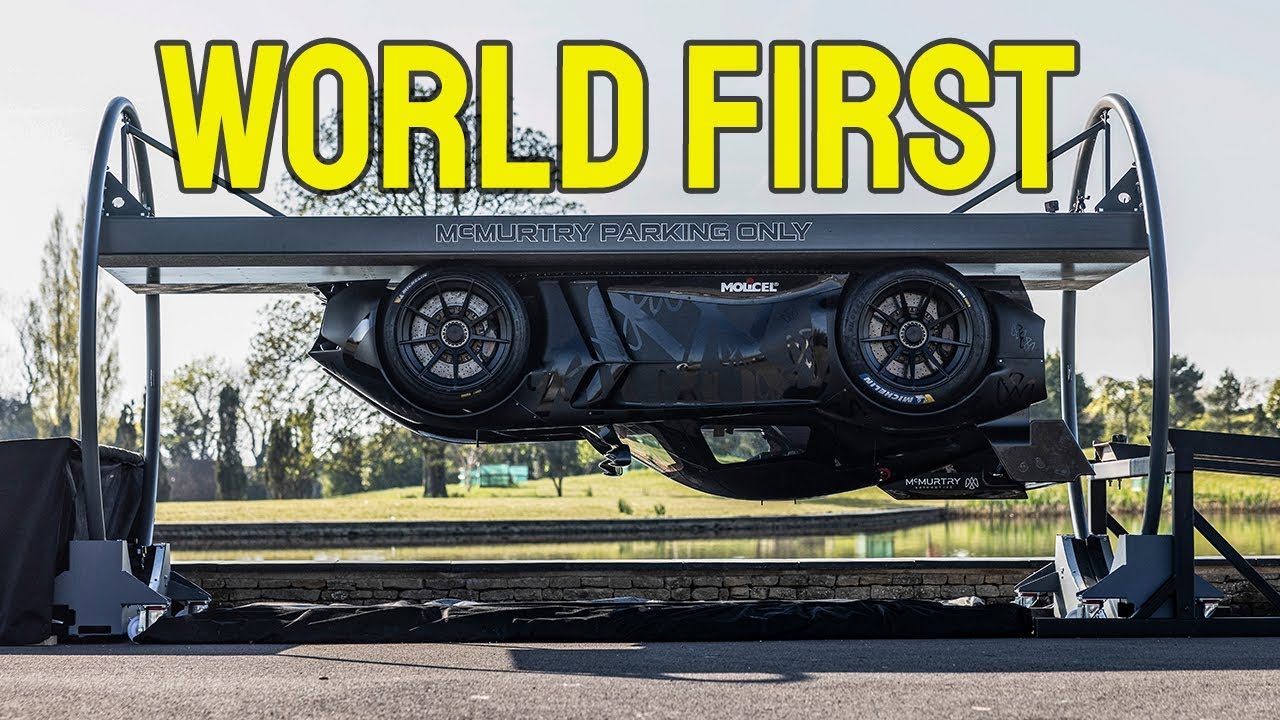
The clearest modern example is the McMurtry Spéirling, a tiny electric hypercar built around fan-generated downforce. Unlike conventional supercars that depend primarily on wings and underbody tunnels, the Spéirling uses two high-speed fans to extract air from a sealed area beneath the chassis.
The result is extraordinary. McMurtry says the production-form Spéirling PURE can generate up to 2,000 kilograms (4,409 pounds) of downforce from zero miles per hour. In other words, its aerodynamic system can produce more downward force than the car itself weighs, even before it starts moving—as demonstrated in the video above.
That gives the single-seat electric machine an unusual advantage: it doesn't need to reach high speeds before its tires receive a massive aerodynamic helping hand. McMurtry also claims the car can achieve up to 3g of lateral acceleration and 3g under braking. Its fans spin at up to 23,000 rpm, drawing air through filters and expelling it from the rear.
The technology is not just a marketing gimmick. The Spéirling demonstrated its capabilities at the Goodwood Festival of Speed, where its astonishing acceleration and cornering grip helped make it one of the most talked-about performance cars in recent years. It is, however, a track-focused machine rather than an ordinary road-going supercar.
The Idea Is Older Than You Might Think
Fan-generated downforce is not a new invention. One of its most famous early applications appeared in Formula 1 in 1978, when Gordon Murray designed the Brabham BT46B, better known as the fan car.
The Brabham used a large rear-mounted fan to extract air from beneath the chassis. Side skirts helped seal the area under the car, allowing the fan to create a powerful low-pressure zone. The result was an enormous aerodynamic advantage, particularly through slower corners where conventional wings and ground-effect systems were less effective.
Niki Lauda drove the BT46B to victory at the 1978 Swedish Grand Prix, its only World Championship race appearance. The design attracted protests from rival teams, and Brabham eventually withdrew it amid the controversy. The car remains one of Formula 1's most memorable engineering experiments.
Gordon Murray later revisited fan-assisted aerodynamics with the road-going GMA T.50. Its prominent 400-millimeter rear fan is part of a sophisticated system that manages airflow through the diffuser and around the rear bodywork.
However, there is an important distinction: the T.50's fan does not simply suck the entire car onto the road like the Brabham or McMurtry. Instead, it helps the underbody and active aerodynamic components work more effectively by controlling airflow and reducing turbulence.
Why Don't All Supercars Use Fan-Generated Downforce?
If a fan can generate so much grip at low speeds, it might seem like an obvious solution for every supercar. In reality, the technology introduces engineering challenges that make it difficult to implement on ordinary performance cars. The main considerations include:
- Power consumption: Fans need energy to operate. A high-performance system can require substantial electrical or mechanical power, adding complexity and potentially reducing efficiency.
- Weight and packaging: The fan, motor, ducts, filters, and supporting structure take up valuable space and add weight. Engineers must fit everything around the engine, suspension, battery, and cooling systems.
- Debris management: A fan pulling air from beneath a car can also encounter dust, stones, water, and other road debris. Filters and protective components are essential.
- Ground clearance: A powerful suction system works best when airflow beneath the car is carefully controlled.
- Uneven roads, bumps, and changes in ride height can complicate that task.
- Noise and durability: Fans spinning at extremely high speeds create noise and mechanical stresses. Making the system reliable enough for repeated use is another challenge.
There is also the question of whether a road car actually needs this much downforce. Most drivers will never approach the limits of a conventional supercar's aerodynamic grip on public roads. A fan system makes much more sense on a dedicated track machine, where every fraction of a second matters and the added complexity can be justified.
What Enthusiasts Think About Fan-Assisted Downforce
Reddit users are fascinated by the idea of a car generating downforce while barely moving. In a discussion about the McMurtry Spéirling, commenters in r/supercars expressed amazement at its fan-powered grip, with several pointing out just how unusual it is to have substantial downforce available on demand at very low speeds.
The technology's history also gets plenty of attention. In a discussion about the Brabham BT46B in r/F1Technical, users explored whether fan cars need skirts to create their suction effect and whether losing that low-pressure seal could create safety concerns. Another r/formula1 discussion revisited the BT46B's remarkable history, including its single Grand Prix victory and subsequent voluntary withdrawal.
There is also some appreciation for how the technology has evolved. In a discussion about the Gordon Murray T.50 in r/cars, commenters highlighted that its rear fan does more than simply generate downforce: it helps manage airflow, improve diffuser performance, and reduce aerodynamic drag in certain operating modes.
The Future Of Fan Cars Could Be Electric
Electric powertrains could make fan-assisted aerodynamics more practical. An electric motor can drive a fan independently of the engine's speed, allowing engineers to control airflow precisely when needed. That is particularly useful for a machine like the McMurtry Spéirling, whose electric powertrain and aerodynamic system can be designed together from the beginning.
Active aerodynamic systems could also become increasingly sophisticated. Instead of running a fan at full power all the time, a car could adjust its operation according to speed, braking force, steering input, and driving mode. The aim would be to deliver extra grip when it is useful while reducing energy consumption and drag when it is not.
The Gordon Murray T.50 already demonstrates how a fan can work alongside active spoilers and diffuser controls to balance downforce and aerodynamic efficiency. The McMurtry Spéirling takes the concept further with genuine fan-generated suction, showing just how much grip can be produced without waiting for the car to build up speed.
Fan cars are unlikely to replace conventional aerodynamic designs across the supercar world. They are complicated, expensive, and demanding to engineer. But for manufacturers chasing extraordinary track performance, the appeal is obvious. Sometimes, the fastest way to make a car stick to the road is not to push more air over it; it's to pull the air out from underneath.
More From Motor101
RECOMMENDED FOR YOU

One Engine, Two Boosters: Why Some Automakers Opt For Twin-Charging
From Detroit To Tokyo: Where Every Major Automaker Is Actually Headquartered
Is Body-On-Frame Really Better For Off-Roading?
An F-150 Lightning Owner Resold His Truck And Nearly Got His Money Back: 'A Little Less Than We Paid New'
More Automakers Are Letting Cars Steer With Their Rear Wheels
Jeep Is Taking Marvel Superheroes Off-Roading
Automakers Have A Clever Way To Make Cars More Fuel Efficient