Why Do Some Cars Have Flat-Bottom Steering Wheels?
The strange shape isn't just for looks; there's a clever reason automakers are flattening the bottom of your steering wheel.


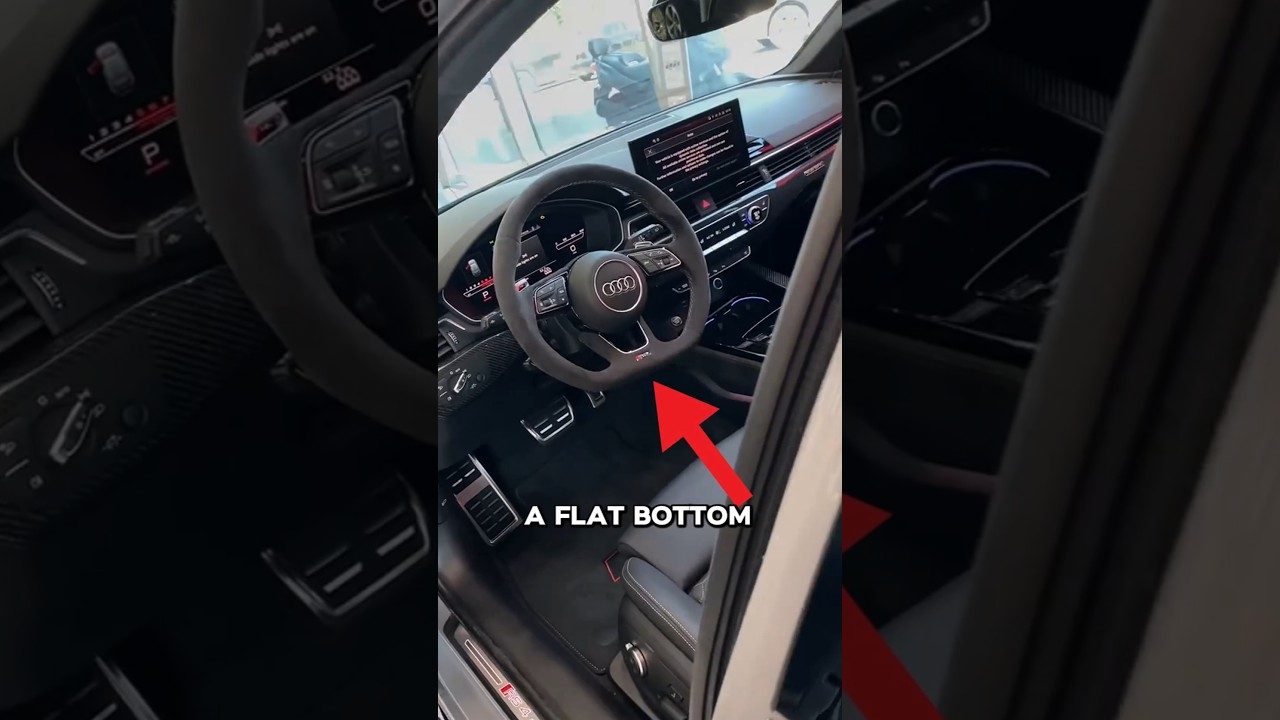
If you've ever glanced down at your steering wheel and wondered why the bottom is flat, the top is slightly squashed, or the entire thing looks more like a rounded rectangle than a circle, you're not imagining it.
Modern steering wheels come in all sorts of shapes. Some are nearly perfect circles, while others have flat bottoms, flattened tops, thicker side grips, or even squared-off designs.
And while the styling can make a car's interior look sportier, there's usually more going on than simple aesthetics.
It's Mostly About Your Legs
The most obvious reason for a flat-bottom steering wheel is space. When you're sitting behind the wheel, your legs occupy the area immediately below it. A traditional circular steering wheel extends farther downward, potentially reducing the space available for your thighs and knees.
Flattening the bottom creates a little more room without requiring the entire steering wheel to become smaller. That can be particularly useful in sports cars, where drivers often sit lower to the ground and closer to the steering wheel.
A flat-bottom design can also make getting in and out easier, especially when the steering wheel is positioned close to the driver's legs. There's another advantage: it can make the cockpit feel more open.
But there can be a practical benefit for enthusiastic drivers, too. The flatter section provides a visual reference for the steering wheel's orientation. If the wheel is centered, the flat portion sits at the bottom, making it easier to tell, at a glance, how much the wheel has been rotated.
What A Flat-Bottom Steering Wheel Actually Does
Flat-bottom steering wheels also became strongly associated with performance cars, and manufacturers quickly discovered that the shape was an easy way to make an ordinary cabin feel sportier. But there are several more practical benefits besides that:
- More legroom: The flat bottom creates extra clearance for your thighs and knees.
- Easier entry and exit: There's less steering wheel rim occupying the space you need when climbing into or out of the driver's seat.
- A visual reference: The flat section can help you quickly judge whether the steering wheel is centered.
- Better cockpit packaging: Designers get a little more freedom to position the wheel, pedals, seats, and dashboard around the driver.
- A distinctive interior: Unusual steering-wheel shapes give automakers an easy way to differentiate a model's cabin.
- A sportier appearance: The shape has become closely associated with performance cars.
None of these benefits means a flat-bottom wheel is automatically better than a traditional round one. It's simply another compromise between comfort, packaging, styling, and the way a particular car is designed to be driven.

Why Not Make Every Steering Wheel Flat?
Because a circle still has some important advantages. A traditional round steering wheel provides the same shape and grip wherever your hands happen to be. During normal driving, that's convenient. You can feed the wheel through your hands during a turn without suddenly encountering an unusually shaped section.
There's also the question of steering geometry. In many situations, the steering wheel needs to rotate significantly as the front wheels turn. A circular wheel is comfortable to grip at virtually any angle. A heavily squared-off wheel can feel less natural when you're making large steering inputs.
That's one reason extremely aggressive steering-wheel shapes are more common in performance-oriented cars than in family sedans.
There's A Packaging Trade-Off
The steering wheel isn't designed in isolation. Its shape has to work with the dashboard, instrument cluster, steering column, pedals, driver's seating position, airbags, switches, and the driver's body.
The airbag is particularly important. The center of the steering wheel houses the driver's airbag, which means manufacturers have to package a considerable amount of hardware inside a relatively compact space.
The spokes and rim also have to maintain the required strength while accommodating controls for everything from audio and cruise control to driver-assistance systems. As steering wheels have gained more technology, their shapes have sometimes become even more unusual.
The Rise Of The Yoke
The most extreme example is the steering yoke. Instead of a conventional circular rim, a yoke removes much of the upper section of the steering wheel. The idea can improve forward visibility and create a more futuristic appearance, but it also changes the way drivers interact with the steering system.
Whether a yoke is actually better depends heavily on the car's steering ratio and how much the wheel needs to rotate during ordinary driving. A yoke can work particularly well with very quick steering systems that require relatively little rotation.
In a car that needs multiple turns of the wheel, however, the missing upper section can make traditional hand-over-hand steering more difficult. That's why steering-wheel design is ultimately a compromise between ergonomics, packaging, styling, and steering behavior.
What Drivers Think About Flat-Bottom Steering Wheels
Reddit's car communities have plenty to say about steering wheels that aren't perfectly round, and as you can imagine, a consensus is impossible.
In a 2024 discussion on r/BMW, owners debated the merits of flat-bottom wheels. Some said they preferred the extra clearance, particularly drivers with longer legs or larger thighs, while others simply preferred the feel and appearance of a conventional round wheel. One owner said the additional clearance made a noticeable difference when driving a manual car.
Owners of the Toyota Supra have been similarly enthusiastic. In one r/Supra thread, a driver called the flat-bottom wheel a "must," while another said it made getting in and out easier and provided a little more legroom.
But not everyone is convinced. A more recent r/BMW discussion produced plenty of criticism of flat-bottom designs, with some owners describing round steering wheels as cleaner, more comfortable, and more natural. Others pushed back, saying they liked the additional hand support and the thicker feel of some flat-bottom wheels.
That divide is probably the most interesting takeaway. For some drivers, the flat section genuinely improves ergonomics. For others, it's mostly a styling choice—and one they don't particularly like.
Is A Flat-Bottom Wheel Better?
Not necessarily. For most drivers, the difference is fairly minor. A flat-bottom wheel can provide additional legroom and make a cabin look sportier, while a conventional round wheel remains extremely effective and intuitive.
The biggest advantage depends on the car and the driver. In a compact sports car, where space around the driver's legs can be tight, those few extra inches of clearance can make getting in and out noticeably easier. In a larger sedan or SUV, however, the practical benefit may be much harder to notice.
There can also be a psychological benefit. Flat-bottom wheels have become closely associated with performance cars, so simply seeing one can make a cockpit feel more focused and driver-oriented. For enthusiasts, that sense of occasion can be just as important as the extra space.
On the other hand, a traditional round wheel remains the more versatile design. Its continuous rim gives drivers a consistent grip regardless of how far the wheel is turned, which can be particularly useful during tight corners or quick steering corrections.
Ultimately, choosing between the two comes down to priorities. If you value extra legroom and a sportier appearance, a flat-bottom wheel can be a worthwhile touch. If maximum versatility and a familiar steering feel matter more, there's a good reason the traditional round wheel has remained the industry standard for so long.
More From Motor101
RECOMMENDED FOR YOU

Why Auto Parts Stores Will Test Your Battery For Free
Woman Brings Honda To Tires Plus. Then They Reveal Mavis Put On 3 Different Tire Brands: ‘Discount Tire Would Never’
What Are Those Little Rubber Hairs On New Tires?
Mazda Won't Let The Rotary Die. This Patent Could Make It More Efficient
What Really Happens When You Put Your Car In Sport Mode
I Bought My Dream Mercedes SL For $8,000. Here's What It Really Cost Me
Why Is WD-40 Called WD-40?