Mechanic Hops In Customer’s Chevrolet. Then He Sees A Simple Mistake That Came Back To Haunt Them: ‘A Few Thousand Bucks’
"On my way to remove mine now."
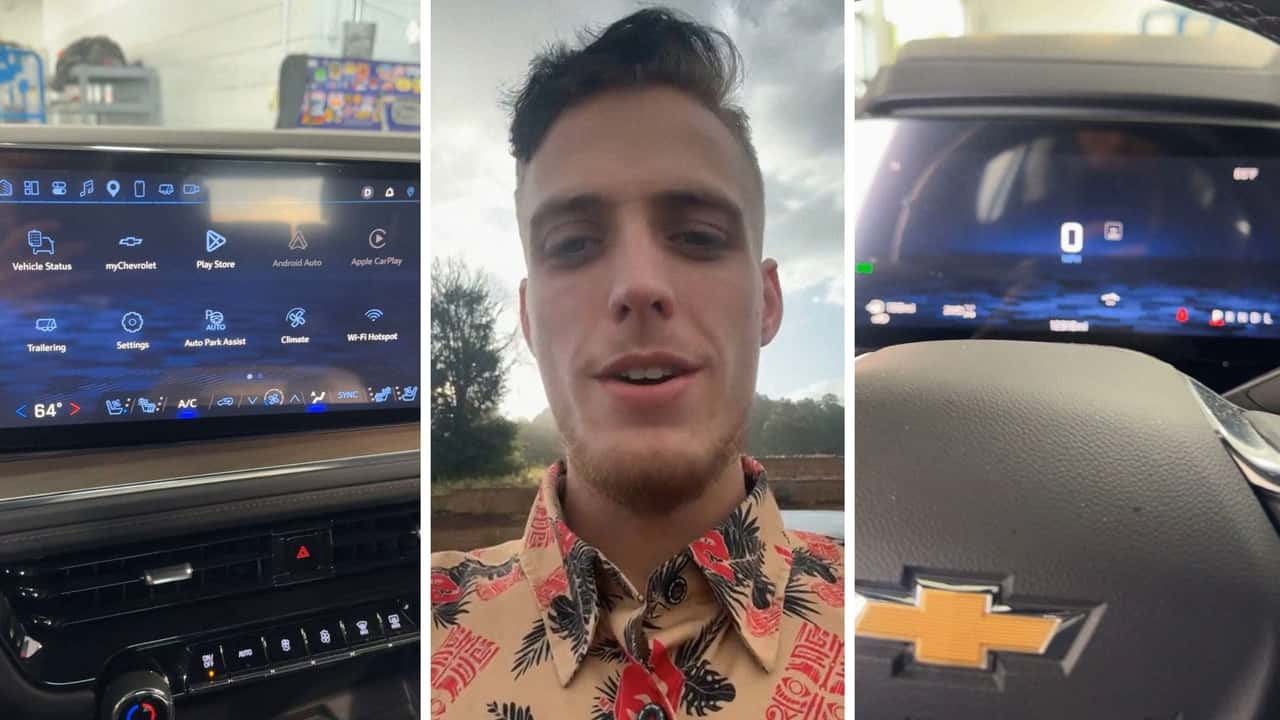

Sometimes inaction can lead to an unexpected and costly mistake for drivers.
A viral video shows how one surprisingly simple mistake can ruin an infotainment screen. Unfortunately for one Chevrolet owner, they learned this the hard way.
The clip from creator Jace Sorenson (@jace_s.dg) states as plain as day, while looking at a customer's Chevy and their infotainment screens, that the simple act of failing to peel the thin sheet of protective plastic from the infotainment display could eventually cost the owner several thousand dollars.
“Do not leave them on the radio or on the dash because after a few years it's going to bake on and actually destroy those screens and cost you a few thousand bucks,” he said in the clip that's been viewed more than 3.9 million times.
Revealing A Tough Truth
Sorenson acknowledged in the comments that the warning catches many people by surprise, calling it “not a well-known fact.” The reactions beneath the clip suggested plenty of owners had treated the clear film as a useful extra layer, rather than something that it's imperative to remove.
One viewer immediately recognized the problem in her own household.
“I got to remove the one from the radio, he gets to remove the dash and won’t!” she wrote.
Many people said they'd left the plastic on their screens.
Another said, "On my way to remove mine now."
That reluctance is easy enough to understand and forgive, even if it could prove costly. The plastic can feel like a useful guard against scratches, fingerprints, or the slow accumulation of wear. It also preserves a small piece of the new car experience, even after the vehicle has been on the road for months. From a psychological and tactile standpoint, the tiny act of peeling the film away can feel like breaking the seal on something pristine.
The wording in Sorenson’s clip did create some confusion. He referred to the material as a “screen protector,” a phrase commonly used for accessories designed to remain on phones, tablets, and other electronics.
What appears on the Chevrolet’s displays looks more like the temporary film applied before a vehicle reaches its owner, likely to provide protection during the transport process to the dealership. Leaving the film in place provides one more “still new” nuance to make buyers feel satisfied.
That distinction prompted a commenter to ask whether a separately purchased protector posed the same danger.
“What about an actual screen protector? One like your phone,” she wrote. “Because I ordered one and put it on.”
Another commenter warned that those products could also become difficult to remove, though the clip itself does not establish that every aftermarket protector carries the same risk. Materials, adhesives, and installation methods can vary considerably, making Sorenson’s advice most directly applicable to the factory covering visible in the video.
Gallery: Chevrolet Infotainment Review







How Heat And Age Accelerate Wear
Sorenson’s concern is tied to what happens after that plastic spends years pressed against a dashboard display as the vehicle interior endures repeated cycles of sunlight and heat. Over time, those conditions can leave temporary film brittle, cloudy, or stubbornly attached.
The problem may not be that the screen suddenly stops functioning beneath it. Instead, damage could occur when an owner finally tries to lift hardened material, remove residue, or scrape at a surface that was never meant to stay covered indefinitely.
Sorenson does not show a failed display or explain whether this particular customer had already reached that point. The clip serves as an early warning and reminder to remove the covering before it damages the screen’s outer surface.
The potential bill is believable because modern vehicle displays or digital gauge panels can be tied into a larger electronic assembly. That means a damaged surface may not be solved with a cheap sheet of replacement glass. Parts, labor, and any required programming could quickly push the repair beyond what an owner would expect from something caused by a thin layer of plastic.
Because the clip does not identify the Chevy’s model or year, an exact replacement bill is difficult to pin down, but current prices show how quickly the costs can climb. One electronics repair company lists mail-in touchscreen repairs at about $290 for a 2014–2018 Silverado and $400 for a 2015–2022 Colorado. A specialist in GM infotainment hardware estimates that dealership replacement of an HMI module, the computer behind many screen functions, typically runs $800 to $1,800 once the part, diagnosis, programming, and labor are included.
GM’s parts catalog lists one video-processing module used in several 2021–2023 Silverado models at an MSRP of about $650 before installation. Those examples do not prove Sorenson’s customer faced a multi-thousand-dollar bill, but replacing damaged components behind both the radio display and digital dash could plausibly move the total into that territory.
Drivers who leave the film untouched may believe they are preserving an expensive screen. But Sorenson’s warning is that the effort to keep it looking new could wind up accelerating aging and damaging the vehicle’s info nerve center through a kind of determined negligence.
Motor1 reached out to Sorenson via direct message and comment on the clip, and to Chevrolet via email. We’ll update this if they respond.
RECOMMENDED FOR YOU
GM Is Already Replacing The New Chevrolet Equinox EV
CarMax Vs Carvana: Which Used-Car Giant Has The Better Return Policy?
Woman Drives New Chevrolet Trailblazer. Then Her iPhone Updates. Then Apple CarPlay Stops Working
Hyundai Needs To Build This Baja Santa Fe For Real
This Supercharged Corvette Hit 300,000 Miles On Its Original Engine
Mercedes Recalls 311,000 Cars For Rollaway Risk
Man Makes Offer On His Dream Car. Then He Tries To Pay With His American Express: 'Not A Credit Card'