‘We’re Supposed To Go 100,000 Miles’: Mechanic Checks New Transmission Fluid. Then He Compares It To Fluid After 35,000 Miles
'I have trucks with over 700 thousand with the original transmission fluid and still running strong.'
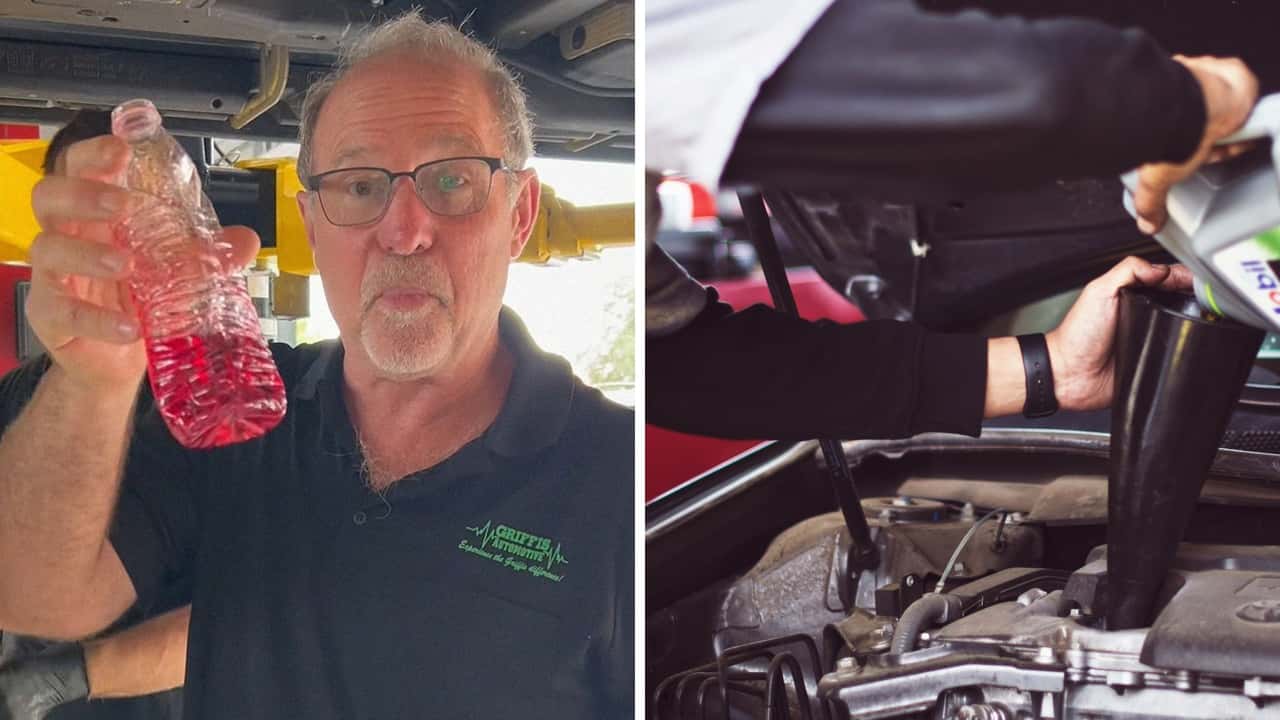

An independent auto shop owner took to Facebook, holding plastic bottles up to the camera in order to call out something he says is killing American transmissions: manufacturer service intervals that let fluid get filthy before anybody touches it.
In one of the bottles, the fluid is bright cherry red. In the other, drained from a customer’s car at 35,000 miles, the fluid has the color of motor oil dredged from a parking lot puddle.
The 1-minute, 34-second clip was posted by Griffis Automotive Clinic Inc., an independent shop in Groveland, Florida, whose channel logs the kind of grievances independent techs share with each other in the bay. It has racked up more than 1.1 million views and hundreds of comments arguing both sides of a debate that has split working mechanics for two decades.
Transmission Fluid: Old VS. New Side-By-Side
The tech makes his case with the bottles first. “So, this is brand new transmission fluid. Brand new. This is a 35,000-mile transmission fluid. Thirty-five thousand miles. But the manufacturer says we’re supposed to go 100,000 when we service this,” he says, holding the muddy second bottle. “Brand new; 35,000 miles.”
His second exhibit is a small valve in his hand. “Now, this right here is a transmission fluid temperature control valve. This is an aftermarket transmission temperature control valve. This keeps the transmission fluid about 200 to 220 degrees,” he says, pointing to the stock part. “This keeps it about 140 degrees,” he adds, referring to the aftermarket part.
That is the argument compressed into props. The shop’s view is that the manufacturer is running its transmissions hot on purpose—close to the upper end of what the fluid can tolerate—and then telling owners not to change the fluid until it has been baked for 100,000 miles.
“Maybe what’s wrong with all the transmission failures in the world we live in today is the manufacturer is cooking the transmissions, and they’re not telling you to service this nasty [expletive] fluid at 35,000 miles and put clean fluid back in it,” he says. “And everybody in the aftermarket world says, 'Oh, don’t service your transmission because it makes it fail.’ Does it really make it fail to get this crap out and put clean fluid in?”
He works the math out loud. “I mean, your engine’s got five quarts. This has got 10 quarts. You change that every 5,000. You’re only supposed to change this every 100,000? I mean, it’s kind of a no-brainer.”
The 100,000-Mile Question
The 100,000-mile figure is the upper end of a wide industry range, not a settled standard. AAA’s advice page on transmission fluid acknowledges manufacturer “lifetime fluid” framing, saying, "Some car manufacturers say their transmissions are designed so that the fluid should, in theory, last the vehicle’s lifetime." But the auto club then walks that back, saying the actual guideline “for most vehicles” recommends draining and replacing the fluid “every 30,000 to 150,000 miles.”
Consumer Reports puts the floor slightly higher and the ceiling lower. Its transmission maintenance guide tells readers that “intervals for changing transmission fluid vary widely” and “for some cars and trucks, it can range from as little as 30,000 miles to more than 100,000 miles.” Both publications send the reader back to the owner’s manual rather than the marketing language.
The visible state of the 35,000-mile fluid in the bottle—dark brown, not transparent red—is the part Griffis is using to argue that the manufacturer’s service window doesn’t match what the fluid is actually doing inside the transmission.
‘Changing Fluid Wouldn’t Cause That’
In the comments section, the “drain it on a schedule” camp arrived early.
“I service transmission fluid every 4th oil change on the engine, and my truck has 385,432 miles on it and both the engine and transmission are still going strong,” Larry Warner wrote. Several other commenters posted similar mileage figures with regular service intervals attached.
The opposing camp showed up with the “don’t touch it or it will fail” argument that Griffis was pre-empting in the video. Giles Fish replied to Warner, “Old fluid has friction material that helps the clutches. Don’t listen to this guy.”
Jeffrey Lewis put it as a question that anchored a 100-plus-reply subthread: “Ok so what you tell the customer after changing the transmission fluid and the car doesn’t go in drive?”
The most common rebuttal was that a flush at 150,000 miles is a different procedure than a service at 35,000 miles.
“That means the service was too late for an already failing transmission,” Cj Gruesbeck wrote. James NeverContent Clouse put it more bluntly: "If that happens it is due to poor maintenance and the transmission was already on its way out. Changing fluid wouldn’t cause that.”
There was a smaller “YOLO” crowd. David Ruthven claimed his Ford F-250s and F-450s have crossed 700,000 miles on original fluid. Henry Herren said the same about a 2003 Chevrolet 2500 HD at 300,000-plus.
Motor1 reached out to Griffis Automotive Clinic, AAA, and Consumer Reports for additional comment. We’ll be sure to update this if they respond.
RECOMMENDED FOR YOU

Tesla Driver Gets New Tires Installed. Then He Takes A Closer Look At The Fine Print On Them: 'Just Drive In Reverse'
The Toyota Supra Final Edition Is A Lukewarm Farewell To An Icon: Driven
Nissan Salesman Takes Customer On Test Drive. He Wasn't Expecting To Break Down: ‘Bro Is NOT Making The SALE’
The Simple Trick That Lets You Start Your Car When Your Key Fob Battery Dies
Mechanic Works On Land Rover Discovery—He Accidentally ‘Totals’ It: 'Don't Tell The Customer'
Mitsubishi Goes Under The New Pajero To Show Its Truck Roots
Man Buys Lease On New Car. The Salesman Steps In To Clarify—Toyota Leases Are Different: 'I Do This With Subaru'