Man Waits For Fiance In 7-Eleven Parking Lot. Then A Surveillance Camera Starts Talking To Him: ‘The Next Step Is Sending A Drone'
"Clearly a camera recognizing body movement and position..."
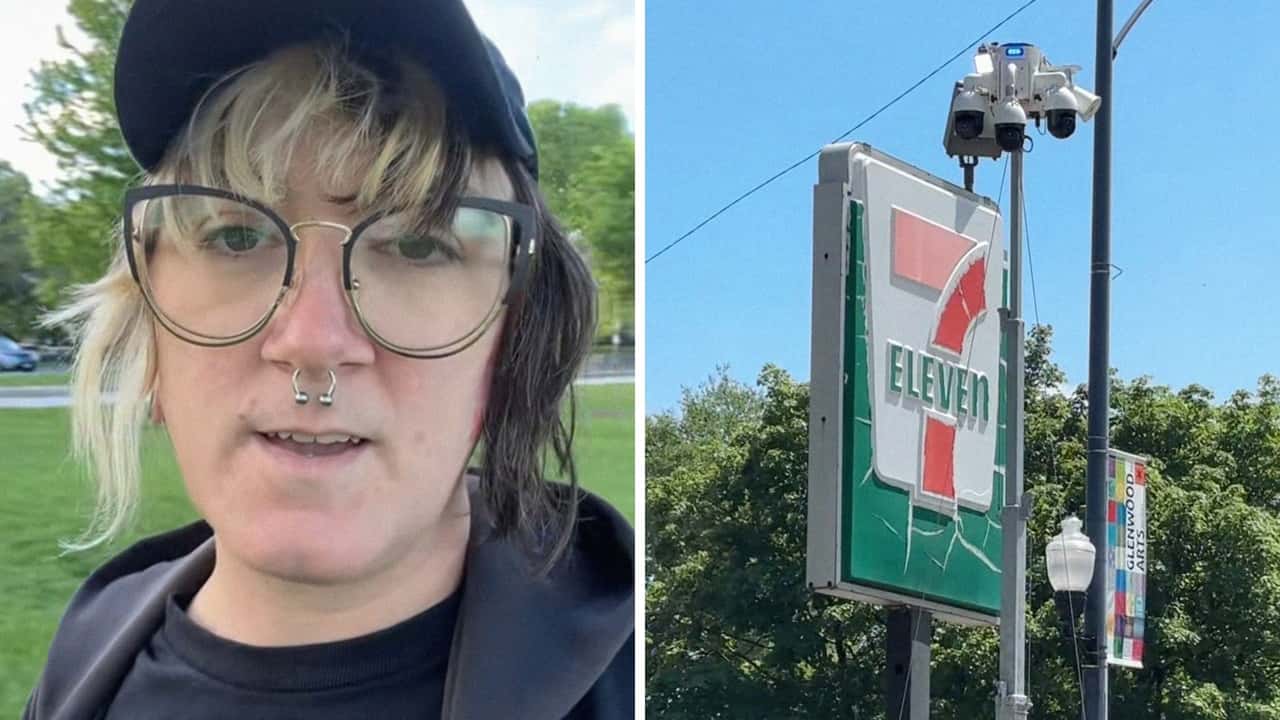

While sitting in a 7-Eleven parking lot in Chicago waiting on his fiancée to come out with a drink, a man got a talking-to from the property itself. A solar-powered camera tower parked by the store sign detected him and broadcast an order to stop loitering. He filmed the moment, and the comments turned into a discussion about how much of American public space is now watched by machines that talk back.
The 13-second TikTok was posted earlier this week by Trash god (@trashbagdeity161), a Chicago creator whose channel mixes scenes from city life with political commentary. It has pulled more than 427,000 views. The shot zooms slowly across the lot and settles on a trailer near the sign, stacked with solar panels and a battery of pan-tilt-zoom cameras.
‘It Just Told Me Not To Loiter’
“So I’m at 7-Eleven waiting for my fiancée who’s inside getting a drink, and this thing just told me to not loiter,” Trash god says in the clip, which he later noted took place in the Rogers Park neighborhood on the city’s Northside.
In the comments he described how it worked. The tower stayed quiet for the first five minutes he was there, he wrote, until he sat down. “Then a small white light came on, clearly a camera recognizing body movement and position, then it broadcasted.” His caption summed up his feelings about the chain: “Eeeehhh [expletive] 7/11 after this [expletive].”
What The Camera Actually Is
Most of the comment section insisted it was a Flock camera, the automated license plate readers that have spread across American roads. Trash god corrected them, and he was right. The unit is a mobile surveillance trailer of the kind built by LiveView Technologies, or LVT, whose lettering sharp-eyed viewers spotted on the side. Flock reads plates; LVT’s solar towers have cameras on a mast plus a two-way speaker, and the company sells AI-driven “talk-downs” that detect a person and trigger a spoken warning. That lines up with the white light and the broadcast Trash god described.
In an email, LVT told Motor1, "LVT units utilize advanced edge-AI video analytics to identify specific behaviors or postures that indicate potential criminal activity or life safety or security risks. For instance, the system looks for suspicious behaviors such as potential car break-ins, individuals assuming a catalytic converter theft posture underneath vehicles, pacing between parked cars, or an individual or vehicle lingering in a designated zone after hours or past a set threshold (e.g., a loitering timer). LVT customers control which behaviors, boundaries and timer thresholds the system follows, and they can easily modify them as needed."
The LVT spokesperson added, "When one of these customer--determined behaviors, boundaries, or timers is detected, the unit initiates an active deterrence protocol to notify individuals that the property is being actively monitored."
The company also said that the systems can both automated and operator-driven "depending on how the customer configures" it.
LVT said, "Because every environment is different, the LVT platform allows customers or property owners to remotely adjust and tune these settings. They can customize specific "detection zones," set active schedules (such as only enabling loitering timers after business hours), and adjust sensitivity thresholds."
People who commented on the video were taken aback by the talking surveillance cameras.
Commenter Damien Strix wrote, “The next step is sending a drone at you.” Trash god answered, “[expletive] literally. I need a signal jammer.”
It is closer to reality than it sounds. Flock Safety, the very company most viewers mistook the tower for, launched a drone product in 2025 that, in the company’s words, “gives private-sector security teams the ability to quickly launch a drone in response to a security breach at a power plant or a break-in at a retail store.” A drone answering a parking-lot alert is now something a business can buy, not just a thought experiment.
What Does The Law Say About Your Privacy In A Parking Lot?
Illinois law has something to say about cameras like this. The state’s Biometric Information Privacy Act, or BIPA, makes it unlawful for a private company to use facial recognition to identify or track people without their written consent, with damages of up to $5,000 per violation.
Whether a unit like this one falls under it depends on what it captures. LVT describes its system as reacting to visible attributes rather than identities, which would sit outside the law, but at least one commenter wondered aloud whether the cameras were logging faces, which would be a different legal matter entirely.
LVT told Motor1 that its systems do not use or store facial recognition or biometric data, nor do they record audio.
"All AI analytics focus strictly on object classification (such as identifying people, vehicles, or movement), behavior (such as loitering, casing vehicles, violence), and superficial visual attributes (such as clothing color) to execute active deterrence. As such, our technology is designed to comply with applicable biometric privacy laws, including BIPA," the company said.
The company also said that customers solely own and control the footage and that its systems store recordings up to roughly 30 days.
"Footage that is not flagged or manually saved by the customer is automatically overwritten as local storage cycles," an LVT spokesperson continued. "Footage is uploaded to LVT's secure cloud platform only when it is associated with a triggered alert event or when a customer manually designates it for saving. LVT doesn't disclose customer data to any third party unless authorized by the customer or required by law."
For most viewers the tower was less a legal puzzle than a vibe check on the country. “Our version of cyberpunk is way lamer,” wrote Serzio. Others reached for obvious references, from “This new season of Black Mirror looks great” to “okay Big Brother” and a long run of nods to George Orwell’s classic tome 1984.
Many commenters observed that Trash god was not loitering. “Not loitering by definition,” wrote Dèja Amara. “You purchased something from this business and are waiting for your other party to exit the store.” Several commenters said the same machines had turned up at their own gas stations and grocery lots.
“The one next to my house just blasts opera all day and night, on repeat too,” one wrote.
Surveillance Society
Mobile camera towers like this one are multiplying in the places drivers often make brief stops, like gas stations, drugstores and convenience store lots. They are sold to retailers as a cheaper alternative to a guard, but they cannot tell a shoplifter from a man waiting on his fiancée.
For now the worst they can do is talk. Trash god’s answer was to take his business elsewhere, which may be all that customers can do until the law or social convention changes.
Motor1 reached out to Trash god via TikTok direct message, and to 7-Eleven and LiveView Technologies via email for comment. We’ll be sure to update this if any of them respond.
RECOMMENDED FOR YOU

Woman Flirts With Man At A Family Dollar. Then She Makes A Comment About His Toyota: ‘Don’t Ignore That Red Flag’
This Tiny Hatchback Is The Best-Selling Car In China. But How?
2 Men Try To Buy The Same GMC Truck On The Same Tuesday. Then The Salesman Steps In—And Makes A Controversial Decision
Woman’s Neighbor Keeps Parking In Her Reserved Spot. Finally She Decides She’s Had Enough: 'She Called Your Bluff!'
Man's Ford Screen Asks To Update—It Includes Video Streaming Karaoke. There’s Just One Problem: 'Don't Update'
Woman Loses Key Fob To $15,000 Mercedes G Wagon. Then She Finds Out The Replacement Cost: ‘I Wish Somebody Would’ve Warned Me’
Woman Gets Pulled Over By Cop—He Tickets Her For Something She Didn't Do: 'The Dealership Literally Puts Those On'