Home
Toyota
Tundra
News
‘It Takes Me To A YouTube Video’: Man Changes Oil In Toyota Tundra. Then He Has To Scan A QR Code To Access The Oil Filter
"At first, it seems like a normal oil change."
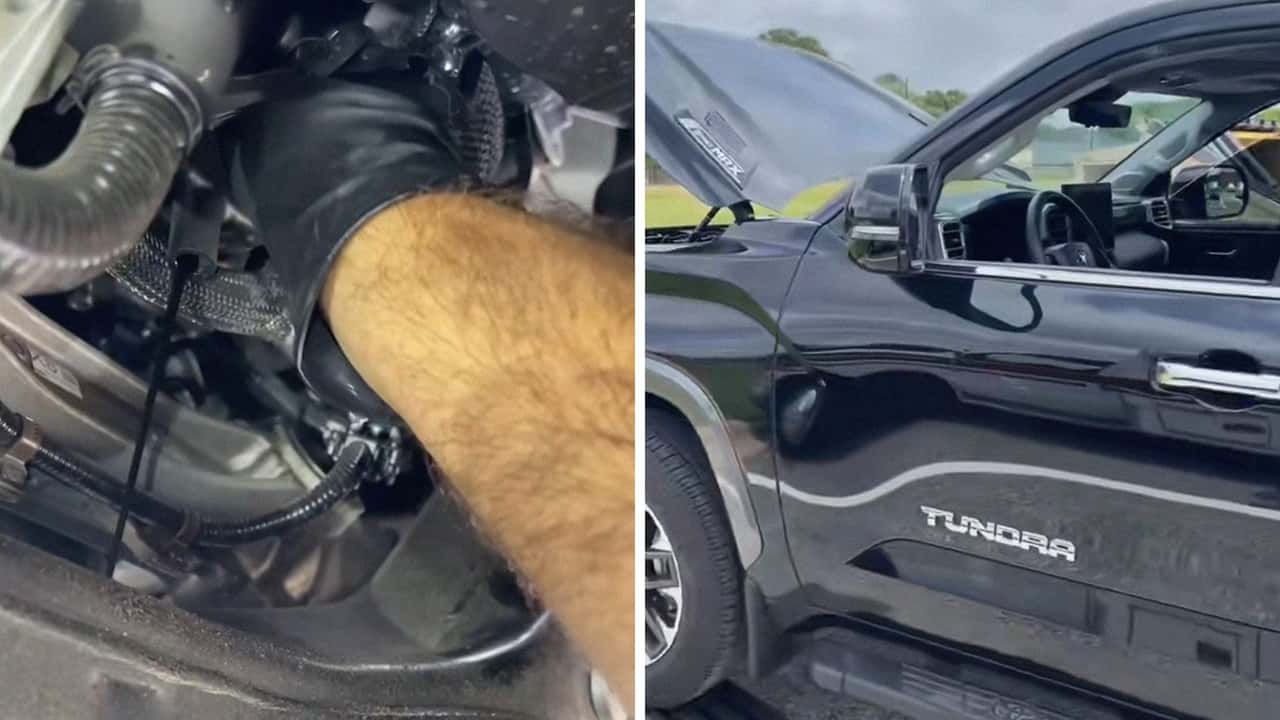
Photo by: joybarrett1961
Chad Swiatecki 
By: Chad Swiatecki
May 24, at 8:00pm ET
Add Motor1.com as a preferred source in Google
- (https://twitter.com/intent/tweet?url=https%3A%2F%2Fwww.motor1.com%2Fnews%2F796671%2Ftoyota-tundra-oil-change%2F&text=%E2%80%98It%20Takes%20Me%20To%20A%20YouTube%20Video%E2%80%99%3A%20Man%20Changes%20Oil%20In%20Toyota%20Tundra.%20Then%20He%20Has%20To%20Scan%20A%20QR%20Code%20To%20Access%20The%20Oil%20Filter&via=motor1com)
- copy
Share
Comment
For generations, changing your truck’s oil pretty much required just three things: a drain pan, a wrench, and accepting that at least some oil was going to end up on your hands. But expectations on basic maintenance steps have officially changed, as we learn from a mechanic who recently discovered that an oil change on a Toyota Tundra Hybrid now also involves a QR code, a hidden electronic air dam, and a trip to YouTube before you can even reach the oil filter.
The viral clip from creator @joybarrett1961 starts with the 2024 Tundra up on blocks for a parking lot oil change. Once underneath, the narrator scans the camera across the access points involved. And that’s where the degree of difficulty and time on job start to ratchet upwards.
“At first, it seems like a normal oil change,” he said on the clip that’s been viewed more than 905,000 times. While not exactly convoluted and complicated at a Rube Goldberg level, one quickly gets the sense that Toyota engineered the truck in a way that made an oil change up on a lift almost a necessity.
Oil Change Gets Complicated Quickly
The problems start once he discovers that the oil filter sits behind a protective cover held in place by four bolts. Two are easy to access, but the other two are tucked behind what appears to be an electronically controlled air dam mounted underneath the front of the truck.
That’s when the job briefly turns into a scavenger hunt. Printed directly on the assembly is a QR code labeled “owner manual scan to deploy.” After pulling out his phone and scanning it, the mechanic is redirected to a YouTube tutorial explaining the sequence needed to lower the flap and access the two elusive bolts.
According to the instructions, the truck has to be powered on and off within 45 seconds before the driver holds the turn-signal control upward for two seconds to electronically deploy the dam downward. Only then can he finally access the remaining bolts and remove the panel covering the oil filter, with the mood underneath the truck not improving much even after solving the first Indiana Jones-esque challenge.
“And of course it’s got a little drain spout that’s going to drain it right on top of the frame for you, so you have a nice mess to clean up when you’re done,” he said.
The situation becomes even more awkward because the lowered air dam was hanging directly in the mechanic’s workspace while he was lying on a creeper underneath the Tundra. “I’m under here and I barely have space in between my body and this flap,” he said.
In the comments section, viewers offered workaround solutions, sympathy, and varying levels of rage toward modern truck engineering. Some focused less on the electronic flap itself and more on how to prevent the inevitable oil spill once the filter comes loose.
“Foldable funnel is such a great tool, highly recommend,” one viewer wrote.
Another commenter claiming to work at a dealership offered a more improvised solution, writing, “We just use an empty water bottle at our dealership."
Others said a simple hose clamp setup or modified runoff tube could help keep oil off the frame rail during future changes. But a large portion of the discussion centered on removing the air dam altogether and never dealing with it again.
“That would be the only time I'd have to deal with that flap because it wouldn't be there on the next oil change,” one commenter wrote. A few commenters said they had already removed similar systems from other trucks and SUVs altogether.
Not everyone in the discussion thought Toyota’s setup was pointless. Several viewers noted that active air dam systems exist because engineers are trying to squeeze every possible mile out of a gallon of fuel.
Mileage Gains Make Trucks More Tech
Modern pickups increasingly balance buyers’ demands for feeling rugged and easy to work on, while manufacturers layer in aerodynamic systems, emissions equipment, and efficiency-focused engineering. That contrast has become noticeable as full-size trucks evolve into computer systems atop heavy-duty engines and lose any heritage as stripped-down work vehicles that invited DIY maintenance.
Many newer systems and components, such as deployable air dams and extensive underbody shielding, are designed to improve fuel efficiency for large vehicles that spend hours at highway speeds. An air dam that improves airflow underneath the truck might sound trivial, but across an entire production lineup, those modest improvements can help manufacturers meet tightening efficiency and emissions requirements.
From the perspective of many owners and independent mechanics, those same systems can turn once-simple jobs into increasingly technical guessing games.
What do you think?
View
Comments
For the mechanic and viewers of the clip, their irritation stemmed from the growing sense that once-simple maintenance tasks now require access to dealership tools, factory procedures, or internet tutorials just to perform work many truck owners once handled in their own driveways.
Motor1 reached out to the creator via direct message and comment on the clip, and to Toyota via email. We’ll update this if they respond.
We want your opinion!
What would you like to see on Motor1.com?
Take our 3 minute survey.
- The Motor1.com Team
Share this Story
- (https://twitter.com/intent/tweet?url=https%3A%2F%2Fwww.motor1.com%2Fnews%2F796671%2Ftoyota-tundra-oil-change%2F&text=%E2%80%98It%20Takes%20Me%20To%20A%20YouTube%20Video%E2%80%99%3A%20Man%20Changes%20Oil%20In%20Toyota%20Tundra.%20Then%20He%20Has%20To%20Scan%20A%20QR%20Code%20To%20Access%20The%20Oil%20Filter&via=motor1com)
- copy
GO TO COMMENTS
(
)
Got a tip for us? Email: tips@motor1.com
View all comments ( )
Popular

Bugatti Restores One-Off Veyron With A Mirror-Like Aluminum Body
BMW Kept This Hatchback A Secret For Decades
Skoda Wants You To 3D Print Pieces Of Your Car At Home
The Gas BMW M3 Isn't Dead: Next-Gen Prototype Roars
latest articles
- The Ford Ranger Is Getting A Bigger V6 For 2027: Report Oct 20 - Rumors -
- BMW Already Has A Deal On The New i3. But It's Not Cheap Oct 20 - Pricing -
- Remember The Ford Flex? This Weird SUV Is Now A Great Used Buy Oct 20 - Why Buy? -
- Mercedes Isn't Sold On Extended-Range EVs: 'Would You Really Switch?' Oct 20 - Interview -
- Cadillac Driver Is Fed Up With Auto Stop. Then She Buys A $9 Item On Amazon To Disable It Oct 20 - Trending -
- Bugatti Restores One-Off Veyron With A Mirror-Like Aluminum Body Oct 20 - Supercars -
- Lexus NX Goes Hybrid Only For 2027 Oct 20 - Official -
RECOMMENDED FOR YOU
Toyota Tech Works On Car With Extended Warranty. Then The Warranty Company Says It’ll Only Cover A Quarter Of The Cost
The Ford Ranger Is Getting A Bigger V6 For 2027: Report
Mechanic Works On Toyota. Then He Realizes The Owner Almost Got Ripped Off: 'Bad TXV Valve'
BMW Already Has A Deal On The New i3. But It's Not Cheap
Toyota Mechanic Inspects Customer's Car. Then He Checks The Warranty—And Decides To Quit His Job Instead
Remember The Ford Flex? This Weird SUV Is Now A Great Used Buy
Toyota Tells Man LED Bulb Can’t Be Replaced Alone—He Needs To Replace The Whole Assembly For $300. Then He Finds This DIY Trick