The Chinese are getting stronger - but how are Audi, BMW and Mercedes doing
The three German premium brands are losing ground, but not all equally
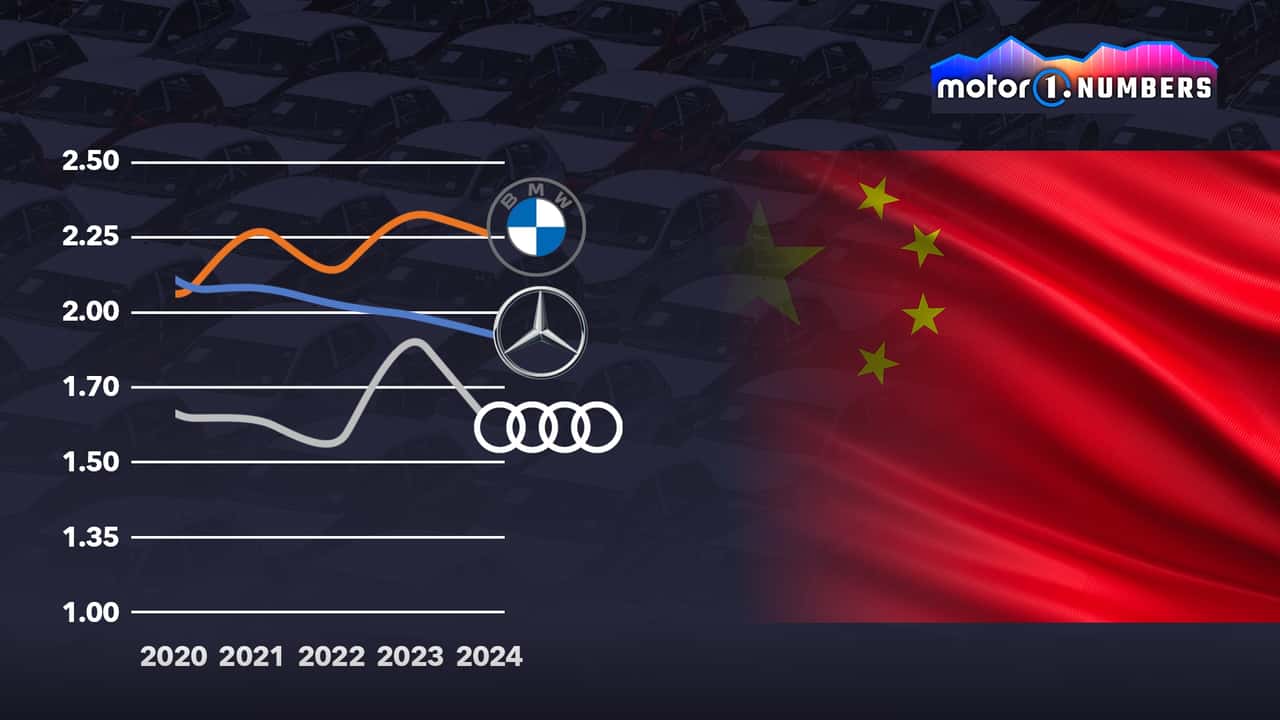

Things are not going so well for Audi, BMW and Mercedes. What was, a few years ago, the industry's role model is now a worrying case. Although their situation is not as desperate as that of some of their mainstream rivals from Europe, the US and Japan, there is a clear trend shift that needs to be carefully analysed.
In 2024, the three brands together sold 5.79 million units (excluding Mini, Rolls-Royce, smart and Mercedes vans) or 5.4 per cent less than global deliveries in 2023. This is the fourth lowest annual sales level in the last ten years for the three brands, behind only 2020 (pandemic year) with 5.77 million units, 2022 with 5.72 million units and 2015 with 5.58 million units.
Last year's total was almost 500,000 units lower than the 2019 record of 6.29 million units. In other words, the world's most powerful premium car brands lost half a million units in sales from before the pandemic to now. This is a large amount of cars that must cause concern, especially when considering production capacity.
BMW holds up better
However, the situation is not equally dramatic for all three brands. BMW, for example, has just recorded its third best year ever with 2.20 million units. It has managed to keep its annual volumes above 2 million units since 2016.
Not so for Mercedes, which was the leader among the three brands between 2016 and 2020, but then started to record declines from 2022. This brand lost 355,000 units between 2019 and 2024.

Cars delivered in the last ten years (excluding MINI, Rolls-Royce, smart and Mercedes vans).
Audi also has its own problems. Although it recorded a record in 2023 with 1.89 million units, it has not yet fully recovered after the pandemic. Last year, its overall volume decreased by 12%, the biggest drop among the three brands. The total volume was 1.67 million units, lower than the units sold during the pandemic years 2020 and 2021, with 1.69 and 1.68 million units respectively. The lack of new cars in the last two years had a negative impact on sales of the Four Rings brand.
Global deliveries
| 2023 | 2024 | 2023 vd 2024 | |
| Audi | 1,895,240 | 1,671,218 | -11.8% |
| BMW | 2,253,835 | 2,200,177 | -2.4% |
| Mercedes (without smart) | 1,973,800 | 1,923,400 | -2.6% |
| The three brands together | 6,122,875 | 5,794,795 | -5.4% |
Figures do not include Mini, Rolls-Royce, smart and Mercedes vans.
The real problem is China
In the past, China allowed Audi, BMW and Mercedes to have global dominance. Their cars were a benchmark for the country's fast-growing affluent class. As Germany became increasingly reliant on the Chinese economy, so did its major car manufacturers, including the Volkswagen brand.
This relationship worked until the pandemic hit the global markets and, as the world struggled against the blockades, China quietly began to upgrade its car brands.
Soon, a large part of the Chinese population shifted from foreign to local car brands. This shift was also triggered by the accelerated transition to NEVs (new energy vehicles) and the improvement of software and batteries of Chinese car manufacturers. As a result, they now have a market share of more than 60 per cent at home, at the expense of the lower sales of all non-Chinese manufacturers, with the exception of Tesla.
In 2024, sales in China fell for all three German brands, partly due to the lack of competitive electric cars in their range. Will they be able to catch up and 'modernise' their current image in front of China?
Cars delivered in China in 2024
| Brand | Units delivered | Var.% on 2023 |
| Audi | 650,000 | -7% |
| BMW | 702,000 | -13% |
| Mercedes | 648,000 | -11% |
| Total delivered in China | 1,999,000 | -10% |
Cars delivered by Chinese brands in 2024*
| Onvo | 21,000 | - |
| NIO | 201,000 | +26% |
| Xpeng | 190,000 | +34% |
| Denza | 126,000 | -1% |
| Li Auto | 501,000 | +33% |
| Zeekr | 222,000 | +87% |
| Xiaomi | 139,000 | - |
| Luxeed | 58,000 | - |
| IM | 66,000 | +71% |
| Fang Cheng Bao | 53,000 | +832% |
| Avatr | 74,000 | +149% |
| Hongqi | 412,000 | +17% |
| Voyah | 86,000 | +70% |
| Deepal | 244,000 | +78% |
| Total | 2,391,000 | +56% |
*deliveries mostly in China.
More industry analysis from our Motor1 Numbers series:
The author of the article, Felipe Munoz, is Automotive Industry Specialist at JATO Dynamics.
RECOMMENDED FOR YOU
Every New Car Debuting At The Goodwood Festival Of Speed 2026
Aston Martin Delays EVs To Keep The V12 Alive
'Get Blinded By It': BMW Driver Sees Holographic Tesla On Highway. Then He Notices How Light Is Reflecting Off It. Is That Legal?
‘If You Want A Bougie Car But You Also Want To Save Money’: Woman Reveals The Most Affordable Luxury Car. She’s Got A Point
Onboard With The BMW M2 As It Breaks Its Own Nurburgring Record
Sorry, Canada: You Won't Get The Slate Truck
'It’s A Half Hour Job': Woman Goes To Walmart For An Oil Change. 90 Minutes Later, She's Still Waiting—She Thinks She Knows Why