Ford Escort (1990-2000): Classic of the future?
Only a few "Golf hunters" of yesteryear have survived the test of time
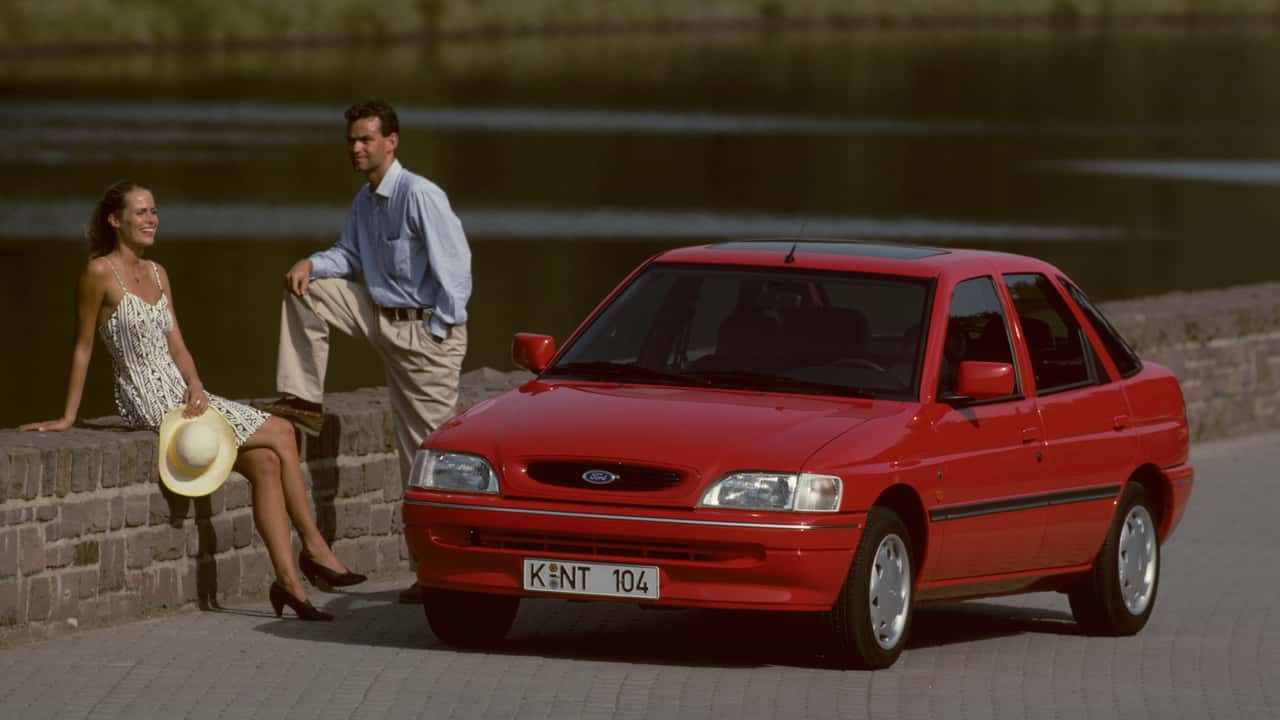

Our regular readers have probably already read our "Do you remember?" series. There we present cars from the past that are now almost forgotten. But what about the models that are still on the road in large numbers? The types that everyone knows, that have been on the road for well over 20 years, but in some cases much less.
Will they one day become classic cars? This is a source of controversy. We want to present some of these models in our series "Classic of the future?"
Gallery: Ford Escort (1990-2000)




If you're breathing a sigh of relief and thinking, 'phew, at least there's one that hasn't been inappropriately revived in some way', unfortunately this time there's no all-clear: it's already happened, as a compact saloon based on the Ford Focus for China. But the endeavour was not quite as inappropriate as past and current namings. (Keyword Capri...)
And before we all get in a bad mood, let's take a look at the glory days of Ford, when they were still cooking their own soup in Cologne and making good decisions.
Ford Escort Si (UK)
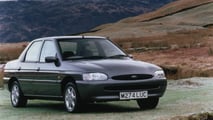
Ford Escort (1995)
At least some variants of today's classic car of the future are not on their way there, they have already arrived, and they are becoming increasingly scarce. We are, of course, talking about the number one Golf hunter of the time, the Ford Escort from 1990 onwards, officially called the '91, '93 and '95 models, but also known as the MK5, MK6 and MK7 among Ford fans.
Escort at number one?
Golf chaser number one? Yes, the then Ford Germany boss John Hardiman used such aggressive words at the time: "I would like to see a real three-way battle between the German mass-production manufacturers here again" - a challenge to the VW Golf and Opel Kadett.
After ten years and a tentative facelift, the Escort MK4 was finally replaced by a successor in 1990. Gone were the days when its angular body shape was still reminiscent of the Taunus and Granada. "The dictates of the wind tunnel have ironed out all the typical Escort corners and edges," writes the ADAC. But there is no complete revolution. Almost like Adenauer at the time, Ford came to the conclusion: No experiments! The Escort becomes curvier, more streamlined like the Sierra and Scorpio, but its stubby rear DNA remains.
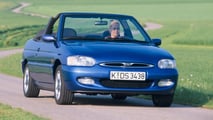
Ford Escort Cabriolet (1997)
In total, the attack on the top cost a whopping 2.5 billion marks. More than any Ford before it. The result is a compact car of similar external dimensions with an extended wheelbase and thus a generous amount of space. The driving behaviour is also more stable, more dynamic and at the same time more comfortable. And the Escort achieves another first: with the 1.8-litre Endura-DE, it has the first large-scale production naturally aspirated diesel engine with an oxidation catalytic converter, which is offered with 60 PS.
This helps to obtain approval for driving on ozone-rich summer days. Ford is fully committed to "environmental compatibility", according to the ADAC. If only they had known back then what is needed today for "environmental compatibility".
Although some engines, such as the 1.4- and 1.6-litre CHVs with 71 and 105 PS, were initially taken from the MK4 range, they were also grateful for the wind-friendly design and landed well below the magical seven-litre mark on long-distance journeys, as I was able to experience with my Escorts on several trips through Europe. In the course of its career, the 1.3-litre OHV from the Fiesta with 60 PS, the lively 1.6 and 1.8-litre 16V with 90, 105 and 115 PS and a turbodiesel with 90 PS were added.
Ford Escort Van (UK)
With the idea of conquering the top spot also came the strategy of one Escort for every person. The hatchback versions were available in three- and five-door versions, joined by a Tourer, a Cabriolet, the saloon version called Orion and a small van called Express. The range was therefore more extensive than that of the competition. Savings foxes bought the CL or CLX, well-heeled pensioners the Ghia and families of five the estate.
Dancing with the Golf
And Ford had a lot of fun with something else: sports versions. The Escort offers three. Die-hard GTI and GSi fans at the time didn't particularly like at least two of them. The classic Ford MK5 initially came as a sporty, comfortable XR3i with a 1.6-litre CHV, which was later replaced by the 1.8-litre Zetec 16V and 130 PS and also did its job in the convertible.
The RS2000 is more powerful. A revised 2.0-litre DOHC from the Sierra with 150 PS was used, including four disc brakes and Recaro interior equipment from 1995, even in an "F1 Edition" limited to 500 units.
But even then, Ford still needed a homologation model for the World Rally Championship. Enter the Ford Escort RS Cosworth. A turbocharged, longitudinally mounted 2.0-litre DOHC catapults the "Cossi" to 62 mph in a good six seconds thanks to all-wheel drive.
Ford Escort RS Cosworth
How can you recognise it? By the most brutal rear spoiler of the 1990s and the big cheeks. Good luck finding an untouched original below the €80,000 (£68,000) mark. However, all three are now classics. Even a good RS2000 now goes for five figures.
Short half-life
Although the Escort continued to run as the Escort Classic until the year 2000, it did not retain its original shape for long. As early as 1993, the front end and rear were redesigned. An oval grille and rounder, two-part rear lights were introduced. In addition, the compact was given better crash characteristics, an airbag as standard and a revised engine range in order to minimise the gap to the Kadett successor, the Opel-Vauxhall Astra, and to continue to appear modern. Ford calls this a completely new model.
Just two years later, the next revision followed in 1995, also a new model for Ford. The MK7 appeared even more rounded, particularly at the front and the bumpers. However, the silhouette of all models from MK5 to MK7 shows that this is a continuous development. This is because it has remained almost identical over the years.
Picture from more glorious days: 1. FC Köln 1995 with Ford Escort Cabriolet
It is also bizarre that the rear sections of the Turnier and Express remain the same as the launch model throughout all facelift phases. The interior now appears more rounded, almost playful. The Escort adapts to the language of the Fiesta and Mondeo. But soon the newcomers VW Golf 4 and Opel Astra G make it look like it belongs to a different era.
In 1998, Ford extended its New Edge design integrated into the Ka to the compact class and launched a completely new successor, the Focus. In 1992, 337,682 Escorts rolled off the production line. By comparison, only 243,400 units were sold in Europe in the first half of 2024. Despite this, the Escort was never able to unseat its two competitors.
More potential future classics:
In the meantime, rust, scrappage schemes and, beyond everything, tuning tinkering have significantly damaged the reputation of the entry-level, family-friendly Escort. Good, untouched models with a 1.4- or 1.6-litre CHV are currently still available for less than €3,000 (£2,500). These are often the ones that have been treated with care, unlike the popular 1.6 and 1.8-litre models, which half of my vocational school colleagues, among others, pounced on at the turn of the millennium.
So don't wait too long. The Escort is still technically an extremely agile and long-lasting daily driver that, with good rust prevention, is suitable for becoming a grateful classic.
RECOMMENDED FOR YOU
These Automakers Have The Most Visited Websites
Mechanic Says Your Toyota May Be Getting The Wrong Oil. Then He Changes Mobil 1 Formula: ‘As A Warranty Inspector This Would Void’
Ford's 57th Recall Of The Year Hits 288,000 Explorers Over Loose Roof Rails
Gotcha: Toyota's New Mid-Engine Sports Car Possibly Caught Testing On Video
Listen To Ford's New Race Car Fire Up For The First Time
A New V8 Mercedes C63 Is Coming. Eventually
Shelby's New F-150 Super Snake Spits Venom At The Ram Rumble Bee