Home
Jaguar
News
CEO: After the death of the current Jaguar comes a revolution
Jaguar is planning completely new and quite expensive electric models from 2025. We spoke with CEO Rawdon Glover about this.
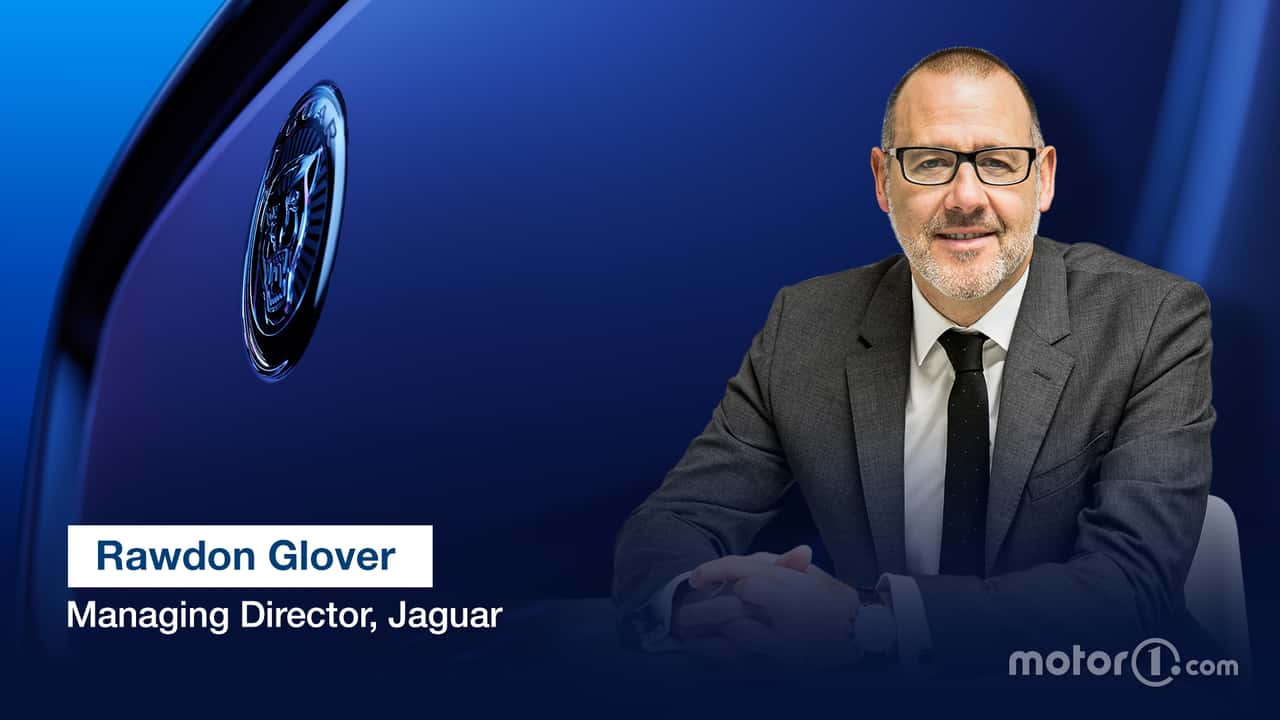
Photo by: Motor1.com

By: Alessandro Lago
Published by: Brian Potter
Jul 17, 2024 at 4:17am ET
Add Motor1.com as a preferred source in Google
- (https://twitter.com/intent/tweet?url=https%3A%2F%2Fwww.motor1.com%2Fnews%2F726893%2Fjaguar-model-revolution-interview-ceo-glover%2F&text=CEO%3A%20After%20the%20death%20of%20the%20current%20Jaguar%20comes%20a%20revolution&via=motor1com)
- copy
Share
Comment
Jaguar has officially initiated the process of "managed extinction" of its vehicles. All the models we know, from the F-Type to the E-Pace to the F-Pace, will no longer be produced and will not be replaced. This is an unprecedented industrial and commercial changeover, but one that is intended to voluntarily reposition the brand in line with the JLR Group's plans.
From 2025, Jaguar models will indeed become something completely different. The cars will be bigger, more exclusive and more expensive, with prices in the region of £100,000 or £110,000. There will only be three models, and the first will be a GT saloon over five metres long. The cars will be exclusively electric and have a range of around 435 miles, but those who buy them will not do so for this reason, but "because of the emotions they arouse".
Gallery: Last Jaguar F-Type (2024)

4


These are the words of Rawdon Glover, head of the Jaguar brand, who explained the reasons and ambitions for this revolution during a round table discussion with the press on the sidelines of the Goodwood Festival of Speed 2024. He believes that the market for electric vehicles today is flattened by technical requirements that force similar designs because they are developed with aerodynamics in mind.
"I don't think there are many distinctive electric vehicles out there today," says Glover, "and we have an opportunity to create something that is desirable first and foremost and makes people say, 'Wow, that's incredible! The philosophy should take its cue from the past, particularly that of company founder William Lyons, who maintained that Jaguar is at its best when it "copies nothing", leading to the creation of icons such as the D-Type, E-Type and, more recently, the XJ220 hypercar.
But let's see Rawdon Glover's answers.
Motor1: Won't Jaguar's new strategy be affected by the European de facto ban on combustion engines by 2035?
Glover: We believe that electric mobility is a kind of fusion that is progressing at different speeds in different parts of the world. We believe that electromobility will allow us to do certain things, especially in terms of the actual design. Once you've committed to an architecture, it's very difficult to say: "Oh yes, why are all the investments going in this direction? So we've committed to this direction."

Rawdon Glover, CEO von Jaguar
At company level, we have other brands and other platforms. All of that will change depending on market trends, but in terms of overall strategy, that's what it will be. Again, with any platform, it's a long-term game. You need around six years to bring new models to market and then you have a nine-year cycle.
So if you go for it, you're making a 15-year commitment to the platform. It's very difficult to walk away from that. For me, that's the future, whether it comes as quickly as we thought or whether it comes a bit later. But there is no way we can put in a hybrid engine or a petrol engine. We can't go back.
But couldn't flexible, so-called multi-energy platforms be developed?
They are much more expensive. Flexibility has its price. So I'm not sure it's so easy to say: "We should have chosen a flexible platform", because in reality we would have taken a completely different route in terms of vehicle design and proportions. There are pros and cons.
Jaguar Classic Goodwood 2024
Jaguar
The world of luxury sports cars and electric vehicles don't seem to get along. Let's look at the Taycan, which had a good start and is now seeing a drastic drop in sales. What do you think about that?
Our first car will be a four-door Grand Tourer, so it will be different from the Taycan. There will be other cars with different body styles, which will be in different market segments.
We are starting with the four-door GT, not because it is the biggest segment, but because we think it is the most important one to establish the brand. That's why we chose the 4-door GT, because it has a pure design and establishes the Jaguar movement. We knew it would never be the biggest market we could tap into, but that's why we wanted to focus on this vehicle.
In terms of components, Jaguar is positioned higher today, but has a lot in common with Land Rover. Will you change this strategy?
Yes and no. I should have said from the outset that the products are based on their own architecture. We have the MLA, which is also used for the Range Rover. We call this architecture JEA, which stands for Jaguar Electrical Architecture. It is only for us. This means that we are not restricted in terms of design, which would have been the case if we had switched to the MLA platform.
In terms of the software, battery technology and infotainment systems, they will be very different, but many of the underlying systems that define the vehicle will be used across the JLR group.
JLR is unique, and the reason it's important to us is that Range Rover is an SUV brand and the MLA is an SUV architecture. So having an independent architecture is very important for us.
Range Rover 2022
Range Rover Sport 2022
Do you change much about the components you see in the car? The seats in a Range Rover Sport, for example, are very similar to those in a Range Rover.
The seats in Jaguar products will be completely different. The interior design will also be completely different. Some of the basic technologies of the car, many of the accessories will be the same, but when you get into the car, will you think you're touching the handle of a Range Rover? Not at all. The feel will be very, very different.
Where will the factories be based? Will they be based in the UK?
Yes, in Solihull. Solihull is where we produce the Range Rover and Range Rover Sport, and a completely new plant is being planned for all three products.
So no production in Asia?
No, all products are developed and built in the UK.
Which are the most important markets?
The ones that are expected in terms of size: China, USA, UK, Germany, Italy, Canada. The northern European market, Norway and Switzerland. So I think about 10 or 12 markets will make up the bulk of our volume, which will be about 25 countries, then it will shrink.
What is the biggest challenge, the biggest difficulty in this repositioning strategy?
I think that's a very important question for us. And I think the product itself helps. We assume that 10-15% of our current Jaguar customers will follow us, so relatively few. Of course, we know a lot of customers who drive Range Rovers and Defenders.
We know them well. So it will be an opportunity to talk to them. If we think about the Jaguar of today, a premium vehicle with an entry-level price of 50,000 or 60,000 euros, well, we are now going in a completely different direction when it comes to luxury.
More from Jaguar:
What's the matter with Jaguar?
Jaguar's new GT will be previewed by a concept by the end of the year
From Formula E to the road: Jaguar's commitment to electric power
Only 88 units will be made of this 600-bhp Jaguar XJS restomod
Everything we do, whether it's marketing communications, a website, an app or an HMI, has to enhance the customer experience. It's certainly not the most innovative thing in the world, but it's not being done consistently anywhere. And it's something we need to be passionate about. The way the brand presents itself is really important.
If you could give us a preview of the new GT, what would you say? Is it more like an XJ or an XF?
It has a remarkable road presence and the proportions are a far cry from what we do today. To achieve this, I split the design team into three groups. Within three months, they developed 17 full-size models with different design languages, some were familiar, others looked like something out of a science fiction film. The design language we chose is exuberant. Just think of something that will be really different on the road. And in December 2024, we will unveil our new design language.
As for the timeline, do you want to launch the car in 2025?
I would like to have the car ready in 2024. As I said, we will unveil our new design in December, and in 2025 we will present the first GT, which will be launched at the end of next year.
What about the current models?
The Jaguar F-Type has been discontinued, the last one was produced at the end of May 2024. I was there and it was a historic moment. The same goes for the XE and XF, which are no longer in production, and at the end of this year it will be the turn of the I-Pace and E-Pace. At the moment we are still working on the F-Pace to see how long we will continue to produce it, and it will be the last Jaguar with an internal combustion engine.
Jaguar F-Type
Jaguar XF
Jaguar I-Pace
But it will continue to be sold. In the UK, stocks will run out this year, as they will in France. Elsewhere, they will last a little longer. We need a clear cut.
Do you expect the market share of luxury cars to grow significantly? Are you planning to set up a new sales network?
Yes, we see the luxury market growing. I think I've been in the automotive industry for quite a while and I've worked for brands where you were fixated on the competition and spent all day looking at their specifications, their prices and their volumes and planning accordingly.
We're not going to do that, because we think that in the price range that we're going to be in, we're obviously in a competitive environment, but buyers often have multiple cars at home. It's going to be whether I buy this car, whether I buy this boat, whether I completely renovate my house, whether I buy my third house, or whatever, so we're going to be competing with multiple things.
Jaguar Classic Goodwood 2024
Jaguar
Look at Bentley, Ferrari, Aston Martin, look at their average prices, which keep going up, but they're all driven by the need to create something desirable, something unique, maybe a one-off, but really it's just about working out how to tap into the wealth that's there and finding different points for that base.
As for the second part of the question, we will operate partly through a reduced retail network. Because a higher price clearly means lower volume. We will focus more on urban areas: Paris, London, Tokyo, Chiang Mai - we will have our own shop where we can fully control the environment and experience and ideally add value.
What do you think?
View
Comments
What makes you confident that you can do better than your competitors?
I think the most important point is the design. When I look at our design, I've seen things that you haven't seen before and I think it really stands out. I don't see anything like it on the market.
Jaguar F-Type in Goodwood 2024
Jaguar
Jaguar Classic Goodwood 2024
Electric cars are an incredible tool in terms of the dynamics of the car, but most importantly the experience has to be wonderful, and I'm happy to say that every time we show people our car, they say, "It's wonderful," and that's the point.
Gallery: Jaguars of the past at Goodwood
45




Source: Jaguar
We want your opinion!
What would you like to see on Motor1.com?
Take our 3 minute survey.
- The Motor1.com Team
Share this Story
- (https://twitter.com/intent/tweet?url=https%3A%2F%2Fwww.motor1.com%2Fnews%2F726893%2Fjaguar-model-revolution-interview-ceo-glover%2F&text=CEO%3A%20After%20the%20death%20of%20the%20current%20Jaguar%20comes%20a%20revolution&via=motor1com)
- copy
GO TO COMMENTS
(
)
Got a tip for us? Email: tips@motor1.com
View all comments ( )
Popular
12 Cars With Names That Make Absolutely No Sense
BMW Kept This Hatchback A Secret For Decades
Bugatti Restores One-Off Veyron With A Mirror-Like Aluminum Body
The Gas BMW M3 Isn't Dead: Next-Gen Prototype Roars
latest articles
- Every Rolls-Royce Has A Hidden Feature Most People Don't Know About Oct 20 - Motor101 -
- Subaru Built A 510-HP Electric Wagon Without Toyota's Help Oct 20 - Official -
- The Strange Reason The Golf GTI Had A Golf Ball Shifter Oct 20 - Motor101 -
- Photos: Porsche's Mission S Concept Takes Over New York City Oct 20 - Design -
- The 2027 Honda Passport TrailSport Looks Noticeably Taller Next To Last Year's Model Oct 20 - Off-Road -
- 12 Cars With Names That Make Absolutely No Sense Oct 20 - Lists -
- The Ford Ranger Is Getting A Bigger V6 For 2027: Report Oct 20 - Rumors -
RECOMMENDED FOR YOU
Jaguar Explains Why It Had To Kill All Gas Cars
Subaru Built A 510-HP Electric Wagon Without Toyota's Help
50,000+ People Apparently Want Jaguar’s Radical EV, Most Have Never Owned A Jag
The Strange Reason The Golf GTI Had A Golf Ball Shifter
Jaguar's Next Model Could Be An SUV With Type 01 Styling
Photos: Porsche's Mission S Concept Takes Over New York City
Jeremy Clarkson Is Growing A Jaguar F-Type On His Farm