Polestar 4: First tests criticise the missing rear window
Closed rear as a trademark and weak point of the new model
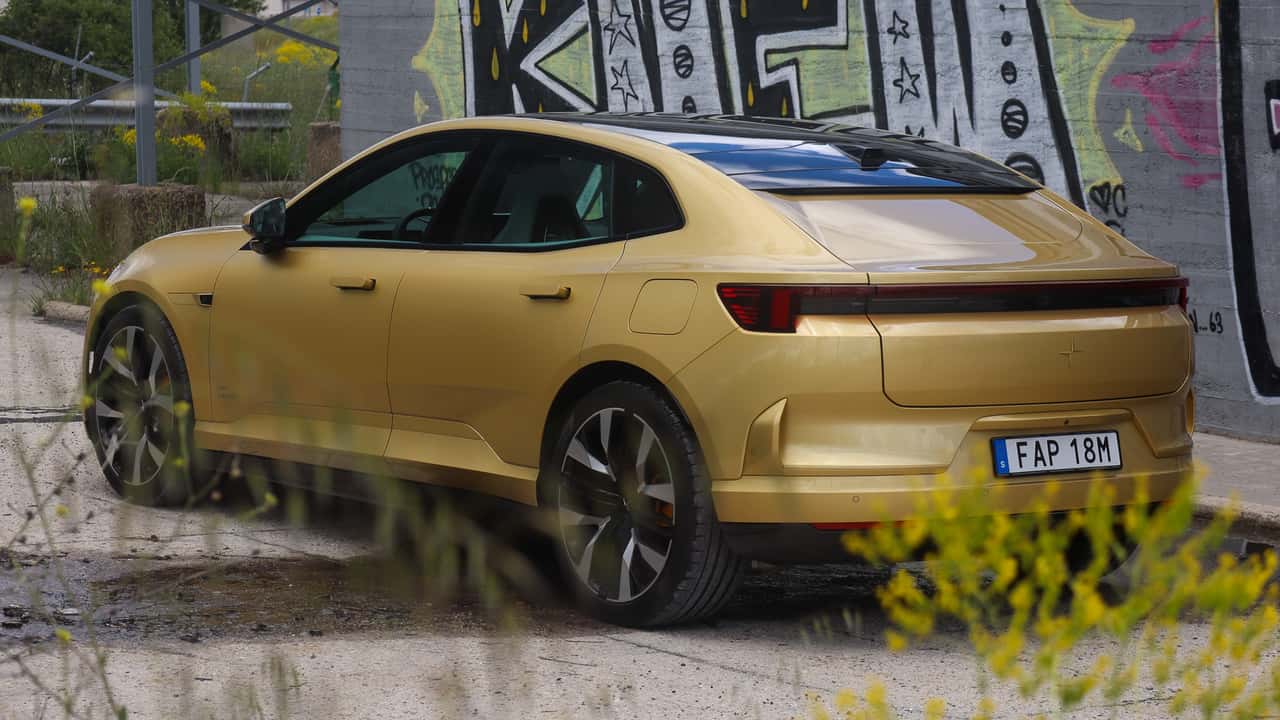

"A car without a rear window? Then I might as well buy a van, right?" The initial test results for the Polestar 4 are not quite as blatant as this purely fictitious statement, but the lack of a rear view does bother the testers considerably. We took a look at the reports from Autocar and our US sister site and summarise the test results here.
- Classification and exterior
- Platform, drive and battery
- Interior and all-round visibility
- Driving impressions
- Prices and conclusion
Classification and exterior
The Polestar 4 is difficult to categorise, says Vicky Parrott from Autocar. The car lies somewhere between SUV and coupé, executive car and sports car. Polestar itself categorises the car as a mid-range coupé SUV, as Kevin Williams from InsideEVs USA writes. In any case, the body is 4.84 metres long and 1.53 metres high. The shape and size lie roughly between the Polestar 2 (4.61 m long and 1.48 m high) and the Polestar 3 (4.90 m long and 1.61 m high).
The car competes with the Porsche Macan, the upcoming Audi Q6 e-tron Sportback, the Tesla Model Y and the Genesis GV60. However, the body shape also has something in common with electric saloons such as the BMW i4.

In our opinion, the front looks quite acceptable
Vicky doesn't like the look, but the design is eye-catching and polarising, which is certainly better than boring. She is presumably referring to the rear, as the front looks quite harmonious to us. Kevin says that the Polestar 4 doesn't look fantastic, but at least "quite okay".
Platform, drive and battery
The car is based on the Sustainable Experience Architecture from parent company Geely, on which the Volvo EX30 or the Smart #1 are also based, but not the Volvo EX40 (CMA) or the Polestar 3 (SPA2). The drive is provided by a 272 PS motor at the rear or two motors for a combined 544 PS. Kevin is reminded of the Zeekr 001, which has the same platform and the same motors and even comes off the same production line in China. Both powertrains have a huge battery with a net capacity of 94 kWh. This ensures ranges of around 373 miles, which justifies the name Long Range.
|
Polestar 4 Long Range Single Motor |
Polestar 4 Long Range Dual Motor | |
| Drive | RWD 272 PS, 343 Nm | RWD 544 PS, 686 Nm |
| 0-100 km/h | 7.1 sec. | 3.8 sec. |
| Top speed | 124 mph | 124 mph |
| WLTP power consumption | 17.7-18.1 kWh | 18.6-21.0 kWh |
| Battery gross/net | 100 / 94 kWh (NMC) | 100 / 94 kWh (NMC) |
| WLTP range | 379 miles | 360 miles |
| Max. Charging power AC/DC | 22 / 200 kW | 22 / 200 kW |
| DC charging time (10-80%) | 30 min | 30 min |
| DC charging speed (10-80%) | 2.2 kWh/min | 2.2 kWh/min |
| Charging price | £59,990 | £66,990 |
Alternating current charging with 11 kW is standard, with the 22 kW charger from the "Plus package" available as an option. Up to 200 kW is possible at the fast charger, which should enable the battery to be charged from 10 to 80% in 30 minutes. This results in a charging speed of 94 kWh*(0.8-0.1)/30 min = 2.2 kWh/min - a very high value for a 400-volt system. Incidentally, the new version of the Zeekr 001 has a voltage level of 800 volts. This means that the battery can be charged in less than 12 minutes.
Interior
Inside, there is a 10.2-inch instrument display and a 15.4-inch screen in landscape format, with the Plus package adding a head-up display. According to Vicky, the car feels more like a coupé than an SUV. It is annoying that you have to adjust the ventilation via the touchscreen. The materials are praised by both testers. Beautiful fabrics or optional nappa leather create a Scandinavian ambience. Kevin thinks the interior is even better finished than the more expensive Polestar 3.
Polestar 4 (2024): Das Cockpit
Google software runs on the touchscreen; the rather large icons are easy to hit with a finger. The integrated Google Maps also works well. Kevin finds the system better than the one in the Polestar 3, which, unlike the model tested, has a screen in portrait format. He likes the uniform orange and white appearance of the graphics.
The start page can be configured so that the lane departure warning system, recuperation modes etc. can be called up at the touch of a button. But for some important functions you have to click through several submenus, as both testers found.
This picture gives you an idea of how dark it is in the rear
Both testers are impressed by the amount of space in the rear. People up to around 1.80 metres tall should be able to sit comfortably in the back. This is due to the fact that the roofline remains fairly straight up to a kink just before the missing rear window, writes Vicky. However, Vicky and Kevin also find it a little too dark in the rear. The standard glass roof minimises this impression, but there is still a feeling of confinement. Kevin also describes the rear as "claustrophobic".
Above all, however, the all-round visibility is modest. The image from the reversing camera shown in the interior "mirror" is good, but not as clear and sharp as a normal mirror, and the view when looking over the shoulder is not exactly brilliant either, according to Vicky. Kevin was also very annoyed by the lack of a rear window, especially the lack of distance information, which doesn't make driving in a busy city any easier. Instead, he kept turning his head from left to right to look for pedestrians, cyclists and other cars in the wing mirrors.
The boot offers an impressive 526 to 1,536 litres, plus a 15-litre frunk for the charging cables. This makes the load volume large, writes Kevin, but not as large as the Model Y, which according to the user manual still offers 814 litres of boot space in a five-seat configuration, and even 2,041 litres with the rear seats folded down.
The boot opening has a slope
Boot on a live image from Polestar Day 2023
Driving impressions
Despite the mediocre sprint time of 7.1 seconds, the single-motor version with 272 PS feels more than lively and the pedal feel is good, praises Vicky. The recuperation is set in three stages via the touchscreen: off, low or standard. Off means sailing, low means fairly mild recuperation and standard corresponds to one-pedal driving. A little more recuperation modes in the centre range and paddles on the steering wheel to adjust the settings would be nice, says Vicky.
The steering is direct and the response to steering movements is predictable, according to the test editor. Body roll remains low. On the 21-inch tyres, the Polestar 4 Single Motor remains stable at higher speeds, but there is a noticeable shudder and knocking in the city. Overall, the Polestar 4 is not quite as appealing to drive as the BMW i4 or the Porsche Macan.
The all-wheel drive vehicle with the Performance Package (adaptive dampers and sports suspension) shortens the sprint time to 3.8 seconds. This makes the acceleration seem pretty brutal, which encourages sporty driving. The all-wheel-drive car with the sports suspension and 22-inch tyres feels firmer and comes close to the BMW and Porsche in terms of driving feel. Overall, however, Vicky likes the more relaxed single-engine version better. It also offers better value for money.
Kevin found the all-wheel drive agile and praised the vehement acceleration and low body roll when cornering. With the controlled shock absorbers, however, the car would not roll quite as comfortably as the Zeekr vehicles with air suspension that he has driven. However, he criticised the "fairly vague brake pedal", i.e. the somewhat vague brake feel.
Prices and conclusion
At just under £60,000 for the rear-wheel drive model and £67,000 for the all-wheel drive model, the Polestar 4 is not exactly cheap, says Vicky. However, the standard equipment is very generous. It includes a heat pump, keyless entry, electrically adjustable and heated front seats, a 360-degree all-round visibility system, adaptive cruise control and three-zone automatic air conditioning.
All in all, the Polestar 4 is more coherent than Vicky had feared as it drives well, is spacious, has plenty of range and looks interesting. The "rebellious" design is probably also the main reason to buy one, as other models would drive better and the view to the rear is not obstructed.
Kevin writes that the lack of a rear window could be a requirement for many, and the poor visibility to the rear would not be offset by any significant advantage. He is therefore concerned as to whether this model, which is so important for Polestar, will fulfil expectations in terms of sales figures, especially in Asia, where it competes against the technically superior Zeekr 001 and Zeekr 007 models.
More about the Polestar 4:
Sources: Autocar, InsideEVs.com, Polestar (Daten)
RECOMMENDED FOR YOU
Would A Massive Discount Entice You To Buy A Polestar 4?
You Bought The Car. Why Are You Still Paying For Subscriptions?
Polestar Won't Fight US Ban, Effectively Ending Its American Future
Car Salesman Says Nissan Rogue Is Identical To This Crossover SUV. The Other One’s Cheaper: 'Stole They Whole Flow'
The Best New Cars Coming Out In 2026
JLR's New North American CEO Has A Lot Of Work To Do
Polestar Is Finally Giving People What They Want: Buttons