Home
News
Commercial Vehicles
UK now has Europe's biggest zero-emission bus market
Just like the EV car segment, the sector is facing challenges, though.
Angel Sergeev 
By: Angel Sergeev
Feb 20, 2024 at 4:29am ET
Add Motor1.com as a preferred source in Google
- (https://twitter.com/intent/tweet?url=https%3A%2F%2Fwww.motor1.com%2Fnews%2F709287%2Fuk-europe-biggest-zero-emissions-bus-market%2F&text=UK%20now%20has%20Europe%27s%20biggest%20zero-emission%20bus%20market&via=motor1com)
- copy
Share
Comment
The UK's bus, coach, and minibus market is showing signs of resurgence after a challenging few years, with 4,932 new units registered in 2023, as revealed by the latest figures from the Society of Motor Manufacturers and Traders (SMMT).
This represents a significant 44.6 per cent increase compared to 2022 levels, indicating a gradual return of passenger confidence. However, despite this uptick, registrations remain 16.0 per cent below the levels seen in 2019, highlighting the lingering effects of the pandemic on the industry.
Gallery: UK new bus and coach 2023 market

5

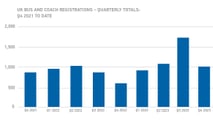
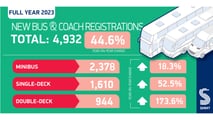

The revival of the market has been primarily driven by robust investment in single and double-decker buses, with registrations soaring by 52.5 per cent and 173.6 per cent, respectively. Additionally, minibuses have experienced notable growth, with a rise of 18.3 per cent over the year, as fleets across the UK invest in new passenger transport assets.
A noteworthy trend within the sector is the increasing adoption of electric or hydrogen vehicles, which accounted for a remarkable 45.1 per cent of new single and double-decker bus registrations. This figure nearly triples the market share of new cars, underscoring the pivotal role buses play in Britain's journey towards achieving net-zero emissions. With 1,159 zero-emission vehicles (ZEV) buses entering service last year, the UK emerged as Europe's largest ZEV bus market by volume.
What do you think?
View
Comments
However, challenges persist, particularly within the minibus segment. Unlike van drivers who have a license derogation allowing them to operate zero-emission vehicles weighing up to 4.25 tonnes, minibus drivers must wait until 2025 before being permitted to do so. This delay in licensing is stifling demand, as many minibus fleets defer their investment in zero-emission vehicles until their drivers are authorised to drive them.
To address these hurdles and accelerate the transition to greener transportation, the industry is calling for swift action. Funding initiatives like the Zero Emission Bus Regional Area (ZEBRA) programme, initiated in 2022, have provided crucial support. However, with 58 expressions of interest filed for the second round of funding at the end of 2023, there is a pressing need for rapid approval and allocation of funds to expedite the rollout of affordable, zero-emission mass mobility solutions.
UK's shift towards zero-emission mobility:
UK: Auto industry calls for EV incentives
One-millionth electric car hits UK roads
Source: SMMT
We want your opinion!
What would you like to see on Motor1.com?
Take our 3 minute survey.
- The Motor1.com Team
Share this Story
- (https://twitter.com/intent/tweet?url=https%3A%2F%2Fwww.motor1.com%2Fnews%2F709287%2Fuk-europe-biggest-zero-emissions-bus-market%2F&text=UK%20now%20has%20Europe%27s%20biggest%20zero-emission%20bus%20market&via=motor1com)
- copy
GO TO COMMENTS
(
)
Got a tip for us? Email: tips@motor1.com
View all comments ( )
Popular
12 Cars With Names That Make Absolutely No Sense
BMW Kept This Hatchback A Secret For Decades
Bugatti Restores One-Off Veyron With A Mirror-Like Aluminum Body
The Gas BMW M3 Isn't Dead: Next-Gen Prototype Roars
latest articles
- Photos: Porsche's Mission S Concept Takes Over New York City Oct 20 - New York Auto Show -
- The 2027 Honda Passport TrailSport Looks Noticeably Taller Next To Last Year's Model Oct 20 - Off-Road -
- 12 Cars With Names That Make Absolutely No Sense Oct 20 - Lists -
- The Ford Ranger Is Getting A Bigger V6 For 2027: Report Oct 20 - Rumors -
- BMW Already Has A Deal On The New i3. But It's Not Cheap Oct 20 - Pricing -
- Remember The Ford Flex? This Weird SUV Is Now A Great Used Buy Oct 20 - Why Buy? -
- Mercedes Isn't Sold On Extended-Range EVs: 'Would You Really Switch?' Oct 20 - Interview -
RECOMMENDED FOR YOU
Los Angeles Gets 500 VinFast EVs As New Ride-Hailing Service Takes On Uber And Lyft
Photos: Porsche's Mission S Concept Takes Over New York City
A Farm Tractor Just Set A Record At An F1 Track
The 2027 Honda Passport TrailSport Looks Noticeably Taller Next To Last Year's Model
Daimler Truck Shows Robot Rigs, Airships, Vertical Cities For 2070
12 Cars With Names That Make Absolutely No Sense
The VW ID. Buzz Cargo Is Now Longer And Ready To Haul More