MG Cyberster (2025) first drive: Pros and cons of the 510-PS roadster
The beautiful Chinese roadster is not an extreme athlete and doesn't do everything right, but it does a lot of things right
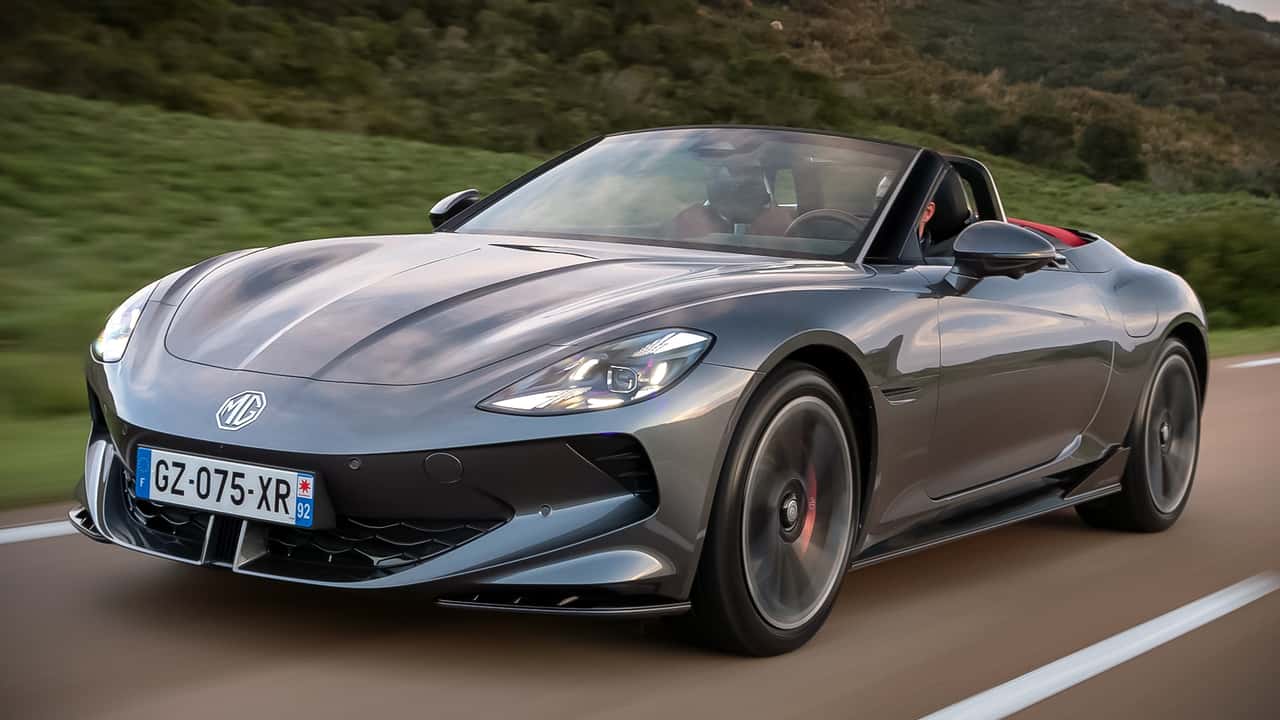

With such attractive curves and 510 PS, this new, highly exotic roadster has absolute dream car potential. And it costs less than £60,000. Enthusiasts with petrol in their blood rub their eyes in amazement and then the excitement is sucked right out of their faces as soon as they find out that this is a purely electric and Chinese car.
Time to throw old sports car stereotypes overboard or is the MG Cyberster more appearance than reality? We were able to find out during a first ride on winding country roads (and a bit of motorway).
Jump straight to:
Exterior | Interior | Driving report | Conclusion
What's that?
A big, fat surprise? Not really, after all, the Cyberster was already shown as a study in 2021 and the production version was presented at the Goodwood Festival of Speed a good one and a half years ago. But the world's first electric production roadster, according to MG, is definitely a ray of hope. If only because nobody builds roadsters any more. And roadsters with scissor doors three times over. At least not ones that you can afford if you don't own seven holiday homes and a yacht with a helicopter on it.
Now a Chinese manufacturer (who mainly earns its money with very affordable small cars and SUVs) is reminding us what a classic British-style roadster should look like. Even if a brand logo of extremely classic British design adorns the bonnet of the car.
You will probably have noticed that the MG name was sold to SAIC in China after Rover went bankrupt. There, they are capitalising on the tradition they bought and simply giving themselves a present for MG's 100th birthday this year.

An extremely handsome gift, in our opinion, and the first roadster with an MG badge since the popular MG F, which was built from 1995 to 2005. According to the German press team, sales figures are not so important for the time being. However, the Cyberster should certainly polish up the manufacturer's image. And if it does manage to win over a few more buyers, then it is not unlikely that MG will follow it up with the remarkably attractive Cyberster Coupé. We would have absolutely nothing against it.
The basis for the open-top Cyberster is the Modular Scalable Platform developed by SAIC, which is also used by the MG4, which is in great demand, but with a longer wheelbase. For the sports car feeling, there is a double wishbone axle at the front, a five-link axle at the rear and a 50:50 weight distribution. The dampers are not adjustable.
Only the all-wheel drive top version Cyberster GT was available for the test drive. Here, two permanently excited synchronous motors (204 PS at the front, 340 PS at the rear) provide a system output of 510 PS and 725 Nm of maximum torque. It goes from 0-62 mph in just 3.2 seconds, with a top speed of 124 mph. The second variant leaves out the front motor, delivering 340 PS and 475 Nm of torque. Here, the 0-62 mph sprint should be achieved in 5.0 seconds, with propulsion ending at 121 mph.
Both versions utilise a very flat nickel-cobalt-manganese battery with a net capacity of 74.4 kWh. The WLTP range of the more powerful GT is specified as 316 miles. The maximum charging speed is 144 kW.
| Fast data | MG Cyberster XPower |
| Drive | 2 permanent magnet synchronous motors |
| System power/torque | 510 PS / 725 Nm |
| Battery | 74.4 kWh net |
| WLTP range | 316 miles |
| Max. DC charging speed | 144 kW |
| Base price | £59,995 |
Further performance parts come in the form of Brembo 4-piston brakes and Pirelli PZero tyres. In addition, the car was sent to England for a final tuning session before the European launch so that the development team there could adapt it to the driving dynamics preferences of local buyers. The suspension and assistance systems were therefore fine-tuned once again. In addition, the seats were lowered slightly and the car was fitted with a wind deflector.
Exterior
You wouldn't know it at first glance, but the MG Cyberster is quite a handsome fellow. In fact, we are a long way from the lively Mazda MX-5 vibes here. If we put it alongside a current Porsche 911 Cabrio, it comes closer. You can see for yourself in the following table:
| Dimensions | MG Cyberster xPower |
| Length x width x height | 4,535 mm x 1,913 mm x 1,329 mm |
| Wheelbase | 2,690 mm |
| Weight | 2,060 kg |
| Payload | 225 kg |
| Boot capacity | 249 litres |
You have to hand it to those responsible: When driving, you don't notice the vehicle's generous width (and the roads in the south of France, where we drove, are anything but casual) or its comparatively heavy bones.
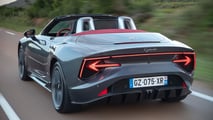
Even if beauty is always in the eye of the beholder, the majority will probably agree that the designers have achieved quite a feat here. The front does without the aggressiveness that has become so widespread in the meantime, appearing friendly but still present. The rear in Kammback design is perhaps the car's best feature, but with its thick diffuser and eye-catching rear lights, it would also be conceivable on a modern TVR.
The sweet spot is certainly the scissor doors, which have a whole host of buttons inside and out to open them. Practical: they barely open outwards, so they don't need much space at the sides. A sensor ensures that they do not hit the top when the ceiling is low.
Interior
If more and more German premium suppliers are "forgetting" how to bring cockpits with reasonable material quality to the people, Chinese manufacturers of all things must apparently remind us how it can all look. The Cyberster interior makes a really good impression in this respect, and if you use thin plastic, then just put a leather cover over it. Poof - problem solved.
With this application of artificial leather and fake Alcantara, it doesn't really matter, because the covers feel totally OK. In the case of the steering wheel, I even had to ask again to confirm. Yep, it's an artificial cow, I wouldn't have noticed.
In general, the cockpit is very driver-orientated. The passenger doesn't have much say and if he wants to adjust something, he has to bend at least a little. On the other hand, he gets a useful handle to hold on to with his left hand so that he doesn't turn green when you use the launch control or simply hit the accelerator.
Four screens (between 7 and 10.25 inches in size) provide information in front of the driver. However, there is no head-up display. Infotainment is located to the left of the instrument display, with various settings for charging etc. to the right. In the display below, you organise the performance settings and climate control, among other things.
All in all, this works relatively logically, but the screens are not the very last word in terms of response. You have to press them more often every now and then until something happens. Ergonomically expandable: The navigation screen on the left (regardless of whether you use Apple CarPlay/Android Auto or not) is covered quite extensively by the steering wheel and it's a bit awkward to steer past, like when the 2.10 metre guy is sitting in front of you in the stadium. However, MG is already working on moving the maps to the right-hand screen for the local market. That should put an end to the issue. In the same way, the Apple/Android mirroring will work wirelessly very soon.
The topic of sitting fits surprisingly well in the Cyberster. I recently read somewhere that from 1.80 metres it can get tight with your own hair and its contact with the soft top. I definitely can't confirm that. I would put the limit at around 1.90 metres. Furthermore, the seat can be pushed back far enough so that even taller people can stow their long legs under the steering wheel with ease.
The seats themselves could perhaps be a little larger, but they are extremely comfortable and hold firmly in place. The seating position is just a little too high. They know that at MG too, but they can't really do anything about it. In any case, it would enhance the interior, which is what you want so much when you drive a roadster, if your own bum was stowed a little further down.
Speaking of stowage: The boot of the Cyberster is relatively large for this type of vehicle and very usable. Regardless of whether the soft top is up or down (it does this in ten seconds at speeds of up to 30 mph), you can easily lighten the load at the winery on a weekend trip without having to carry your luggage on your lap.
The car also has a very useful storage compartment behind the seats (with a net), which will definitely swallow two smaller sports bags. There is no frunk, however, which seems a little odd considering how much bonnet space would be available for it.
Driving report
It's hard to believe when you look at the Cyberster's spectacular figure and performance data, but the MG representatives spoke to us almost with the tongues of angels during the test drive: No, this car is definitely not a hardcore sports car, but is fully designed as a Gran Turismo.
So if you want to dance on the razor's edge and preferably with the devil, you've come to the wrong place, and after a few hours with this beautiful birthday present, I can absolutely confirm the builder's assessment. Of course, this also raises the question of whether MG currently has the depth of development or the standing to bring an uncompromising driving dynamics monster á la Porsche 718 Boxster onto the market.
But the Cyberster certainly has entertainment value, so you can rest assured. As is the case with electric cars, especially those with a more performance-oriented approach, the forward thrust is far less important for the overall experience than the fabulous figures on paper might suggest. It speaks volumes that a 0-62 mph value of 3.2 seconds no longer makes you fall to your knees in disbelief and pay homage to the god of acceleration, but simply think: "Aha, so that too.
The acceleration is, of course, anything but gentle on the stomach, although you can regulate the rough kick in the back in three stages. "Sport" and, most importantly, "Race track" are somewhere in the "Warp speed" range on the speed scale, while the third level, "Normal", is similar to the pure e-mode of a plug-in hybrid. The performance can be modelled better here, but the Roadster is then already significantly slower. Unfortunately, I was unable to check out the combustion engine sound as one of two selectable sound levels, as a fault with the test car probably threw a spanner in the works.
The brake pedalling is unusually soft, so you have to tap in really hard to get a full deceleration performance. But that's what you get. Interesting: The four recuperation levels (adjustable via the left steering wheel paddle) are virtually indistinguishable from one another. Even if you click into the one-pedal driving mode, the recuperation remains pretty weak.
My impression of the steering and front axle: both could have a bit more bite. But the aim here really seems to have been a tuning towards a pleasant, well-behaved and safely tuned touring car and not a beast that delivers sensations on an assembly line, but constantly almost kills you.
The steering is not super fast, but it is quite harmonious, precise and smooth. For sportier driving, I recommend switching to the firmest of the three settings. There is then more meat and more feel. Then switch to the lighter modes for urban driving.
The engineers have done a very good job with the Cyberster's suspension comfort. Even on short bumps, the car does not show any weakness in this respect. One characteristic of the suspension set-up that is certainly worth discussing: the car quickly becomes unsettled on poor roads with bumps, gets out of sync and loses its balance/contenance more quickly than is actually desirable in a sports car.
With a Porsche or a BMW, they would never wave such a flaw through; on the other hand, it is precisely this behaviour that gives the Cyberster a liveliness and involvement even at lower speeds that is a lot of fun.
Gallery: MG Cyberster (2024) first drive
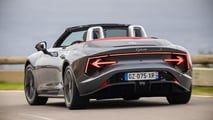
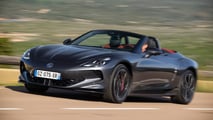
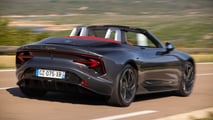
Nevertheless, I would recommend that those responsible take another look at the spring/damper set-up and bring a little more composure to the ride. However, the car does not lose its good-natured character as a result. A very strict eye was also kept on the ESP set-up. In this case, "off" definitely does not mean "off".
So if you try to turn the car sideways, which is not really a big problem with the monstrous power and the significantly more powerful engine at the rear, the stability control system will tell you rather rudely to please refrain from this nonsense. Even if you have previously "deactivated" it.
| Driving performance | MG Cyberster XPower |
| 0-62 mph | 3.2 seconds |
| Top speed | 124 mph |
| Fuel consumption | WLTP consumption: 3.25 mi/kWh |
One thing remains to be said: The MG Cyberster feels much more comfortable when driven at seven tenths than when you put the knife fully between its teeth. Gently curving country roads with longer, then also faster bends are its favourite domain. This is where it shows its strengths, where it feels very harmonious and pleasing.
Of course, the question remains as to whether the high performance level with two motors and all-wheel drive is absolutely necessary. The acceleration figures of the 340 PS version are also excellent. In addition, the pure rear-wheel drive and 100 kilos less weight could give the Roadster a good shot of more playfulness. We will hopefully soon be able to find out whether this is the case. The same applies to whether the single-motor Cyberster uses electricity more economically. Our test car's on-board computer showed a consumption of around 2.2 mi/kWh (naturally with a rather sporty driving style at times). This pushes the range below 185 miles.
Conclusion
MG's gift to itself is definitely also a gift to car fans. That may sound strange for an electric car of Chinese provenance, but who else dares to put a roadster on the market at the moment? Especially one that looks as gorgeous as the Cyberster?
As far as driving performance is concerned (this refers to the car's set-up, not its brutal propulsion), there is certainly room for improvement. Nevertheless, the first and only e-roadster on the market is fun to drive. What's more, its excellent ride comfort, very good seats and high-quality, spacious interior make it suitable for everyday use that you can really work with.
The power consumption was of course quite high in the test, and the price is certainly ambitious for an MG, even if the vehicles are in principle fully equipped for £54,995 and £59,995 respectively. For me, taking the objectively assessable parameters into account, a 7/10. Half a point on top for the looks and the courage to bring a roadster.
Learn more about MG:
RECOMMENDED FOR YOU
The V12 Mercedes-Maybach S680 Makes You Feel Like A Villain: Driven
Top Gear Star Richard Hammond Hit With $2,300 Speeding Fine And Seven Points
I Drove Ford's 300-HP Maverick. It Feels Like A Hot Hatch
Shocking: Ferrari's Controversial EV Is Reportedly Sold Out
The Ferrari 849 Testarossa Earns Its Name
Woman Goes On Test Drive. Then She Takes The Car Straight To AutoZone: ‘I Need A Full Diagnostic’
I Drove The Base Subaru WRX. It's Exactly What Enthusiasts Have Been Asking For