Audi RS 3 (2025) first drive: Fine tuning
Audi Sport makes its best horse in the stable a little more magnificent
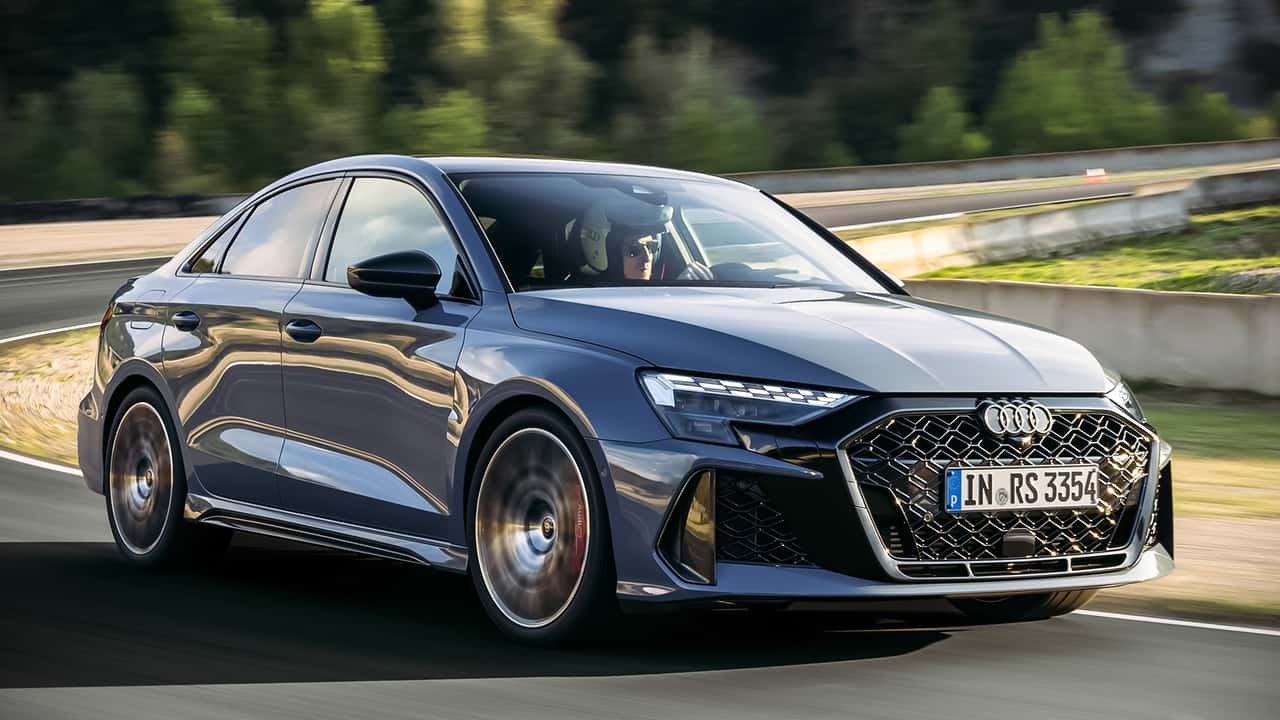

I think most of us will agree. Audi has really hit the mark with the current RS 3. After two immensely fast and loud, but largely clumsy driving tests, we didn't want to trust our brains, hands and butts when we were allowed to drive the Generation 3 for the first time.
The people around RS 3 project manager Marvin Schwätter were able to retain the fast and loud characteristics (the car has actually become much, much faster), but now the car suddenly danced and dribbled knots in our legs and was finally able to drive wildly and excitingly and easily from the hip. That was a good three years ago and although no one would have needed it in terms of talent, it's now getting the obligatory facelift. Including a new Nordschleife record for compact cars.
In 7:33 minutes, the optimised top A3 recently pounded the ring - a hefty seven seconds faster than before. So a lot must have happened. We have now been able to find out what exactly has happened, whether you can feel it in any way and whether, as a driver of the current model, you now have to sell your car immediately because the facelift is so much better.
Jump directly to:
Exterior | Interior | Driving report | Conclusion
What is it?
With the current efforts to overturn the EU ban on internal combustion engines, it is not yet entirely certain, but it is of course quite likely that we are witnessing the very last application of the glorious five-cylinder engine in a new car. So let's give ourselves a little space for mourning .......... before we continue with the current key data of the award-winning 2.5-litre turbo engine.
These have not changed at all compared to the pre-facelift. At first glance, this seems a little unusual, because there is always more power somehow, but let's be honest: even more power? Really? In our self-experiment, we achieved 0-62 mph times of 3.4 seconds in the previous vehicle. So a lack of propulsion was not really the problem.

Accordingly, it remains at 400 PS and 500 Nm. What doesn't remain is the heart-warming sound that the five-cylinder engine emits from its flap-controlled exhaust system. Don't worry, in spite of all the official regulations, the Audi boys and girls have found ways to improve the sound even further. The exhaust flaps now open more dynamically than before and can therefore open longer and earlier.
The 7-speed dual-clutch gearbox appears unchanged at first glance, but as with many other things in the facelift, this is only superficial. Thanks to our daily dose of EU madness - in this case the new cyber security requirements - all the control units and the entire software have had to be redesigned. The customer should notice as little of this as possible, but of course there were opportunities for a little fine-tuning. After all, the radically better Nordschleife time doesn't drive itself.
| Fast data | Audi RS 3 Sportback 2025 |
| Engine | 5-cylinder turbo petrol engine; 2,480 rpm |
| Gearbox | 7-speed dual clutch |
| Drive | All-wheel drive |
| Power output | 400 PS at 5,600 - 7,000 rpm |
| Max. torque | 500 Nm at 2,250 - 5,600 rpm |
| Base price | £60,105 |
So they looked at the gear ratios and got a bit more out of them, but they looked even more closely at the so-called Brake Torque Vectoring. This is the big headline with this model revision anyway and the main reason why the RS 3 is supposed to shred through the bends even more successfully and swiftly than it already does.
This is because the torque splitter - the all-wheel drive system introduced in 2021, which can also distribute power between the rear wheels via two multi-plate clutches on the rear axle - is a hell of a fun piece of hardware and is mainly responsible for the current generation's explosion of fun. But when it came to thrust - in other words, when you took your foot off the accelerator - it didn't do anything until now.
This gap is now filled by Brake Torque Vectoring. In practice, this means that in these previously wasted phases, the car now recognises from the steering angle whether you want to enter the bend quickly, applies the brakes and then brakes the wheels on the inside of the bend, which should significantly tighten the turn-in and prevent understeer even better. Another advantage: the drift mode (in RS 3-speak: RS Torque Rear) is now designed to make the rear end fly even faster.
Another driving dynamics booster comes in the form of new tyres. Previously, there were low rolling resistance tyres (evil tongues claim that it wasn't just the rolling resistance that was poor), such as the Label A-Pellets or the rather radical Pirelli PZero R-Semislick. Now you can also get much grippier Label C tyres in the form of the Bridgestone Potenza Sport or the Pirelli PZero R. The golden mean, so to speak. Both bite better in the dry than the basic rubber and should grip in a completely different world in the wet.
Everything else was already relatively close to God mode in terms of driving dynamics, which is why the other facelift changes are limited to the look inside and out. We'll come to that in a moment. Prices for the revised RS 3s start at £60,105 for the RS 3 Sportback, while the RS 3 Saloon is available from £61,105 and are available now in the UK.
Exterior
We can keep it short here. As is usual with a facelift, the RS 3 gets new aprons and lights with modified light signatures. Lots of light signatures, because: Audi.
Remarkable: Audi itself describes the design of the front as "brute". Martial rhetoric that certainly matches the appearance with the revised single-frame grille and the thick air intakes. To the delight of all "form follows function" advocates, the terrible decorative honeycomb grille at the rear has been removed and a much more imposing look has been created, which is primarily characterised by the rather enormous new diffuser with its central motorsport reflector. Très chic. Especially if you order all the add-on accessories such as air inlet trims, mirror caps or even the diffuser in genuine carbon fibre.
| Dimensions | Audi RS 3 Sportback 2025 |
| Length x width x height | 4,381 mm x 1,851 mm x 1,418 mm |
| Wheelbase | 2,631 mm |
| Weight (incl. driver) | 1,640 kg |
| Luggage compartment | 282 - 1,104 litres |
| Payload | 490 kg |
| Roof load | 75 kg |
| Towing capacity | erm ... no! |
New 19-inch wheels are also part of the facelift programme. The cross-spoke wheels, which were previously only available in the RS 3 Performance Edition, are now also available as an option.
Interior
Sceptics will first notice the new steering wheel. It is now flattened south AND north. In addition, the classic buttons that everyone liked have been replaced by glossy black surfaces, which presumably not everyone will like. At least you don't have to swipe, you can still press. During the test drive, everything went smoothly in this respect; fortunately, accidentally reaching and immediately adjusting everything is a thing of the past. The new logo, RaceTex cover and the stylish red RS mode buttons give the valance a very high-quality look.
Speaking of which: unlike the new A5, the quality of the interior is still outstanding. You can also enjoy the Virtual Cockpit, which for me is still the best digital instruments far and wide.
New bucket seats in the RS 3
Steering wheel button for RS mode setting
Revised cockpit of the RS 3
Carbon back shell on the new bucket seat
Standard seat of the RS 3
In addition to chicer door panels, which will also light up in future, and the usual colour packages (green, grey, red) for air vents, seat stitching and the like, the absolutely fantastic bucket seat with carbon fibre rear panel makes its debut. Previously only available in the Performance Edition. I have now sat in this sports chair a few times and can only recommend it highly. It holds you firmly in place even when you're riding at a faster pace, but it's not a vice that crushes your hips or thighs. It is also absolutely suitable for long journeys.
Driving report
Even if the RS 3 is now something like the Real Madrid of the compact class in terms of driving dynamics, the star is still under the bonnet. The five-cylinder engine remains an absolute powerhouse and a constant source of robust stomach churning and exuberant grin attacks.
It has little appetite for smooth power delivery; up to around 3,000 revs it takes a deep breath, then it's time to hold on tight to the steering wheel and off you go. The whole thing is then quite humourless and like a wrecking ball right up to the 7,000 rpm limit.
The middle rev range is more powerful than one of those Asian all-you-can-eat buffets, but tastes much more pleasant. The needle (or rather the bars in the digital rev counter) rushes upwards so quickly that you don't know whether to describe it as a joy of revving or simply a power overload. In any case, the five-cylinder engine has lost none of its rich capacity for fascination and still offers a charisma and a wealth of power that no four-cylinder engine will ever be able to match.
As you can imagine, the soundtrack plays a huge part in the show programme. The immense sound potential of the five pots from Ingolstadt culminated in the 2016 Audi TT RS, when they were still allowed to roar completely untouched by particulate filters and the like, so that it was already getting tight for delicate ear canals. But even eight years and what feels like 37 "be quiet" regulations later, the sound of one of the most beautiful ignition sequences still reaches the ears with a pleasing amount of flavour and musicality. Thanks to the newly programmed exhaust flaps, it is even a little more musical and varied than before.
The gearbox does what it is supposed to do without being particularly hard or offering a spectacular shift feel (if you operate the paddles yourself). According to Audi, they were already at the limit in terms of shifting speed. I don't think anyone will complain that they would have liked more here.
Strikingly, the RS 3 (in this case equipped with the somewhat more merciful adaptive dampers) is definitely on the firm side. However, there's no need to worry about it crashing and rattling (also in terms of suspension noise comfort).
Nevertheless, it shakes you up quite a bit, even on decent country roads. But that's not necessarily a bad thing, because the control and damping quality are there. It feels more like the car is constantly on its toes and totally ready to sniff out and soak up the next bend. Very lively, very agile. And that is what ultimately makes the RS 3 the driving machine that it is - because it also challenges you, gets you very involved, something is always happening. That's exciting.
Basically, the steering is also very good. That wasn't always the case with the Four Rings. But Audi Sport now knows exactly how to tune the steering properly. It's traditionally not as fixed and over-twisted and front-axle-nervous as in products from M GmbH, for example, but rather more balanced, more sensitive and without synthetics or that rubbery stuff.
What I miss a little: around the centre position, everything feels too light and non-committal, there's not enough of what you could actually use for the initial steering impulse. Towards the outside, everything is fine again, but the car could be given even more character and authenticity with a firmer, more defined centre.
Otherwise, however, the front axle is a real joy to drive, and it communicates very well via the tyres, especially in longer or tighter bends that are taken at speed. What's more, it never smears, so you can really do whatever you want. Grip and bite are available in absolutely huge quantities.
What makes the RS 3 so magical, apart from the absolute energy and explosiveness that it brings to the road in such large parts, is definitely the wonderful balance with which it goes about its work. This is because its movements also benefit time and again from small impulses from the rear axle, which add a small but subtle dash of rear-biased power to the car's immense neutrality. This increases the fun and thrill potential enormously and, together with the great pull to the apex of the bend, feels even more pronounced than before the facelift.
| Driving performance | Audi RS 3 Sportback 2025 |
| 0-100 km/h | 3.8 seconds |
| Top speed | 155 mph (optional: 180 mph) |
| Fuel consumption | Manufacturer: 30.1 - 30.4 mpg-UK |
| Emissions | Manufacturer: 211 - 213 g/km CO2 |
Once again, the RS 3 proves to be an absolute force of nature. It is an immensely talented mix of "ride on a cannonball" and "so foolproof that even my pet would be fast".
This was demonstrated once again during a short stint on the racetrack with the Pirelli Trofeo R-Cup tyres. There's not much you can do wrong. Neither in the extremely neutral RS Performance mode, nor in Dynamic mode, which is a little more relaxed with its own rear end. Here it is actually the traction that makes the biggest impression. And the feeling that you can do so much with the throttle alone. Thanks to the new brake interventions, the car is even more compact in the centre of the bend and even quicker on the way out again. The Ingolstadt-based company has now also made the brakes suitable for the racetrack.
Conclusion: 9/10
Let's be honest, the facelift has not brought the RS 3 a major paradigm shift. We can all be very happy about that.
If you regularly tackle the racetracks of this world, you will be a little faster in future, because the car now does even more good things on bends. On the road, you might find a bit more pull into the corner and a bit more fire out of it, but you'll need a pretty good magnifying glass.
So nothing that changes the car dramatically, rather detail improvements, which means that the Audi RS 3 fortunately remains what it was before: a car whose engine, speed and handling are addictive. Without a doubt not only the fastest, but also the best compact sports car currently on the market.
More RS news:
RECOMMENDED FOR YOU
Audi Nuvolari And Jaguar Type 01 Storm Goodwood. The Internet Reacts
Car Salesman Says Customer Catfished Him—And Walked Away With The ‘Best Price Out The Door’
Watch The 2026 Goodwood Festival Of Speed: Live
Woman Tries To Rent A Car From Enterprise. Then She Checks Out Her Options At Costco: ‘I Was Literally Shocked’
Audi’s New Models Are Carrying It Through 2026
Tow Truck Driver Discovers Yet Another Car With Stolen Wheels. Then He Shares A ‘100% Guaranteed’ Way To Stop Tire Theft: 'Hurts'
Audi Is Rethinking Car Interiors: 'Subtle' Screens, More Buttons, Better Quality