Home
Porsche
911
Reviews
Porsche 911 GTS (2024) facelift test: Hybrid hype or e-castration?
The first electrified 911 is causing a stir. Is it all just for show or does the T-Hybrid really make the car better?
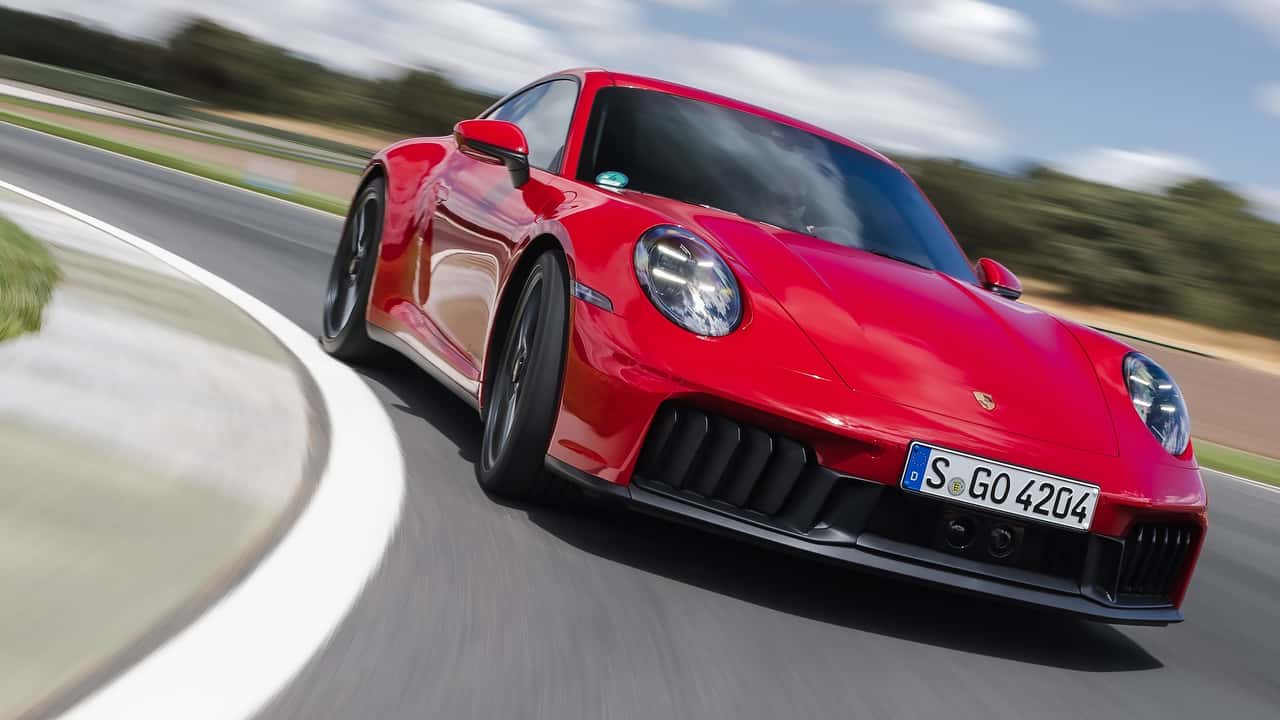
Photo by: Porsche

By: Stefan Wagner
Published by: Brian Potter
Jul 10, 2024 at 8:18am ET
Add Motor1.com as a preferred source in Google
- (https://twitter.com/intent/tweet?url=https%3A%2F%2Fwww.motor1.com%2Freviews%2F726081%2Fporsche-911-gts-2024-hybrid-test%2F&text=Porsche%20911%20GTS%20%282024%29%20facelift%20test%3A%20Hybrid%20hype%20or%20e-castration%3F&via=motor1com)
- copy
Share
Comment
The situation is nothing new. Just don't change anything about the sacred eleven, or else the crowd of petulant hardcore fans and click-happy journalists will be at the gates of Zuffenhausen with flaming torches and pitchforks, yet the past has shown that the uproar was rarely or never justified.
The switch from air to water cooling in the 996, the first Carrera with turbos in the 991 - was it really that wild? Of course not. As if the best sports car manufacturer in the world would unleash something on the public that is half-baked rubbish.
The latest excitement in the 911 universe: electrification, of course. The enthusiasts' souls are boiling. Bah, yikes! Have fun with this lead-heavy eco-nonsense! Hybrid? Gasping for breath faster than an electric turbocharger. But now it's here, the new 911 Carrera GTS with the so-called T-Hybrid. And once again the question arises: have they ruined "our" 911 or is it perhaps - God forbid - actually better than before? We look for answers on the racetrack and on the road.
Jump directly to:
Exterior | Interior | Driving report | Conclusion
What is it?
There have been plenty of denials and denials of denials in recent years. It has been clear for some time that the facelift of the 992, or 992.2 in Porsche parlance, would see the icon go electric. However, if you thought that the Stuttgart-based company would clumsily squeeze a plug-in hybrid drive weighing hundreds of kilos into the non-existent installation space of the 911 (hello BMW M5), then you don't know the people in charge very well.
Instead, in the best Swabian tradition, a great deal of ingenuity has once again shot through the engineers' brains. As it is only right and proper when you have to comply with crude EU madness, we start by - erm, exactly - increasing the engine capacity. The six-cylinder boxer is as new as it gets, is now 3.6 litres instead of 3.0 litres and has virtually nothing in common with the previous unit apart from the bore and stroke ratio.
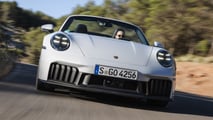
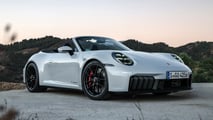
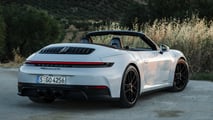
Gallery: Porsche 911 Carrera GTS Cabriolet (2024) in the test

27
Source: Porsche
In order to save space and weight, one of the two turbochargers has been thrown to the wind. The other is located at the bottom right of the engine and is comparatively huge. But that doesn't matter in this case, as it is electrically powered and you no longer have to wait for exhaust fumes to get the huge thing going. It gets going practically always and immediately. What the E-Turbo can also do: Play generator. To do this, it steals energy from the exhaust gas flow and passes it on to the electric motor or the battery as required. It does this with up to 15 PS. What a clever component.
And there is another advantage as the new, larger-displacement engine is a hefty 11 centimetres flatter than before. Flat Six in the best sense of the word. This creates space for the new power electronics (pulse inverter and DC-DC converter), which are now mounted on the motor. Another core component of the first 911 hybrid system is the electric motor located in the 8-speed PDK. It provides support with up to 40 kW and 150 Nm of torque. It is cooled by the transmission oil.
The dual-clutch gearbox itself has been reinforced because of more torque than before. The new B6 alone delivers 485 PS and 570 Nm, while the system output of the new GTS is 541 PS and 610 Nm. An increase of 61 PS and 40 Nm compared to the previous model.
The 400-volt battery with a capacity of 1.9 kWh, water cooling and a good 27 kilos in weight sits on the rear axle. That's still a lot of weight and because Porsche can't really use that in a 911, there's a new 12-volt lithium iron phosphate starter battery up front that weighs just 7 kilos. A normal starter battery weighs three times as much.
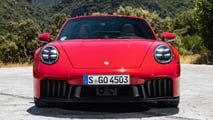
The new front of the Porsche 911 Carrera GTS (2024)
Porsche
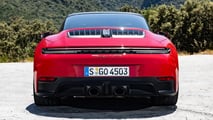
The new diffuser and tailpipes of the Porsche 911 Carrera GTS (2024) are reminiscent of the 911 GT3
All in all, the whole hybrid madness weighs 50 kilos more, and that makes it relatively manageable. A 911 Carrera GTS Coupé with rear-wheel drive now weighs 1,595 kilos. In return, however, it maintains Lambda 1 over the entire map. Lambda 1 stands for the ideal fuel-air mixture and is significantly important for compliance with future standards from Brussels.
The question now is: What is the benefit of this enormous effort on the road? In figures, for example, you will have travelled seven metres further than in the previous GTS after 2.5 seconds at the start. In addition, the acceleration time from 0-62 mph drops by 0.4 to 3.0 seconds. And if by chance you manage a perfect Nordschleife lap, you will be 8 seconds faster than the old GTS (7:16.93 seconds).
Fast data Porsche 911 Carrera GTS (2024) Engine Six-cylinder boxer with E-Turbo + electric motor; 3.6 litres Gearbox 8-speed PDK Drive Rear-wheel drive Power output 541 PS Torque 610 Nm Base price £132,600
Next to the hot hybrid news, the chassis innovations almost seem like cold coffee, but of course they are not. Thanks to adapted spring rates, further developed dampers, wider 315 rear tyres and a roll stabilisation system (PDCC) now integrated into the 400-volt architecture, it should be faster and smoother around corners in future.
In addition, rear-axle steering is now standard and the GTS has been given an absolutely brutal brake system. It is the 10-piston brake from the Turbo S with 49 per cent larger pads than before. What's more, the 410 millimetre rear discs are even larger than on the Turbo daddy.
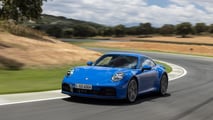
Gallery: Porsche 911 Carrera (2024) in the test
28




Source: Porsche
What should not be overlooked is that the basic Carrera also benefits from the facelift, of course. Thanks to the turbos from the previous GTS and the intercooler from the 911 Turbo, it now produces 394 PS (plus 9 PS).
Exterior
As far as the Carrera is concerned, you probably won't really notice the new features. Everything that previously shone in the front apron has been packed into the LED matrix headlights, which now come as standard. This creates space for larger air intakes. At the rear, there is a new light strip and a modified rear grille.
Here you can see the 992 Carrera front end before the facelift
And this is what the front of the 992 Carrera model year 2024 looks like
However, the design team has taken a much more radical approach with the GTS. Its front end now looks as if it could shred overconfident rivals from the left-hand lane in a fraction of a second. But the five striking flaps (plus one flap that you can't see) actually form this new, slightly frightening mouth for purely aerodynamic reasons.
When the power requirement is low, closed flaps optimise aerodynamics. When the power requirement is high the flaps direct a lot of air to the radiators. At the rear there is a much more dramatic diffuser and more centrally positioned exhaust tailpipes reminiscent of the 911 GT3. Incidentally, the drag coefficient is 0.27 at best, which isn't too bad for a sports car with halfway optimised downforce.
It should also be mentioned that there is a new aero package with 30 kilos more downforce on the rear axle. There is also a carbon-fibre package that looks damn sharp, especially on the GTS. And if you like it colourful: the PTS colour catalogue has been expanded to 127 shades.
Dimensions Porsche 911 Carrera GTS (2024) Length x width x height 4,553 x 1,852 x 1,292 mm Wheelbase 2,450 mm Unladen weight 1,595 kg Payload 450 kg Boot capacity front: 135 litres; rear: 261 litres (373 litres without rear seat)
Interior
Who says that electrification is the only point where the 911 revolution is happening with a knife between its teeth? Yes, just take a look at the cockpit of the 992.2, where you will now find a start button for the first time and fully digital instruments for the first time. My goodness, how are you supposed to digest all that?
Let me tell you, it is relatively easy to digest. Because a) the start button is naturally located to the left of the steering wheel and b) the previous curved display really wasn't the last word in wisdom. The two outer displays were solidly covered by the steering wheel and you could see very little. With the new 12.6-inch screen, this is significantly better and, if you want, you can of course switch to the classic 5-zone display digitally.
Interior of the new Porsche 911 Carrera Cabriolet
Porsche
The seats in the new Porsche 911 Carrera GTS (2024)
Porsche
Brown interior in the new Porsche 911 Carrera (2024)
Porsche
Another new feature is the deeper integration of Apple CarPlay. It now displays information in the instrument cluster on request and enables the operation of vehicle functions directly via Siri, for example.
And while we're at it: As before, the 911's controls work quite well, partly because there are sensible, high-quality buttons for the climate control. What works a little less well - at least for me - are the standard seats in the rear-engined icon. I've often wondered whether I'm just oddly shaped, but it's not the first time I've sat relatively uncomfortably in a newer 911.
Driving report
At last, you might think, we're off. The whole thing starts with the entry-level model, the 911 Carrera, on the nasty bends of the Ascari Race Resort. No need to familiarise yourself. If there's one thing Porsche has managed to get out of the 911 over the years, it's driving dynamics. The car is extremely smooth on the track, even at the limit, and feels even more confidence-inspiring.
Porsche 911 Carrera (2024) with unshakeable front axle on the Circuito Ascari
Porsche
Porsche 911 Carrera (2024) from diagonally behind in Ascari
As long as you don't do anything completely rubbish, you can't really get it out of its stride as it's extremely neutral and track-fast. The steering is once again an absolute dream. You wonder how they always do it. In addition, there is this incredible grip, and not just at the rear. The front axle stands like a rock. And for the rear to move, you have to really overdrive the car. But the magic of the 911 is that it still always feels exciting and totally involving.
Compared to the last model, the optimised three-litre is very well powered despite a single-digit increase in horsepower. Nevertheless, you have to rev it up properly if you want to make good progress - a game that it willingly takes part in with a throaty tinny sound in the vocal chords. The other 992s are now so ridiculously fast that it's a relief when the accelerator foot has to work a little harder for its money. That's all you really need for honest driving pleasure.
Driving performance Porsche 911 Carrera GTS (2024) 0-62 mph 3.0 seconds Top speed 194 mph Fuel consumption 25.7 - 26.9 mpg (WLTP) emissions 239 - 251 g/km CO2
But of course the 992 with its countless variants can always do more. The GTS is likely to attract the most interest in the near future, and not just because it sports a brightly coloured "hybrid" badge, but first and foremost because it is an absolute beast.
The ability to hop straight from the basic Carrera into the GTS helps immensely, of course. And let's tell it like it is: the "electric car" really does feel like a completely different car. You instantly recognise a much more aggressive character, which is noticeable thanks to the mix of extreme extra power and more spontaneous throttle response.
We are now talking about driving figures that are not too far removed from those of the almighty 911 Turbo. Only two tenths are missing up to 62 mph, and seven tenths up to 124 mph.
Porsche
So the electrified drive is a huge advantage and yet I feel I have to allay some fears here. I'm only too happy to do so, because apart from the fact that this pushes like a pig and responds extremely early (full torque is available at under 2,000 rpm), the T-Hybrid 911 still drives like a 911 and not like a fat spaceship from a darker future.
Even after an intensive search, I can't say that the 50 kilos of extra weight can be found anywhere in terms of driving dynamics. On the contrary, the tuners seem to have been quite keen to nip any doubts about the performance potential in the bud.
Compared to the Carrera (and, from memory, also to the 992.1 GTS), the new car behaves more snappily and aggressively when turning in and seems exceptionally motivated. And the same goes for the sound, which is surprisingly wild in this form. We're talking about a much more concise sound than I was previously familiar with from the 3.0-litre biturbo. The new 3.6-litre engine screams high and loud and is quite penetrating., and it adds an electric sound component (the wastegate is no more), which is very exciting in a strange way. It's been a long time since I've heard that in a 911.
Just as remarkable is the almost violent anchor that the new brake rams into the tarmac time and time again. This cannot be compared with before and is on a par with a racing car. Fortunately, the dosage doesn't suffer as a result, but I'm "afraid" you'll have to recalibrate your braking points on track days.
On the wide, winding country roads around Ronda, the differences in character are naturally less noticeable. Here, despite the 10 millimetre lower adaptive sports suspension, the GTS is comfortable enough not to get on the nerves of fans of longer trips.
Gallery: Porsche 911 Targa 4 GTS (2024) in the test
27
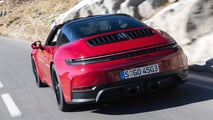
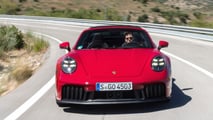
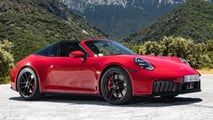
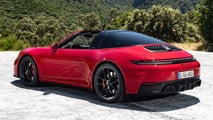
Source: Porsche
A word about the new 911 Targa 4 GTS, which was also ready for a winding country road drive. With a weight of 1,820 kilograms, it is probably the heaviest 911 that has ever put a wheel on this planet. For the author of these lines, this does not detract from its visual splendour. But in every bend (and not only there), it does carry the really big travelling rucksack around with it and this can be felt quite clearly. Despite 541 PS and e-boost, it's more of a 911 for connoisseurs than for gearheads.
Conclusion: 9/10
With the new 911 Carrera GTS, Porsche shows how hybridisation should be handled in the sports car sector. Of course, this is not about radical fuel savings (although at 26.9 mpg according to WLTP, it is only 1.1 mpg above the almost 150 PS weaker basic Carrera). But the Zuffenhausen-based company has achieved a clearly noticeable performance boost, also because its new system results in a manageable increase in weight.
What do you think?
View
Comments
In this way, we will be able to indulge in the joys of the petrol-powered 911 for even longer, which is a great stroke of luck considering what is on offer here. Electrification in this form actually has many advantages, especially because it makes the car measurably and tangibly more dynamic.
In terms of driving performance, it almost comes close to the 911 Turbo. Despite the hefty £132,600 price tag, the two are still more than £26,500 apart, and we'll get used to the strange flap face.
Porsche still relies heavily on the combustion engine:
Porsche Cayenne GTS 2024: with twin-turbo V8 engine and 500 PS
Porsche Boxster and Cayman to live on in the UK
Gallery: Porsche 911 Targa 4 GTS (2024) in the test
Porsche
- Make: Porsche
- Model:
- URL: Porsche
27
Source: Porsche
We want your opinion!
What would you like to see on Motor1.com?
Take our 3 minute survey.
- The Motor1.com Team
Share this Story
- (https://twitter.com/intent/tweet?url=https%3A%2F%2Fwww.motor1.com%2Freviews%2F726081%2Fporsche-911-gts-2024-hybrid-test%2F&text=Porsche%20911%20GTS%20%282024%29%20facelift%20test%3A%20Hybrid%20hype%20or%20e-castration%3F&via=motor1com)
- copy
GO TO COMMENTS
(
)
Got a tip for us? Email: tips@motor1.com
View all comments ( )
Popular
Bugatti Restores One-Off Veyron With A Mirror-Like Aluminum Body
BMW Kept This Hatchback A Secret For Decades
Skoda Wants You To 3D Print Pieces Of Your Car At Home
The Gas BMW M3 Isn't Dead: Next-Gen Prototype Roars
latest articles
- 12 Cars With Names That Make Absolutely No Sense Oct 20 - Lists -
- The Ford Ranger Is Getting A Bigger V6 For 2027: Report Oct 20 - Rumors -
- BMW Already Has A Deal On The New i3. But It's Not Cheap Oct 20 - Pricing -
- Remember The Ford Flex? This Weird SUV Is Now A Great Used Buy Oct 20 - Why Buy? -
- Mercedes Isn't Sold On Extended-Range EVs: 'Would You Really Switch?' Oct 20 - Interview -
- Cadillac Driver Is Fed Up With Auto Stop. Then She Buys A $9 Item On Amazon To Disable It Oct 20 - Trending -
- Bugatti Restores One-Off Veyron With A Mirror-Like Aluminum Body Oct 20 - Supercars -
RECOMMENDED FOR YOU
Porsche Sales Keep Falling, But The 911 Is More Popular Than Ever
12 Cars With Names That Make Absolutely No Sense
One-Off Ruf Project Dragon Heads To Auction With An $8 Million Estimate
The Ford Ranger Is Getting A Bigger V6 For 2027: Report
Porsche Is Cooking Up Even More 911 Specials
BMW Already Has A Deal On The New i3. But It's Not Cheap
Porsche Says It's Not Anti-EV. But The Gas Macan Is Coming Back