‘So Much Creepier’: Woman’s Town Installs AI-Powered Traffic Cameras. Then She Realizes What Else They’re Tracking
"Flock cameras are all over my small town..."
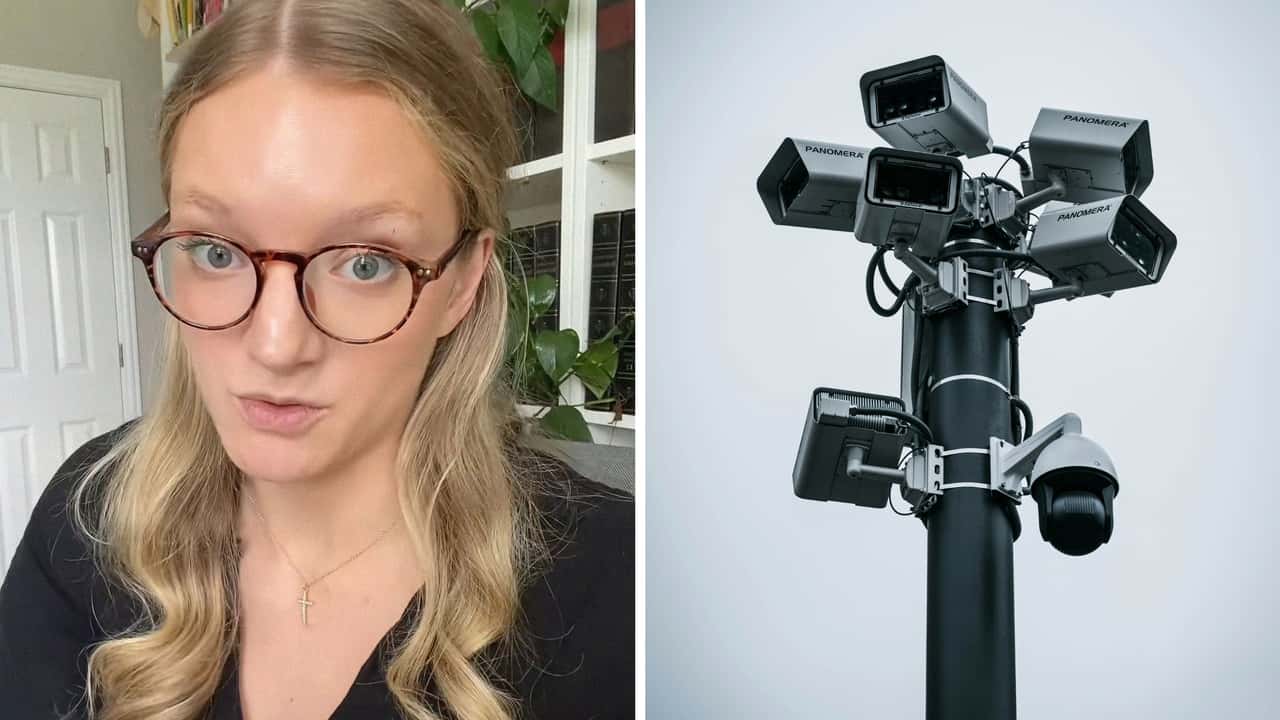

A woman’s post on the ethics of AI-powered traffic cameras has raised serious questions on mass surveillance. She says those cameras aren't just scanning your license plates: they're keeping tabs on the minutiae of our lives.
Allie Voss (@allie_voss) shared her dread about the possible abuse of these systems, and she isn’t alone.
“You know those high-tech traffic cameras that keep popping up everywhere? Some people legitimately still believe that those are just for traffic,” she ominously says. “And while that’s kind of adorable in a way, the reality is so much creepier than most people realize."
She continues, “I think people are used to those typical license plate readers that just do, you know, toll by plate and catch you speeding and stuff like that. But ALPRs, which are basically AI-powered traffic cameras, are also evolving into a way for our government to do mass surveillance. On things that have nothing to do with driving."
“Pattern Of Life Profile”
Voss specifically calls out Flock Safety cameras, remarking that the company is creating “pattern of life profiles” on those it records. “It’s not just drivers: it’s pedestrians, its cyclists, anywhere that you’re out in public. And they’re using it to watch your normal routine, where you go to work, et cetera.”
She says Flock’s technology isn’t just being enforcing driving infractions. According to Voss, the cameras are being checked to ensure children are attending their correct school districts, and even to enforce such mundane infractions as “loud music complaints."
Voss also says that the cameras are being used by law enforcement officials who are accessing Flock’s databases when they don’t want to attain “a legitimate warrant.”
She also said that prospective employers are accessing Flock’s databases to scrounge up information on job applicants.
Big Brother Always Watching?
Voss isn’t the first person to bring up these worries, either. In April, Device Daily reported that “AI-powered city cameras are sounding … privacy alarms.” And like Voss, the piece states that this technology isn’t just being used to capture license plate information from drivers. They’re also being used “to create a vast, searchable database that can be integrated with other law enforcement data repositories.”
The author compares the tech to CCTV surveillance London law enforcement implemented during the 1970s amidst its conflict with the IRA.
Device Daily also says that these cameras are often farmed out to private corporations. These businesses are reportedly incorporating observation decks with AI software, which “significantly increas[es] … their reach.”
According to the outlet, it stores information about vehicles' movements which has created a "massive web" of data. "If a camera collects information from a suspect’s car or truck," it reports, "…one also listed in the National Crime Information Center— AI can flag it and send an instant alert to local law enforcement.”
Specific AI Traffic Monitoring Companies
The same piece highlights efforts by Flock Safety, whose tech helps read license plates and push alerts to police. Flock’s been criticized for being costly: Richmond, Virginia dropped $1 million over the course of a year for its cameras. Others have called into question Flock and similar technology’s efficacy when it comes to curbing violent crime.
Yet some data has shown that AI-powered traffic cameras have made it easier to recover stolen vehicles.
The biggest fear shared by many lies in a basic principle: accountability.
“Data gathered through surveillance infrastructure in the U.S. can circulate with limited transparency or accountability,” according to Device Daily.
Groups including the American Civil Liberties Union and Electronic Frontier Foundation have been calling out license plate trackers for years.
A Global Phenomena
According to NBC News, AI-powered traffic cameras, which are advertised as working to enforce safe driving practices, are often decried as being part of a more sinister mass-surveillance infrastructure.
David Kelly, who is the vice president of Acusensus, an Australian camera business with government contracts, spoke to its practices. “If there’s no violation, we’re not saving the data. There’s no data for us to save. And if, when it’s reviewed, if there’s no citation that’s issued, there’s no data that’s saved,” he said. Kelly did purportedly note that while his business doesn’t save these images, he can’t speak for what local governments do with the same data.
He further claimed that the quick availability of data expedites the process of enforcing the law.
Acusensus also said it's worked with several US universities and colleges, where their Heads Up camera systems are being tested. This tech allows Acusensus to determine more granular commuting behaviors, such as if drivers are “speeding, using cellphones and failing to wear seat belts.”
Is This A Breach Of Privacy?
Many are worried about the implications of such mass surveillance.
According to Legal Reader, “Critics argue that these systems can sometimes issue tickets unfairly.” And if that’s the case, then, as Kelly stated, pictures can be saved to a database even when private citizens are just going about their life and doing nothing wrong.
Flock Safety was on the receiving end of a “federal lawsuit filed in Norfolk, Virginia.” The suit alleged that images and recordings of citizens were improperly used by law enforcement. In February, a federal judge ruled that Flock’s cameras don’t infringe of people’s freedoms. However, the judge did state that this ruling could change in the future with newer technological advancements down the line.
Motor1 has reached out to Voss via TikTok direct message for further information. We'll update this if she responds.
RECOMMENDED FOR YOU

Mechanic Blamed For Lexus' Sudden Damage. Then He Finds An American Tire Depot Receipt
What Is The Most Reliable Car Brand? Here's What The Data Says
Man Fuels Up At BP. Then He Catches Them Overcharging For Gas: ‘How Did 15 Gallons Get Charged?’
Man's Uber Gets Pulled Over. Then The Driver Asks Him To Lie To The Cops: 'Mind You It Was $75'
She's Sick Of Her GMC Yukon. So She Lets The Bank Repo It: 'Hope I Don't Regret This'
Woman Takes Camry To Toyota For Stereo Fix. They Say It’ll Cost $1,200. Then She Goes To Best Buy
Man Goes To Car Wash. Then He Uses A Little-Known Trick To Deep Clean The Inside