Citroën DS (1955-1975): A goddess turns 70
We look back and have fresh pictures from the Retromobile classic car fair


When it comes to the top 10 most famous cars in history, the Citroën DS is always at the top. Even if you wouldn't know it from looking at the range, it will be celebrating its 70th birthday in 2025. Time to take a closer look at the history of the "goddess" and its derivatives.
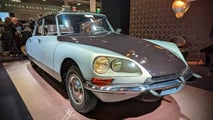
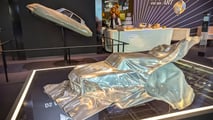
As part of the Retromobile classic car show in Paris, the DS brand is taking the opportunity to celebrate its namesake from Citroën. The original DS made its debut at the same venue 70 years ago. DS variants can also be seen on other stands. We took a lot of pictures at the show, which you can see here:
Gallery: Citroën DS at the Retromobile 2025

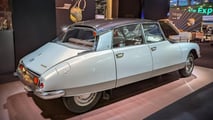
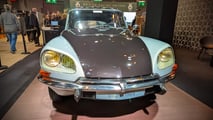
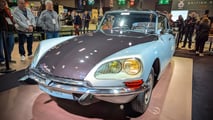
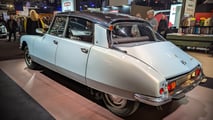
The fathers of the DS
The VGD (Véhicule de Grande Diffusion) project, launched in 1938 on the initiative of Pierre Boulanger, then director of Citroën, was continued from 1950 by his successor, Pierre Bercot, and culminated 17 years later with the presentation of the DS 19 in October 1955. Three men in particular were involved in the development and fine-tuning of the car.
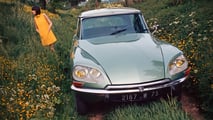
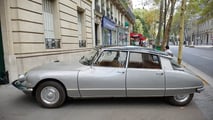
Gallery: Citroën DS and ID (1955-1975)
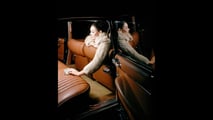
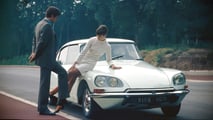
The first, André Lefèbvre, a trained aeronautical engineer, was a staunch advocate of front-wheel drive, aerodynamics, lightweight construction and optimum mass distribution. The second, Paul Magès, a self-taught engineer, was the inventor of hydraulics.
He developed the famous hydropneumatic suspension and the hydraulic systems for the DS's steering, clutch and brakes. Finally, it was Flaminio Bertoni, a talented stylist, sculptor and painter, who, together with his team of designers, gave the DS its revolutionary and elegant lines.
Paris Motor Show 1955: World premiere of the DS
Under the magnificent vaults of the Grand Palais, visitors to the Paris Motor Show awaited a world premiere. On 6 October 1955, a Thursday, the DS 19 was unveiled to astonishment and admiration. The model's name came from its engine, which had a capacity of 1,911 cubic centimetres and developed 55 kW (75 PS).
The avant-garde and elegant lines of the streamlined saloon set new standards. The public and journalists were enchanted, and even many of its competitors praised the DS 19's ingenuity. Legend has it that 12,000 sales contracts were signed by the end of the first day. By the end of the show ten days later, the number had risen to around 80,000.
Production of the DS began at the Quai de Javel plant in Paris on 7 October 1955, just one day after the world premiere. Crowds flocked to see the first cars on the road. The pioneering technical and stylistic solutions aroused curiosity. The DS was not only an automotive sculpture, but also a manifesto of innovative technology.
The hydropneumatic suspension, for example, offered an unprecedented level of comfort and safety. Another new safety feature was the extremely powerful hydraulically assisted braking system with disc brakes on the front axle - a rarity at the time. The DS 19 braked so effectively that even some experienced drivers were confused when they first encountered the new model.
Several versions of the DS 19 were launched in the 1950s. The technically simpler ID 19 introduced in 1956, recognisable by the conventional brake pedal instead of the DS 19's unique "brake mushroom", was followed in 1958 by three different estate versions: Break with additional folding seats under the boot floor, Commerciale without rear seats and Familiale with a row of folding seats in the middle.
In 1959, the rear wings were widened and the front wings were fitted with characteristic air vents, known in French as cendriers (ashtrays).
The DS 19 had a very international career right from the start. From 1956 it was also built in the United Kingdom and Belgium, and from 1959 in South Africa. A symbol of French elegance and avant-garde, the DS 19 was exported throughout Western Europe, to almost every country in the British Commonwealth, including Canada and Australia, and to the USA. In America in particular, the DS 19 quickly gained a large following.
DS 19 Prestige in the chauffeur-driven version
In October 1958, a version of the DS 19 specially designed as a chauffeur-driven saloon was unveiled at the Paris Motor Show. In addition to the black paintwork, it featured a retractable glass panel between the front and rear rows of seats. The seats themselves are upholstered in grey leather at the front and grey fabric at the rear.
Five months later, in March 1959, the model was launched under the name DS 19 Prestige. Innovative options for the time included an intercom system, a car radio and an early car telephone. The DS 19 Prestige was extremely comfortable and became the car of choice for prominent political and business figures. Over the years, the DS 19 Prestige received the same technical improvements as the normal DS. The model was discontinued in January 1975.
The DS wins the Monte-Carlo Rally
In January 1956, three months after its launch, half a dozen DS 19s took part in the Monte Carlo Rally. The French DS 19 crew of Pierre Courtes/André Court-Payen celebrated a class victory in the world's most prestigious event of its kind. All DS 19s that started crossed the finish line, with Courtes/Court-Payen also driving the best-placed French-built car in seventh place overall.
Three years later, the French trio of Paul Coltelloni/Pierre Alexandre/Claude took the second overall victory for the DS. Other top finishes followed before a Finnish team, Pauli Toivonen/Ensio Mikander, took the overall trophy in a DS 21 in 1966. However, this was preceded by a controversial disqualification of the actual winner, the Mini.
In the 1960s the DS 19 confirmed its reputation as a refined, comfortable and elegant car. With regular developments, it continued to extend its technological lead. In July 1959, the engine output was increased from75 PS to 78 PS thanks to a new cylinder head and a modified ignition system. From 1961, the four-cylinder engine produced 83 PS, enabling a top speed of 150 km/h (93 mph).
New dashboard and more power
In September 1961 the entire range was given a new dashboard, all black with a light grey stripe. The car radio, standard on the DS Prestige, was now available as an option.
In September 1962 the DS was given a facelift. The large air intakes in the front wings were removed. New features included two rubber bumpers on the front bumper and a redesigned front skirt. This upgrade further improved the car's aerodynamics, reduced fuel consumption and increased the top speed to 160 km/h.
In October 1965, one year after the launch of the top-of-the-range DS Pallas, the DS 21 was introduced alongside the DS 19. Its engine produced 109 PS from a capacity of 2,175 cubic centimetres - enough for a top speed of 175 km/h (109 mph).
Another update followed in 1967 with a new safety feature: the legendary headlights that swivelled with the steering to illuminate the DS when cornering. They were standard on the top-of-the-range Prestige and Pallas models and on the Cabriolet.
Following the introduction of an all-black dashboard in September 1968 and the replacement of the DS 19 by the DS 20, the instrumentation was completely redesigned in 1969. Two large circular gauges now provided information on speed and revs, while a third circular instrument grouped the warning lights and displays. The upper panel now spanned the entire width of the dashboard.
The year 1969, however, was marked by a major mechanical upgrade. The DS 21's 2.1-litre engine now produced 139 PS with electronically controlled fuel injection. This gave the saloon a top speed of more than 185 km/h (115 mph). With this improvement, the DS maintained its position and remained an exceptional car in every respect.
DS Cabriolet: Four seats under the open sky
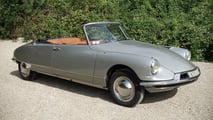
The coachbuilder Henri Chapron, who had previously made a name for himself with the independent production of DS-based convertibles and the production of the DS Prestige model, was commissioned to develop a production convertible. Following the construction of three prototypes, the car was unveiled at the Paris Motor Show in October 1960.
The DS Cabriolet's quality craftsmanship and clean lines were complemented by a full leather interior. From August 1964, additional headlamps and special wheel trims, characteristic features of the DS Pallas, were fitted as standard. At the time, the Cabriolet was almost twice as expensive as the saloon.
DS Pallas: luxury and elegance
Presented at the 1964 Paris Motor Show, the DS Pallas featured a luxurious interior never before seen in a French production car. Distinctive features included stainless steel rubber strips, special tail lights with chrome strips and wheel discs, and additional headlamps.
In addition, the seat upholstery is now more voluminous, the front seat backs are higher and an exclusive leather interior is available as an option. The DS Pallas is available in an exclusive metallic paint finish in addition to the body colour options available across the range.
DS Présidentielle: state coach for the president
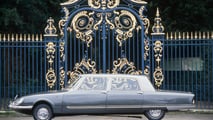
French President Charles de Gaulle ordered a new model based on the DS to replace the state car he had been using since 1955. One of the specifications was that the DS Présidentielle should be longer than the Lincoln used by US presidents. The DS design team and coachbuilder Henri Chapron set to work.
The new state car, which arrived at the Elysée Palace in Paris on 14 November 1968, was an impressive 6.53 metres long. Its interior was extremely luxurious. The head of state is separated from the chauffeur by a window, and any interpreter is seated in a folding chair. The President and his guests enjoy full brown leather upholstery, electric windows, air conditioning, direct and indirect lighting, an intercom system and the contents of a mini-bar.
One million DS
On 7 October 1969, the one millionth DS rolled off the assembly line at the Quai de Javel plant in Paris. The DS 21 Pallas in Sable Metallisé went straight from the factory to the Paris Motor Show, which had opened five days earlier, where it was given a place of honour. The car was raffled off to 22-year-old Gilles Delègue, an engineering student at the École Centrale.
The 1970s: the age of maturity for the DS
From September 1970, the DS was offered as standard with a new manual gearbox with five forward gears instead of four. A year later, a Borg-Warner three-speed automatic gearbox was also available. Before the DS was finally retired after 20 years in July 1975, it underwent one last improvement: in September 1972 the DS 21 was replaced by the DS 23. This model was powered by a 2,347 cc engine with electronic fuel injection, which produced 141 PS and enabled a top speed of almost 190 km/h (118 mph).
Number 1,456,115 - the last DS
At around 3pm on 24 April 1975, the last DS rolled off the production line at the Paris plant - after exactly 1,456,115 units had been produced worldwide, the series was discontinued. The last example is a DS 23 Pallas in Bleu Delta. As a sticker on the windscreen reveals, it is the 1,330,755th DS to be produced at the main plant. It was delivered to a loyal DS fan from the Gironde region of France, who already owned eight other DS.
The DS as a film star
The DS quickly made a name for itself both on the big screen and on the streets. He made many important appearances in films ranging from film noir to comedy, which are still remembered by cinephiles today. The DS appeared alongside Brigitte Bardot in "The Parisienne" (1957), Alain Delon in "The Icy Angel" (1967), Jean-Paul Belmondo and André Bourvil in "The Mastermind" (1969) and comedy legend Louis de Funès in "The Adventures of Rabbi Jacob" (1973).
In its film roles, the DS always represents elegance, speed and power. In some cases, its futuristic technology is exaggerated to the point of fantasy. In Fantomas (1965), the DS is transformed at full speed into a jet plane in which the villain Jean Marais escapes from his pursuers. In the Hollywood blockbuster Back to the Future 2 (1989), directed by Robert Zemeckis and co-produced by Steven Spielberg, a DS becomes a red and yellow flying taxi.
The DS - automotive monument and sculpture
A true avant-garde car, the DS was revered as a sculpture in its time. In his 1957 book Myths of Everyday Life, philosopher and writer Roland Barthes theatrically described the DS as "the almost exact equivalent of the great Gothic cathedrals".
Also in 1957, the DS, designed in the design studios on the Quai de Javel, was the only car invited to the Milan Triennale. A wheel-less example was presented at the Palazzo Dell'Arte al Parco, literally floating on a metre-high column. The prestigious international exhibition of decorative and industrial arts and modern architecture honoured the DS body with its Industrial Design Award.
At the Paris Motor Show in October 1962, the DS, which had just undergone aerodynamic improvements at the front, was also displayed like a sculpture. Again, it was shown without wheels and with a fully clad underbody. Like a rocket, the DS stands vertically in a circular pit and is slowly rotated around its own axis by an electric motor. The presentation impressed the visitors, including President Charles de Gaulle.
The DS - an icon of advertising
The launch of the DS brought a breath of fresh air to the advertising department at the Quai de Javel plant. The first brochure, printed in September 1955, a month before the world premiere at the Paris Motor Show, was a firework of colours. It was designed by the artist René Dumoulin.
The poster "L'air et l'eau" (Air and Water), published for the Paris Motor Show in October 1959, is legendary: it shows the body of a DS on four red spheres floating on water. The photo, taken by surrealist photographer Pierre Jahan to illustrate the principle of hydro-pneumatic suspension, went around the world. It is still considered an icon of automotive advertising. From the early 1960s, graphic designer and publisher Robert Delpire was responsible for DS advertising.
More from the history of Citroën:
RECOMMENDED FOR YOU
Rare Mazda 767B Engulfed In Flames At Laguna Seca
Woman Charges Her Rivian At Costco For 1 Hour. Then She Sees How Much It Costs: ‘Electric Car People Have Been Lying’
1958 Ferrari Reappears With A Shocking $5 Million Estimate
Man Shops For Ford Mustang At CarMax. Then He Sees What They Want For It: ‘These Prices Have Gotten Outrageous’
This Lovely Mercedes 190 Evo II Restomod Packs 765 Horsepower
Chrysler Dealership Gives Florida Woman 'Brand-New' Goodyears. Then She Inspects Them
This Is One Of The Rarest Mercedes G-Classes Ever Made, And It Just Sold For $143,000