Xpeng P7+: Successor to the P7 gets 800-volt technology
The saloon also grows significantly and gets a new look
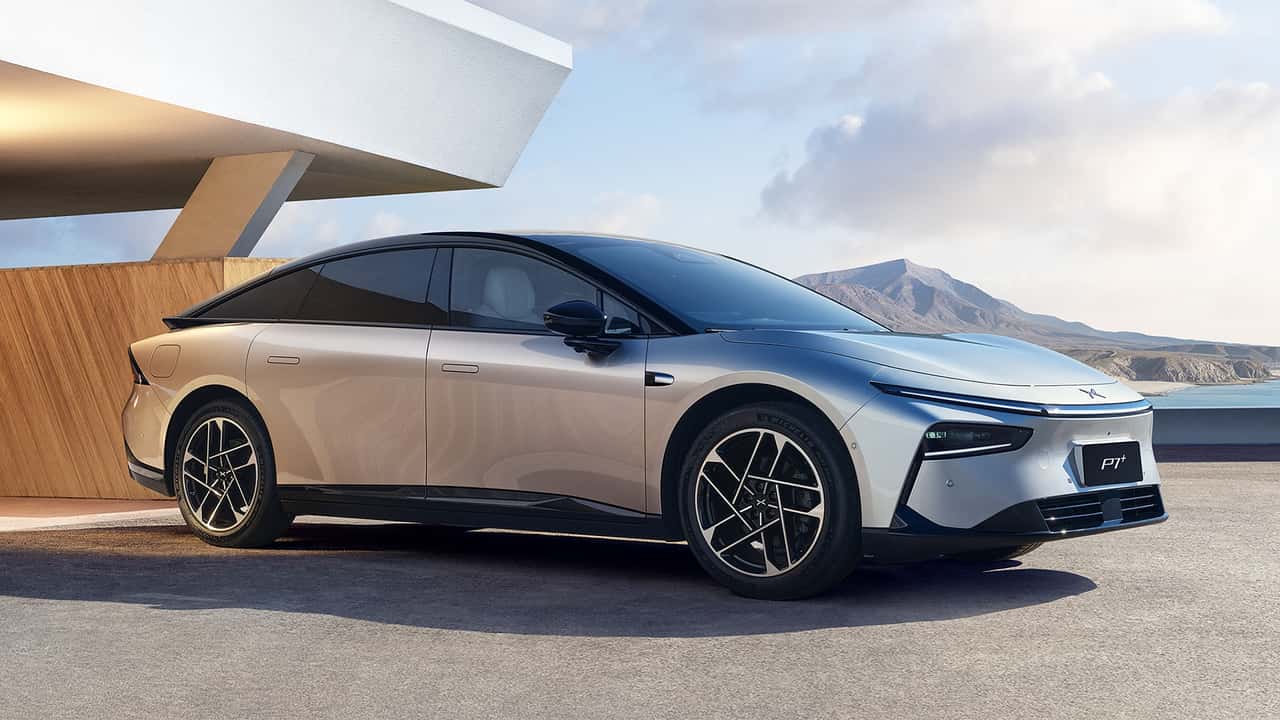

The Chinese brand Xpeng offers three vehicles in Germany: the P7 sports saloon, the G9 flagship SUV and the G6 coupé SUV. The P7 was the first model to be launched in China four years ago, but has only been available in Germany since 2024. Nevertheless, this model is now getting a successor, called the P7+. The car made its debut at the Paris Motor Show this past October.
The model will be converted to 800-volt technology, as the G9 and G6 already have. This enables faster charging at the DC charging point. In addition, silicon carbide inverters now ensure lower power consumption - just 11.6 kWh per 100 kilometres (5.4 mi/kWh). However, this is unlikely to be a WLTP value, as the tiny Fiat 500 Electric already requires 13.0 kWh/100 kilometres (4.8 mi/kWh), making it the most economical electric car on the market. It is possible that the figure represents consumption without charging losses.

Xpeng P7
Xpeng P7+
The car also has a slightly different look. At the front, the continuous light line and the headlights below it have been retained, but the latter have been given a horizontal eyelid line. There are also changes to the rear end of the side windows. The modified body shape shows that this is not just a facelift:
Xpeng P7
Xpeng P7+
After all, the rear lights have also been changed, and significantly so:
Xpeng P7
Xpeng P7+
The interior is also new; there is a new, white steering wheel and new air vents under the touchscreen. There is also a fairly large display for the rear passengers:
Xpeng P7
Xpeng P7+
As far as dimensions and technical changes are concerned, we have to rely on information from CarNewsChina, as the German press release is still completely silent on this. It should be noted in the information for China that there was a facelift model in the domestic market between the P7 and the P7+ with the designation P7i, which is apparently not coming to us.
There is a clear upward shift in the dimensions: The P7+ is almost 17 cm longer and six centimetres higher than the P7. The wheelbase, on the other hand, remains almost identical:
| Length | width | Height | Wheelbase | |
| Xpeng P7+ | 5,056 mm | 1,937 mm | 1,512 mm | 3,000 mm |
| Xpeng P7 | 4,888 mm | 1,896 mm | 1,450 mm | 2,998 mm |
Xpeng has not yet revealed the size of the boot, but promises "an extraordinary amount of storage space - especially with the rear seats folded down".
As far as the drive system is concerned, the Xpeng P7 is available in Germany as a rear-wheel drive model with 276 PS and as an all-wheel drive model with an additional 197 PS asynchronous motor at the front, resulting in 473 PS. Both have an NMC battery with 82.7 kWh net for a WLTP range of up to 358 miles. Charging takes place at up to 175 kW; the charging time is specified as 29 min (10-80%). This results in a charging speed of 2.0 kWh/min.
The P7+ is available in China with two different batteries, but apparently only as a rear-wheel drive model with a choice of 180 or 230 kW. The batteries both work with LFP technology and store 61 and 76 kWh respectively. There is no information on charging. The two batteries in the G9 can be charged from 10 to 80 per cent in 20 minutes, which corresponds to charging speeds of 2.7 and 3.3 kWh/min respectively. We will have to wait and see whether the P7+ is similarly fast.
Gallery: Xpeng P7+




The German press release deals almost exclusively with the artificial intelligence of the new car. Xpeng even talks about the world's first "AI-defined vehicle", which is not only used for semi-autonomous driving, but also for the chassis, drivetrain and cockpit. The car can learn from the behaviour and preferences of individual users.
In terms of sensors, the P7+ features the Xpeng AI Hawkeye Vision Solution, consisting of two optical cameras at the front and rear as well as millimetre-wave radar and ultrasonic sensors. Xpeng has dispensed with LiDAR systems. Equipped in this way, the car is already highly autonomous in China. The motorway assistant Highway NGP is also due to come to us in 2025. It remains to be seen when the car itself will be launched here and how much it will cost. The P7 is available from €49,600 (approx. £41,000).
More from Xpeng:
The bottom line
While the Xpeng G6 and G9 already had an 800-volt architecture, the P7 still lagged behind in terms of charging speed with its 400-volt system. Xpeng apparently wants to rectify this with the P7+. This should put the saloon well ahead of its German competitors, the BMW i5 and Mercedes EQE. However, a 76-kWh battery and the corresponding range would be disappointing, as the EQE already uses a 96-kWh battery for a range of 429 miles.
Sources: Xpeng, CarNewsChina
RECOMMENDED FOR YOU
Brabus Bodo Cabriolet: 1,000 HP Open-Top Beast, Only 77 Made
Woman Tells Trader Joe’s Worker Her Car Is Making A Sound. She Can’t Believe How The Cashier Responds: ‘You Both Panicked’
Land Rover Defender Dakar: 626 HP Rally Beast You Can Drive
You're Probably Not Using All Of Your Car's Key Fob Features
Spyker Is Back: The 789-hp C8 Preliator XXV Makes Its Debut
Woman Gets Goodyears. Then The Shop Tries To Take Them Back—And Replace Them With Cheaper Douglas Tires: ‘Go To Costco’
You Can Make a Fiat Topolino Street Legal. Here’s How