Why petrol cars will cost more and electric cars less in 2025
To limit fines in Europe, manufacturers should produce fewer petrol cars and more electric cars.
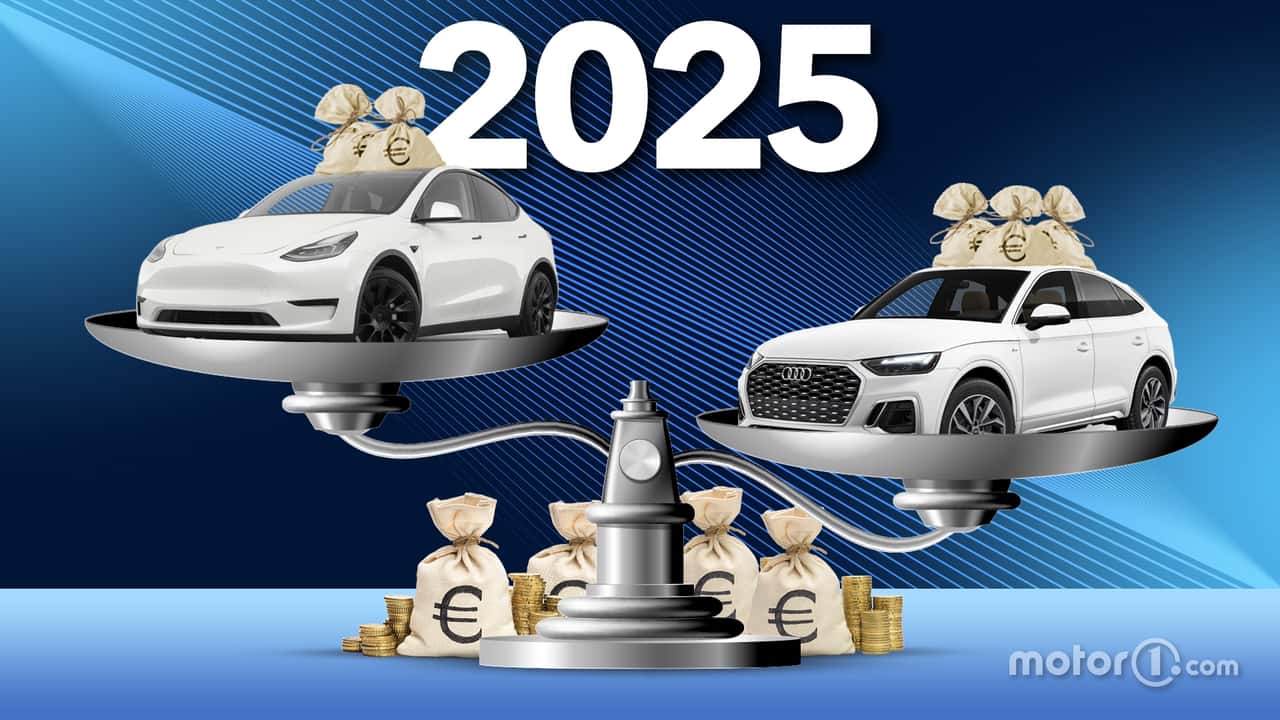

There's a lot of talk about 2035, the date from which cars with combustion engines (petrol, diesel, LPG or hybrids) could disappear from vehicle registration documents. But there's a much closer date that is scaring carmakers even more, and which will have repercussions for anyone buying a new car in the coming months.
We're talking about 2025, which begins in a few weeks' time and which will see a drastic reduction in average CO2 emissions for manufacturers. As has been planned for years, Europe has set itself the target of reducing atmospheric emissions of carbon dioxide (the main greenhouse gas responsible for climate change) and, from 2025 to 2029, the CO2 of models sold by each brand must fall from an average of 115.1 g/km (2020-2024 target) to 93.6 g/km.
The likely consequences are twofold. Firstly (and this is the bad news), the price of petrol cars could rise, while that of electric cars is likely to fall. Let's see why.
Sell less to pay fewer fines
Manufacturers who exceed the new limit set by Brussels will be forced to pay heavy fines to Europe, of the order of €95 per gram of CO2 in excess of the limit imposed for each group, all multiplied by the number of cars sold on EU markets in the course of a year.
The impact of the fines is potentially very high on the entire automotive industry, with penalties that, according to figures quoted by Luca De Meo, CEO of Renault, could amount to as much as €15 billion. The alternative put forward by De Meo himself would be to produce 2.5 million fewer cars, given that not enough electric cars are being sold.

Luca de Meo, CEO of Renault and Chairman of ACEA
Jean Philippe Imparato
The problem is precisely this: if sales of electric cars do not reach an average market share of 20-25% of total sales for most manufacturers, the quickest way to reduce penalties is to reduce production of combustion engine cars in order to balance the sales mix and thus reduce average CO2 emissions. Stellantis has already announced that it will do this from 1 November 2024, as Jean-Philippe Imparato, Chief Operating Officer for Europe, has stated.
But if production and therefore the supply of traditional cars (petrol, diesel, LPG and hybrids) is reduced and demand does not change, the side effect is a physiological increase in the prices of new and used cars, provided they are not electric. This is exactly what happened in the two years following the pandemic, when the supply chain for raw materials came to a standstill.
Will electric cars cost less than petrol cars?
The next, but longer, step is to increase the share of EV sales. An objective that is difficult to achieve at the moment, and one that has led De Meo, also in his capacity as Chairman of Acea (the European Automobile Manufacturers' Association), to ask Europe for greater flexibility in introducing the new CO2 limits.
This is where the falling prices of electric cars and the paradigm shift come in. To sell more electric cars, manufacturers could also rely on new promotional campaigns with their own incentives to stimulate EV purchases. This is good news for motorists, who would then be able to buy electric cars at reduced prices, particularly for those in the UK and France who no longer benefit from government incentives.
Charging an electric car
There is, however, a downside to this, namely the possible incentive to buy an electric car, even for those who don't need one. Sales staff at dealerships risk being encouraged to recommend the battery-powered car to the majority of potential customers, which could lead to purchasing errors and the emergence of an unhappy clientele - the main enemy of electric cars.
To buy or to wait?
That's why we'd like to offer some practical advice to those who need to change their car in the near future. Those who are already considering buying an electric car should probably wait for the best times and likely price reductions, unless they already have a good offer today.
On the other hand, those looking for a conventional petrol, diesel or hybrid car, particularly one with a CO2 threshold of over 100g/km, would do well to accelerate their purchase before prices rise.
Another case is that of plug-in hybrids, which benefit from the WLTP certification cycle for CO2 emissions. Many groups will be pushing these PHEVs in particular to reduce the average carbon dioxide in the range, with aggressive marketing campaigns and prices likely to fall as well due to the arrival of new plug-ins from China.
Which brands and groups are most at risk?
According to data provided by the ICCT (International Council on Clean Transportation), the average CO2 emission level of cars registered in 2023 has reached 107 g/km, far from the new target of 93.6 g/km. A reduction of 13.4 g/km is needed, equivalent to a 12.5% cut in emissions.
In reality, the situation is even more complex, as the different car groups or pools have achieved different levels of average CO2 emissions in 2023, and in turn have specific targets for 2025 that also depend on the average weight of cars sold. This means that the average target of 93.6 g/km for 2025 varies slightly from one pool to another.
| CO2 emissions 2023 | CO2 emissions target for 2025 | Difference | |
| Ford | 119 g/km | 94 g/km | -25 g/km |
| Volkswagen | 120 g/km | 95 g/km | -25 g/km |
| Mercedes-Benz | 109 g/km | 91 g/km | -18 g/km |
| Hyundai | 109 g/km | 94 g/km | -15 g/km |
| Toyota-Mazda-Subaru-Suzuki | 109 g/km | 94 g/km | -15 g/km less |
| Renault-Nissan-Mitsubishi | 111 g/km | 96 g/km | -15 g/km |
| BMW | 104 g/km | 93 g/km | -11 g/km |
| Kia | 104 g/km | 93 g/km | -11 g/km |
| Stellantis | 105 g/km | 96 g/km | -9 g/km |
| Volvo | 70 g/km | 90 g/km | +20 g/km |
| Tesla-Honda-Jaguar Land Rover | 49 g/km | 90 g/km | +41 g/km |
(Source: 2023 data and 2025 estimates from the ICCT and the European Environment Agency)
The table above (based on 2023 data and 2025 estimates from the ICCT and the European Environment Agency) shows that the groups furthest away from their new CO2 emissions target are Ford and Volkswagen, with Mercedes-Benz not far behind. The group closest to the target is Stellantis, with Volvo and Tesla Pooling being the only groups already complying with their new limits for 2025.
Ford Capri
Volkswagen ID.7 GTX Tourer
Using data from the first quarter of 2024 and estimates of the 2025 target provided by Dataforce, however, we find that the substance changes little, with Ford, Volkswagen and Mercedes-Benz remaining the groups that have the most catching up to do in the race to reduce CO2 emissions. According to Dataforce, Stellantis is also a little behind on its targets, as is BMW.
| CO2 emissions first quarter 2024 | CO2 emissions target 2025 | Difference | |
| Ford | 125 g/km | 93 g/km | -32 g/km lower |
| Volkswagen | 123 g/km | 94 g/km | -29 g/km |
| Mercedes-Benz | 108 g/km | 88 g/km | -20 g/km |
| Renault-Nissan-Mitsubishi | 114 g/km | 97 g/km | -17 g/km |
| Stellantis | 113 g/km | 97 g/km | -16 g/km |
| BMW | 106 g/km | 91 g/km | -15 g/km |
| Hyundai | 108 g/km | 96 g/km | -12 g/km |
| Toyota-Mazda-Subaru-Suzuki | 105 g/km | 97 g/km | -8 g/km |
| Volvo | 56 g/km | 88 g/km | +32 g/km |
(Source: H1 2024 data and Dataforce 2025 estimates)
Let's do some quick calculations based on ICCT data for 2023. If Ford, in theory, did not improve its average CO2 range by 2025, it would be forced to pay a fine of €2,375 per car sold in Europe, just like the Volkswagen group.
If Ford's total registrations reached 300,000 units (as in 2023), the fine would amount to €712 million. The situation would be even worse for Volkswagen, which, faced with a hypothetical fine of €2,375 per car sold (2.7 million in 2023), could have to pay a fine of around €6.4 billion. This is no mean feat for a company that made an operating profit of €22.6 billion last year.
The latest example is Stellantis, which plans to register 1.88 million cars in Europe by 2023. If the group maintains the same level of sales and does not improve its CO2 average, it would theoretically have to pay a fine of €855 per car, i.e. a total of €1.6 billion.
Industry in turmoil:
Pooling
Pools are groupings of carmakers who join forces specifically to pool their model ranges for the purpose of calculating CO2 emissions. This is the case, for example, with the Toyota pool, which from 2021 will include all the models from Toyota, Mazda, Subaru and Suzuki, or Tesla (between 2019 and 2021 with FCA), which has joined forces with Honda and Jaguar-LandRover.
Tesla Model Y
Honda CR-V
Range Rover Evoque
In practice, groups that sell fewer electric and hybrid cars and are struggling to reduce their average carbon dioxide emissions are turning to groups that focus entirely on electrics, such as Tesla. Behind the payment of almost undisclosed fees for this type of 'CO2 credit', 'pools' or groupings of carmakers are created, which average the total CO2 emissions of the different brands present.
These pooling agreements are very important for manufacturers and are constantly evolving. They run for a maximum of five years, with the cards being reshuffled on a cyclical basis according to the manufacturers' assessments. For example, the news of Suzuki's exit from pooling with Toyota, Mazda and Subaru is very recent. Suzuki has decided to join forces with Volvo in order to comply with the new CO2 limits and avoid having to pay penalties to the EU in 2025. Renault and Volkswagen have also expressed mutual interest in a new pool between the two groups. New pools will certainly be formed in the years to come.
Cars 'killed' by new regulations
One of the first victims of the tightening of CO2 emissions was the Suzuki Jimny, which has been withdrawn from Suzuki's European range from 2020 because of the new limits scheduled for 2021. As a reminder, the Jimny, which is only marketed as a two-seater SUV, emits 174 g/km of CO2, but its N1 homologation does not add its emissions to the rest of the brand's automotive range (M1).
Suzuki Jimny Mata
To further reduce CO2 emissions, Suzuki is apparently planning to stop selling the small Ignis and possibly the Swace on the European market, replaced by new electric models such as the e-Vitara.
Who is exempt from the new CO2 emission limits?
Europe has decided that there are exceptions to the rule of the new CO2 limits, reserved respectively for manufacturers selling between 10,000 and 300,000 cars a year in the EU, those selling less than 10,000 cars a year and those registering 1,000 cars or less.
| EU sales between 10,000 and 300,000 units | EU sales of 10,000 units or less | EU sales of 1,000 or less |
| Exemption until 2029 | Exemption until 2035 | Indefinite exemption |
Examples: Porsche |
Examples: Alpine, Aston Martin, Bentley, Ferrari, Lamborghini, Maserati, McLaren, Rolls-Royce |
Examples: Alpina, Bugatti, Brabus, Bertone, Caterham, Dallara, Donkervoort, Gordon Murray Automotive, Hispano Suiza, Ineos, Koenigsegg, Lotus, Morgan, Pagani, Praga, RUF, Radical, Wiesmann. |
This means that manufacturers of luxury, sports and niche cars such as Ferrari, McLaren, Aston Martin and others are exempt from CO2 emission limits until 2035. Very small manufacturers such as Bugatti, Pagani and Dallara, which sell fewer than 1,000 cars a year in Europe, are exempt for an indefinite period.
Ferrari 12Cilindri
McLaren W1
Tourbillon Bugatti
The same does not apply to Porsche, which remains below the limit of 300,000 cars registered in the EU and will not have to worry about CO2 emissions until 2029. After that date, the electric Macan and the electric 718 Cayman will contribute to meeting the future limits.
Sources: International Council on Clean Transportation, European Federation for Transport and Environment, European Environment Agency, Dataforce
RECOMMENDED FOR YOU
Porsche Confirms It's Laying Off Another 5,000 People
Honda Could Resurrect The High-Riding Accord Crosstour
Lexus Has The Happiest Dealers In America. Infiniti Doesn't
Woman Drives Her Mother's New Car. Then It Starts Panicking: 'Intruder Alert. You're Not Phoebe'
These Automakers Have The Most Visited Websites
The Government May Ban Bad Door Handles
VW Explored A Range-Extending Gas Engine For The ID. Buzz