Ferrari F80 revealed: 1,200 PS and £3 million for the LaFerrari successor
Built with components from Formula 1 and the 499P hypercar that won at Le Mans
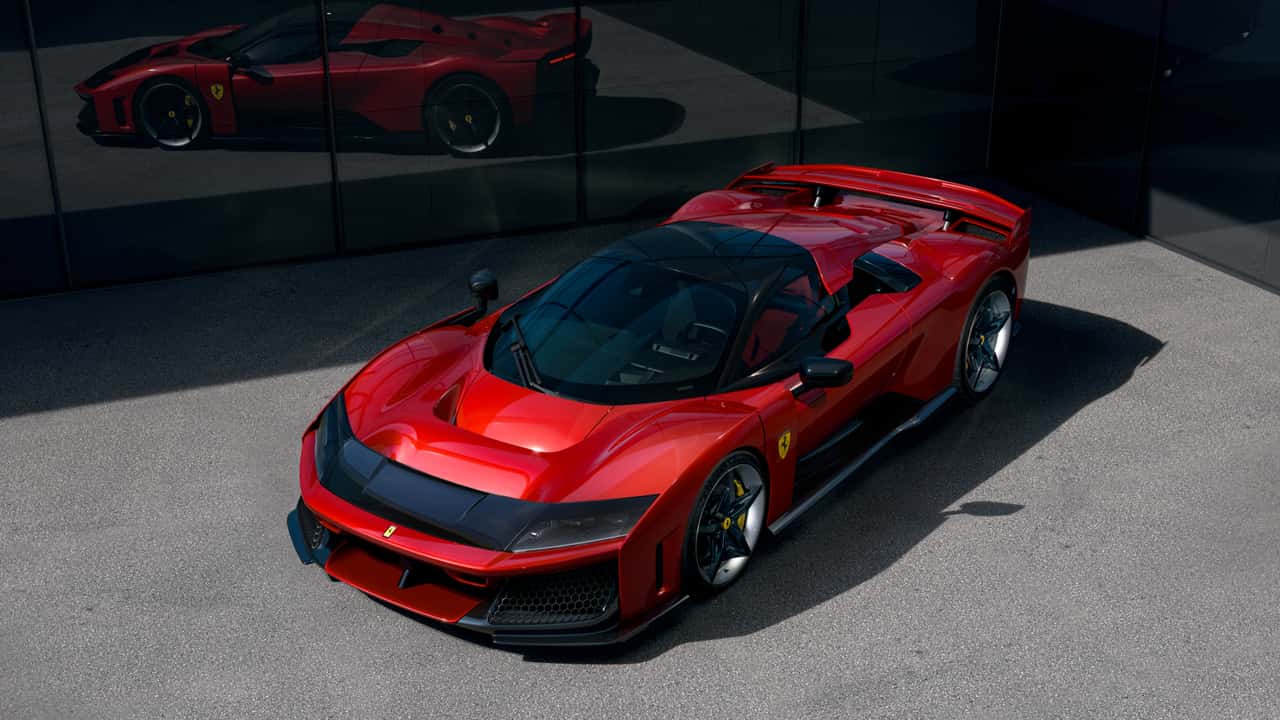

It is called the Ferrari F80 and it is the most powerful road car ever built in Maranello: 1,200 PS, for a top speed of 217 mph, 0-62 mph in 2.15 seconds, 0-124 mph in 5.75 seconds.
It has a "1+1" cockpit to reflect the link with the single-seaters that race in Formula 1, of which the F80 also exploits turbo electrification technology to reduce the response lag of the combustion engine.
The hybrid mechanics, on the other hand, maintain the set-up of the Ferrari 499P racing car, the hypercar that won the last two Le Mans 24-hour races.
The F80 is also the successor to a family of legendary sports cars that are part of the history, not only of the Maranello marque, but of all motoring: Ferrari 288 GTO, Ferrari F40, Ferrari F50, Ferrari Enzo, Ferrari LaFerrari.
- Ferrari F80: exterior
- Ferrari F80: dimensions
- Ferrari F80: interiors
- Ferrari F80: heat engine, hybrid module, battery
- Ferrari F80: chassis, suspension, brakes, road dynamics
- Ferrari F80: prices
Gallery: Ferrari F80


Ferrari F80: exterior
The historical legacy of the Ferrari F80 began with the Ferrari 288 GTO of 1984, from which the legendary Ferrari F40 (1987) was also born. In the 1990s it continued with the Ferrari F50 (1995), and in the early 2000s the baton was passed to the Ferrari Enzo (2002), right up to the Ferrari LaFerrari unveiled a decade ago (2013).
Today, in 2024, it is the turn of the Ferrari F80 to show what the Maranello-based manufacturer is capable of in terms of technology and performance. The 1,200 PS make the F80 the most powerful Ferrari road car ever made, with a limited production run of 799 examples until 2027, the year the company celebrates its 80th anniversary. Tradition respected, therefore, even in the name, as in the case of the F40 and F50 predecessors.
The Ferrari F80 has been designed by the Centro Stile led by Flavio Manzoni, very much in keeping with technical and functional requirements. The very vertical flanks, which rest at the wheels, separate the upper part of the bodywork, forming almost a right angle, as if the 'top and bottom' of the car were two separate bodies.
This architecture makes the cabin stand out like a bubble, with the rear surface in body colour and the roof in painted carbon fibre. In addition, the "1+1" configuration of the seats gave the designers the opportunity to tighten the cabin cell to optimise aerodynamics, also characterising the car's overall aesthetics.
The front end deliberately has no 'biological' design elements as it is not intended to resemble the look of a human or animal. Consequently, the headlights are camouflaged behind a visor, forming a black screen with both optical and aerodynamic functions.
Ferrari F80, the front end
Behind it is a truncated tail, which has two configurations that give distinct aesthetic perceptions: one with the wing moving in the rest position and the other raised. The rear lights are thin, to create a sandwich effect while - on the bonnet - there are six air vents, like the number of cylinders in the combustion engine.
Aerodynamics has never been so extreme on a homologated model, with the application of aerodynamic concepts used in Formula 1 and in endurance races of the WEC (World Endurance Championship).
In the front 'S'-shaped duct, called the S-Duct, there is a triple wing profile, the rear wing can also be tilted in the angle of attack, as well as raised and lowered, and the fairing bottom of the body is modelled with significantly 'protruding' blades and channels, for a total of 1,050 kg of vertical load generated at 155 mph to mash the car to the ground (460 kg at the front, 590 kg at the rear).
Ferrari F80, extreme aerodynamics
Ferrari F80, the rear wing
Ferrari F80 dimensions
The Ferrari F80 is 4.84 metres long, 1.14 metres high, 2.06 metres wide, with a wheelbase of 2.67 metres. The boot capacity is 35 litres, the petrol tank can hold 63.5 litres and the car's dry weight is 1,525 kg, with a weight distribution of 42% front and 58% rear.
| Dimensions | |
| Length | 4.84 m |
| Height | 1.14 m |
| Width | 2.06 m |
| Wheelbase | 2.67 m |
| Luggage compartment capacity | 35 litres |
| Weight |
1,525 kg dry |
| Weight distribution |
42.2% front and 57.8% rear. |
Ferrari F80: the interior
The Ferrari F80 wants to give the perception of being a Formula 1 car, with the "1+1" cockpit inspired by that of a single-seater, designed around the driver. The seats are staggered lengthwise (with the passenger positioned further back) and are also differentiated in terms of colours and materials.
Reducing the width of the cabin has created advantages for aerodynamics (generating less drag) and for containing weight in a high area of the car, with benefits for road handling as well.
The steering wheel has been redesigned, which is smaller in size than that of the Ferrari LaFerrari (1.4 cm less in width, 7 cm less in height) to increase visibility and the sporty feel of the drive. And in place of the digital touch surfaces, physical buttons on the spokes have returned, to make it easier to use, and to make the buttons more recognisable by touch: a change that we will also find in future road cars from the Prancing Horse.
Ferrari F80, the steering wheel has reduced dimensions
Ferrari F80: thermal engine, hybrid module, battery
As with the supercars that preceded the Ferrari F80, the technological trend in motorsport has been followed: the 288 GTO and the F40 mounted a turbocharged V8 because Formula 1 cars in the 1980s used turbocharged engines, and similarly today in both Formula 1 and the WEC, Ferrari engines are V6 turbo hybrids, an architecture transferred to the F80 road supercar.
The Ferrari F80's combustion engine is a 3.0-litre V6 with 120° dry sump lubrication, developing 900 PS at 8,750 rpm and revving up to 9,000 rpm with a limiter set at 9,200 rpm. The specific power output of 300 PS/litre is one of the most impressive technical figures, while maximum torque is 850 Nm at 5,500 rpm. The gearbox is double-clutch and has eight gears.
Ferrari F80, the combustion engine
For the first time on a road-going Ferrari, there is a 48-volt electric motor between the turbine and the compressor (mounted on the same axle), which has allowed two larger turbochargers to boost power without lagging. This technology derives from Ferrari's experience in F1 with the MGU-H concept used in the powertrain of single-seater racing cars.
Then there is the link that the F80 has with endurance racing, as in the case of the components derived from the powertrain of the 499P, winner of the last two editions of the 24 Hours of Le Mans: crankcase, timing chains and tensioners, oil pump, bearings, injectors and fuel pumps.
In order to lower the centre of gravity, the engine is very close to the flat bottom (there are just 10 cm between the crankshaft axis and all the components arranged on the bottom of the sump), and the powertrain is tilted to raise the gearbox which allows the underbody to have an aerodynamic extractor of record length: 1.80 metres.
The toughening up of the V6 compared to the 296 GTB to get 237 more PS has not increased the weight of the engine.
Ferrari's racing experience led to the first electric motor entirely designed, tested and produced by Ferrari in Maranello.
The rear MGU-K electric unit with 800 volt architecture revs up to 30,000 rpm, with 81 PS (60 kW) 'on boost' and 95 PS (70 kW) on regeneration, 45 Nm of torque and a weight of 9 kg.
Each of the two front electric motors at 800 volts and 30,000 rpm, on the other hand, has 142 PS (105 kW) and 121 Nm. This electric front axle enables four-wheel drive.
The whole is powered by an 800-volt battery with 2.3 kWh capacity and 39 kg weight.
|
HEAT ENGINE (ICE) |
|
|
Type |
V6 - 120° - Dry sump |
| Total displacement |
2,992 cm3 |
| Bore and stroke |
88 mm x 82 mm |
| Maximum Power** |
900 PS at 8,750 rpm |
| Max. torque |
850 Nm at 5,550 rpm |
| Maximum engine speed |
9,000 rpm (dynamic limiter at 9200 rpm) |
| Compression ratio |
9.5:1 |
| Specific power |
300 PS/litre |
|
HYBRID POWERTRAIN |
|
|
Type |
Internal rotor with tooth coil stator, Litz wire and rotor in Halbach array configuration |
|
E-TURBO (MGU-H) |
|
|
Type |
48V electric motor in axle with turbines and combustion engine compressors |
|
REAR ELECTRIC MOTOR (MGU-K) |
|
|
Operating voltage |
650 - 860V |
|
Peak power |
Regenerative phase: 95 PS; ICE support: 81 PS |
|
Peak torque |
45 Nm |
|
Maximum speed |
30,000 rpm |
|
Weight |
8.8 kg |
|
FRONT ELECTRIC MOTORS |
|
|
Operating voltage |
650 - 860V |
|
Peak power |
142 PS for each of the two electric motors |
|
Peak torque |
121 Nm |
|
Maximum speed |
30,000 rpm |
|
Weight |
12.9 kg |
|
HIGH VOLTAGE BATTERY |
|
|
Maximum voltage |
860V |
|
Maximum power (charge/discharge) |
242 kW |
|
Energy |
2.28 kWh |
|
Specific power |
6.16 kW/kg |
|
Weight |
39.3 kg |
Ferrari F80: chassis, suspension, brakes, road dynamics
The Ferrari F80 has a multi-material chassis, in which the living cell (with hollow cills) and roof (produced in a single session in an autoclave) are made of carbon fibre and composite materials.
The front and rear subframes made of closed-section extruded members are connected to each other by castings which are made of aluminium and are joined to the body with titanium screws.
Compared to the Ferrari LaFerrari, the F80's chassis weighs 5 per cent less and has 50 per cent more torsional and lateral rigidity. The doors open almost 90° above the body.
Ferrari F80, doors open like butterfly wings
The active suspension evolves the scheme of the Ferrari Purosangue, which has no anti-roll bars and controls each individual wheel with 48 volt electric actuators. The layout is double wishbone with inboard dampers and levers created by 3D printing for the first time on a Ferrari road car, imitating the bone structure of living beings to optimise weight and resistance.
This suspension helps to manage aerodynamics, as well as comfort and driving dynamics, which are improved also thanks to the SSC (Side Slip Control) system. In its latest version, 9.0, it has a new speed estimator which measures the vehicle's centre of mass. The software estimates the 'trim angle' parameter contained in the equations on which the car's road behaviour is based, therefore, improving its effectiveness.
From the steering wheel you can choose the Hybrid, Performance and Qualify driving configurations, without the eDrive mode of the SF90 Stradale and the 296 GTB. The F80, therefore, cannot move in 100% electric mode.
The new Boost Optimisation function also identifies the circuit on which you are driving to give extra power in the most appropriate parts of the track, without the need for driver intervention.
A new feature regarding the brakes of the F8 is the adoption of CCM-R Plus technology, derived from Ferrari's racing experience in the Challenge Championship and developed with Brembo for the first time on a road car. It uses long carbon fibres to improve strength (+100%) and thermal conductivity (+300%); the braking surfaces are coated with a layer of silicon carbide (SiC) that resists wear and has a reduced break-in time; and the use of brake pads with a specific compound increases the stability of the coefficient of friction under the most extreme conditions of continuous track driving. The dimensions of the braking system are: front 408 x 220 x 38 mm (6 pistons per calliper), rear 390 x 263 x 32 mm (4 pistons per calliper). These are the stopping distances of the Ferrari F80: 62-0 mph 28 metres, 124-0 mph 98 metres.
The Ferrari F80 is fitted with Michelin tyres
The tyres developed for the F80 together with Michelin measure 285/30 R20 at the front and 345/30 R21 at the rear, and include: Pilot Sport Cup2 tyres, where work has been done mainly on the carcass and tread, and Pilot Sport Cup2 R tyres which, thanks to specific compounds derived from motorsport, bring performance never before achieved on Ferrari road cars.
Ferrari F80: price
The Ferrari F80 in Italy costs €3.6 million (approx. £3 million) including taxes, and will be built in 799 examples. First deliveries start at the end of 2025 with production ending in 2027 to celebrate 80 years of the Maranello marque.
Recent headlines from Ferrari:
Ferrari F80
RECOMMENDED FOR YOU
Ferrari F80 Aperta Spied For The First Time
Why Is WD-40 Called WD-40?
Ferrari CZ26 One-Off Turns SF90 Into A Radical Two-Box Supercar
Cadillac Is Considering A V-Series.R Track Car For Customers
Ferrari Files 'LC67' Trademark. Is Another Special Model Coming?
Genesis G90 Flagship Sedan Spied With New Face
Hot Wheels’ Ferrari F40 RLC Drop Lands August 18 With Tight Limits