Range Rover P38 (1994-2002): The successor to the throne turns 30
How do you replace an icon? The second generation didn't have it easy


We all know the feeling of following in big footsteps. Especially when you follow in the footsteps of legends, it can be difficult, because you are always measured against your predecessor. Just think of King Charles III or the successors to the VW Beetle, Fiat 500 and Ford Mustang. It was a similar story 30 years ago when Land Rover finally presented the second generation of the Range Rover.
Development began as early as 1988
After the original model had been on the market for 24 years, Land Rover finally realised that it was high time for a successor, and so development began in 1988. Since its launch in the summer of 1970, the first generation increasingly moved towards the luxury segment. At the same time, the new Discovery was almost completed and it was foreseeable that the original vehicle concept of the Classic would have to be modernised sooner or later.
Gallery: Range Rover (P38, 1994–2002)


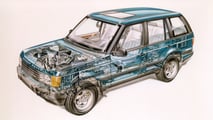
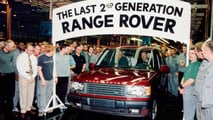

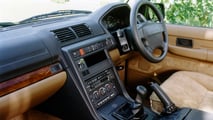
The project is initially referred to internally as Pegasus (a reference to the air suspension), and later as Project 38A or P38A for short (the name of the building in which the project participants work).
George Thomson was Styling Director at Land Rover at the time and was tasked with translating the original design into a contemporary style that would appeal to both existing and new customers. Various designs were produced, with the renowned names Pininfarina, Italdesign Giugiaro, Bertone, John Heffernan and Ken Greenley involved in the process.
Bertone in the final
Bertone's design and the proposal from the Land Rover design department make it to the final selection round, and 1:1 models of each are produced. Intensive market research and acceptance tests with participants from several countries led to the realisation that the Bertone design was not clearly recognisable enough as a Range Rover, so the design by Thomson's team was chosen.
Range Rover (P38, 1994-2002)
Range Rover (P38, 1994-2002)
On 29 September 1994, the "New Range Rover" was presented to the public. It was the first new model presented by the Rover Group after the takeover by BMW and, together with the Mini, was to remain the model in which BMW showed the greatest interest in the following years. However, BMW was not involved in the development of the P38; this only happened with its successor.
The new 1994 model offered more extensive equipment and a lot of premium character to position it above the Land Rover Discovery. In June 1998, the Range Rover was given a minor facelift, which could be recognised externally by the white front indicators, darkened rear lights with a clear upper section and black, rounded surrounds in the rectangular main headlights.
Six and eight-cylinder engines reign supreme
Apart from various special models, the P38 is mainly available in three engine and two equipment variants:
SE: 4.0-litre V8 petrol engine with 185-190 PS; 1994-2002
HSE: 4.6-litre V8 petrol engine with 218-224 PS; 1994-2002
DSE: 2.5-litre R6 diesel with 136 PS, BMW M51D25; 1994-2002
The V8 variants are further developments based on the proven Rover V8 block, which debuted in its basic form as early as 1960 in the Buick Special, while a specially adapted version of the 2.5-litre six-cylinder M51 from BMW is used in the diesel models.
Range Rover (P38, 1994-2002)
The P38 is also based on a ladder-type frame, in this case with rigid axles guided by trailing arms and a Panhard rod. All models have electronically controlled air suspension, which allows the ground clearance to be adapted to the respective operating conditions. The P38A was built from mid-1994 to early 2002, with the last vehicles declared as model year '02.
Range Rover (P38, 1994-2002)
During production, Land Rover referred to the car either as the "New Range Rover" or by its model designation "LP". At the time, motoring journalist Jeremy Clarkson referred to the Range Rover P38 as the "London Taxi", as it bore a certain resemblance to the Metrocab. In fact, it and its successors are often seen as school taxis in affluent London neighbourhoods.
Land Rover classics:
And what did the German press say about the Range Rover at the time? The ADAC takes a close look at a 4.6 HSE with a "brand new" four-speed automatic transmission and the starting aid called ETC. Cost point: DM 108,750. The reward is 224 PS, 9.9 seconds to 62 mph and a top speed of 122 mph.
Despite the open centre differential, the Range Rover should not be chased into the "deepest mire"; on the road, it shows off the advantages of its three-way height-adjustable air suspension. You "just float along" and enjoy good cornering, according to colleagues at the time. But the 2.2-tonne steamer takes its toll in the form of 15.8 mpg-UK of test fuel consumption.
RECOMMENDED FOR YOU
Range Rover Honors America 250 With 'From Sea To Sea' SV Trio
New Jersey Woman Starts Up Toyota RAV4. Then It Rains: ‘Never In My Life Have I Seen This’
Range Rover Built A One-Off SUV You Can’t Order
Man Gets Intoxalock Breathalyzer After DUI. Then He Tries To Use It In 90-Degree Heat: ‘They Put A Camera In There Too?!?’
Daniel Craig’s 1959 Land Rover With Handwritten Note Hits Auction
Ferrari Wants To Turn Taillights Into Active Aero
Full-Size Defender Electric Delayed To 2030s